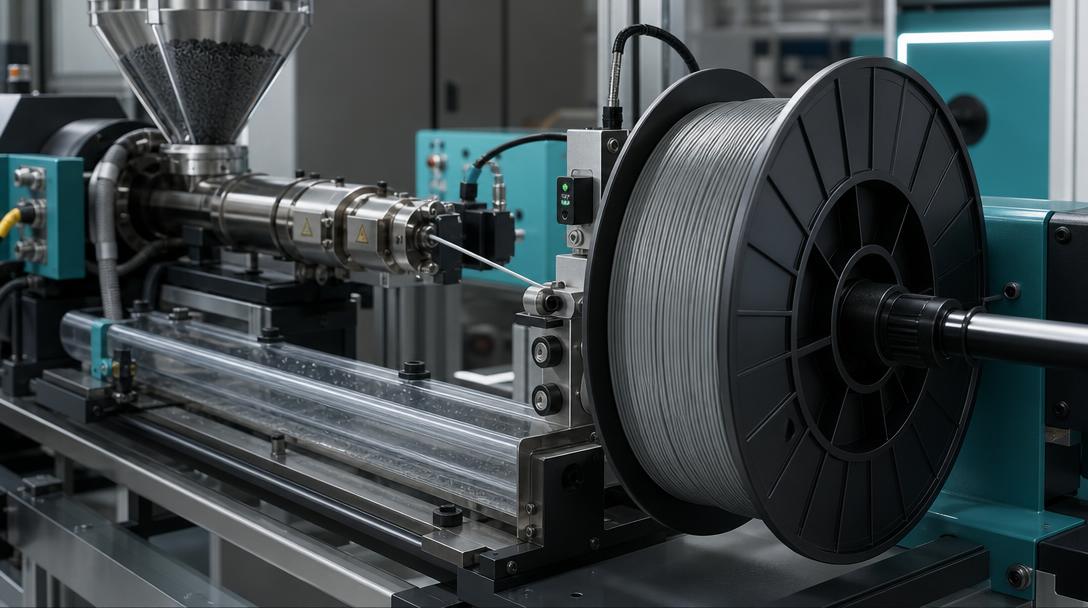
Why Is the 3devo Filament Maker X10 Drawing Attention? From Recycling to Continuous FDM Filament Production
For manufacturers who do not see filament supply merely as buying spools from outside, 3devo’s new Filament Maker X10 system is a noteworthy development. With this production-grade extrusion platform announced on September 3, 2026, 3devo aims to automate continuous filament production from pellets, regrind, or powder. This news matters less for desktop printer owners and more for laboratories developing their own materials, print farms, universities, and production teams that want to establish a recycling workflow.
When we evaluate together the September 3, 2026 announcement from 3DPrint.com and 3devo’s product page as sources, the X10’s core promise becomes clear: bringing the supply chain between material preparation and FDM production in-house. According to the manufacturer, the system uses closed-loop control; in other words, it is designed to measure filament diameter on the line and adjust the extrusion process accordingly. This approach can help produce a more consistent spool when working with raw materials from different batches. However, it is important to remember that actual results will depend on polymer type, additive ratio, moisture condition, and process settings.
Which features of the X10 stand out?
According to 3devo’s technical data, the X10 is designed to operate with four independent heating zones at up to 450 °C. For PLA, the stated production capacity reaches up to 1.5 kg per hour, although the manufacturer specifically notes that this will vary depending on material density and settings. The product page also lists an approximately 2.8-meter cooling path, automatic spooling, and three-axis optical diameter measurement. A spool tolerance claim of ±30 micrometers is also shared for an rPA12 and carbon-fiber-filled example.
In practical terms, these features may mean that the operator does not have to adjust diameter every few minutes. The vibratory feeding system is intended to move pellets, regrind, and some powder-form inputs into the hopper more consistently. The manufacturer also presents a broad materials list aimed at working with recycled polymers, PA12, PETG, ABS, PC, TPU, PVA, and certain high-performance polymers. This list shows a compatibility target; it does not mean every material will be produced at the same quality and speed.
Why does it matter for FDM users?
For a print farm, the main advantage is the ability to prepare filament with custom color or special additives in-house whenever needed. Research teams can also test a small formulation change without waiting weeks for supply. Re-evaluating unused powder left over from MJF or SLS processes within a different polymer workflow is another interesting use case from the perspective of circular manufacturing. Still, it should be emphasized that recycling is not completed simply by buying an extruder; sorting, drying, additive dosing, diameter verification, and print testing all need to be planned together.
For this reason, the X10 is not a direct desktop printer alternative for home users. Its high temperature capability, material preparation requirements, and continuous-operation target place the system much closer to professional production infrastructure. For the produced filament to be used reliably in an FDM printer, not only diameter stability but also moisture, ovality, additive distribution, and spool winding must be controlled.
What this means for the Ucuz3D reader
If you are not considering setting up filament production in-house, the direct message of this development for you is that the material ecosystem is becoming more diverse. In the coming period, recycled, filled, or application-specific filaments are likely to be discussed more often. When choosing the right material for an everyday part, you can first review our printing materials, then get 3d printing service for your part. For production decisions, it is also a healthier starting point to understand the logic of price per gram and check the estimated cost of your file with the instant price tool.
In short, the 3devo Filament Maker X10 aims to turn FDM filament from a mere consumable into a controllable input within the production process. The real impact of the launch will be measured by how consistently and economically teams can turn recycled raw materials into print-ready spools.


 Türkçe
 العربية
 Русский
 فارسی
فارسی Deutsch