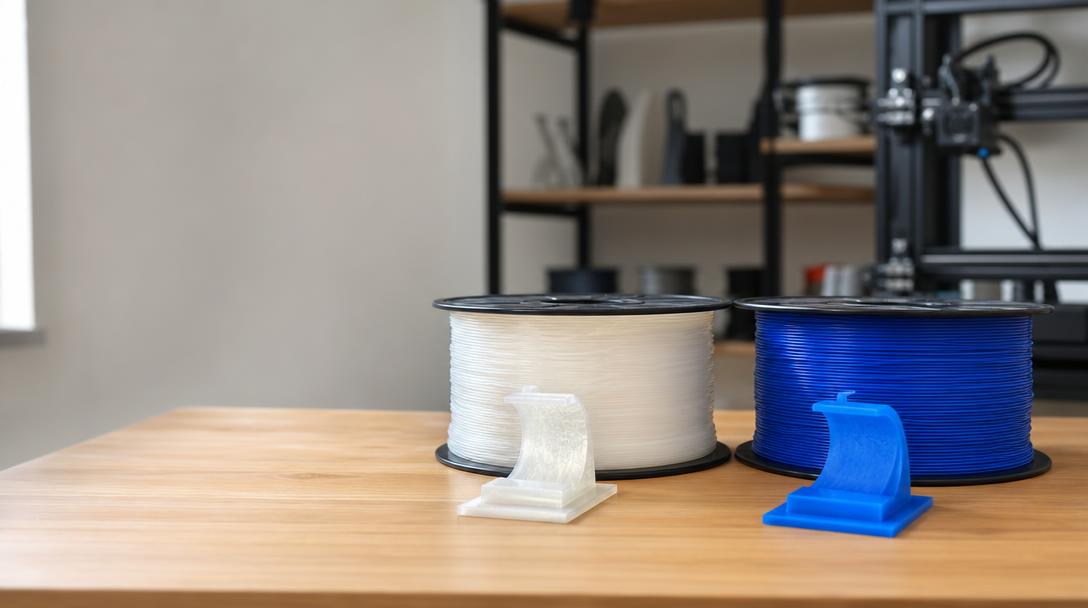
PVA or TPU? Dissolvable Support or a Flexible Functional Part?
In FDM printing, PVA and TPU are specialty filaments that address two different needs rather than serving as alternatives to each other. PVA stands out as a support material during printing, while TPU is intended for parts that bend, absorb impact, and allow deformation during use. Making the right choice for your model depends not only on the filament’s properties, but also on what the part is expected to do after printing.
What are PVA and TPU used for?
PVA is a support filament that dissolves when it comes into contact with water. It is especially useful for complex geometries, internal channels, or situations where it is difficult to clean the contact surface between the main material and the support by hand. When used with a multi-material FDM printer, it offers the potential for cleaner results in hard-to-reach areas of the model. PVA’s main purpose is not to become a durable final part, but to make the printing process easier.
TPU, on the other hand, is an elastic thermoplastic. It can be used in applications that require controlled flexibility, such as cable protectors, vibration dampers, gasket-like parts, bumpers, and grip surfaces. TPU is not a substitute for a rigid carrier or a highly stiff body; its advantage is that it can deform to some extent under load and absorb impact more gently.
Differences in outdoor use, heat, and impact
PVA is sensitive to water after printing. For this reason, it should not be considered as a material for supports that will remain in humid environments or for parts intended for exposed outdoor use. A support made with PVA has already fulfilled its function once it is removed from the model. TPU’s outdoor performance, however, depends on the product formula, hardness grade, and sunlight and temperature conditions; not every TPU blend should automatically be considered suitable for long-term UV exposure.
When impact absorption and flexibility matter, TPU is clearly the more sensible choice. PVA is selected not for part strength, but for supportability. In a heat-exposed application, TPU’s limits should also be evaluated according to the brand and hardness value. PVA, by contrast, is not a suitable candidate for end-use parts exposed to temperature, moisture, and mechanical load.
Printability and cost logic
PVA’s strength is that, in the right multi-material setup, it can reduce the difficulty of complex supports; its weakness is that it absorbs moisture and is sensitive to storage conditions. Moisture-exposed PVA can quickly lose print quality during printing. With TPU, the most important issue is controlled filament feeding, a suitable extruder setup, and patient tuning at lower speeds. Flexible filament can be more demanding than standard rigid filaments.
When evaluating cost, do not look only at spool price. If PVA can reduce the time spent cleaning support surfaces and lower the risk of failed prints, it can reduce total production time in a complex job. TPU, meanwhile, can reduce the need for part replacement by providing longer service life and impact tolerance in the right part. Evaluate the current price per gram approach together with the material used for support and the print time.
Which one for which part?
- Choose PVA: If you need water-removable support, a closed internal cavity, or a hard-to-reach top surface.
- Choose TPU: If you are printing a functional part expected to provide flexibility, impact absorption, grip, or vibration damping.
- Do not confuse the two: Treating PVA as a durable final part, or TPU as a rigid and dimensionally stable carrier, creates the wrong expectations.
If your project’s geometry, usage environment, and target flexibility are not yet clear, you can narrow down the options by reviewing our printing materials. Before sending your part to production, review the workflow on the 3d printing service page; with the instant quote tool, you can see the production cost of your file.
In short, PVA is a temporary support solution for complex FDM geometries, while TPU is the material that makes flexibility part of the product’s function. Once you decide whether you need a helper material that will dissolve in water after printing, or a real part that will flex during use, the choice becomes largely clear.



 Türkçe
 العربية
 Русский
 فارسی
فارسی Deutsch