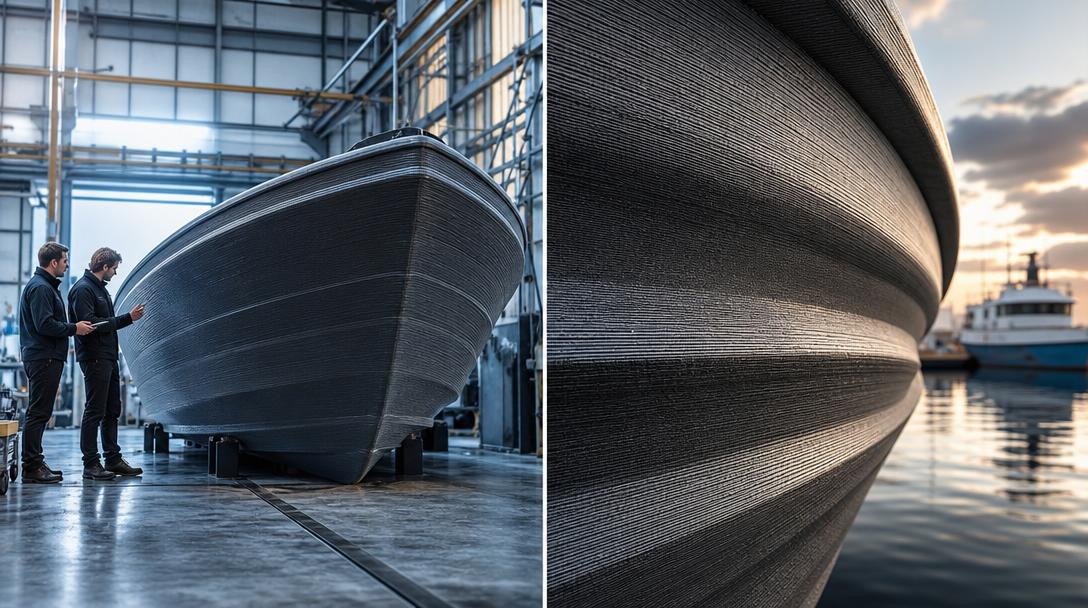
University of Maine’s 3Dirigo X: What Is a 9-Meter 3D-Printed Boat Changing in Manufacturing?
University of Maine announced a new project showing that large-scale additive manufacturing can be used not only for prototyping and mold production, but also for directly usable marine products. The 3D-printed boat called 3Dirigo X targets a hull in the roughly 30-foot, or 9-meter, class. The project was announced by the University of Maine on August 28, 2026; later reports stated that the boat will be tested in marine conditions and is designed with high-performance targets.
For Ucuz3D readers, this development means much more than news about a printer you could buy directly: why is the FDM-based extrusion approach attracting attention for producing large, low-volume, and geometrically customized parts when the right equipment and material selection are used?
Why is the 3Dirigo X project attracting attention?
Producing a large part like a boat hull with conventional methods involves molds, manual labor, assembly, and logistics steps. Large-format 3D printing, on the other hand, offers the potential to produce the hull layer by layer from a digital model, make rapid design changes, and reduce the need for molds. This is especially important for products like boats, which can vary for each customer or mission.
The remarkable aspect of the project is not only its size, but also its goal of testing marine use under real conditions. News sources say that 3Dirigo X will be tested in open-sea conditions and aims for performance at around 40 knots. Values like these indicate a design ambition; they should not be read as proof of mass-production readiness or long-term durability. The truly important stage is seeing how the printed hull behaves under loads such as vibration, water, sunlight, temperature changes, and impact.
The takeaway for FDM manufacturing
This project does not mean you can print a boat with your desktop printer. In large-scale systems, extrusion capacity, build volume, interlayer bonding, part orientation, and post-process reinforcements must all be evaluated together. In large parts, the relationship between print direction and load direction can be critical; the boat’s design, wall structure, and internal support geometry can be just as decisive as the material itself.
On the material side, the word “plastic” alone is not enough. UV and moisture behavior for outdoor use, temperature effects, impact resistance, and deformation under long-term load must also be examined. For this reason, if you are planning an engineering-focused part, it is more accurate to evaluate engineering materials together with your actual usage conditions. Choosing the right material for a large hull or a custom fixture is not just about whether the print succeeds or not.
A practical conclusion for Ucuz3D readers
The strongest message of 3Dirigo X is that FDM can change its value proposition as scale increases. In home printing, the goal is often rapid prototyping or small functional parts. At the industrial scale, however, production from the same digital file without waiting for molds, accelerating design revisions, and economically testing low-volume custom parts come to the forefront.
You can also first clarify your need for a prototype, fixture, or spare part, and then choose the most suitable option from printing materials based on the conditions. If your need is a production-ready part, you can evaluate your file through 3d printing service, and review affordable 3d printing prices and the logic of per-gram pricing. When your file is ready, getting an instant quote through online 3d printing lets you quickly see whether the design falls within production scope.


 Türkçe
 العربية
 Русский
 فارسی
فارسی Deutsch