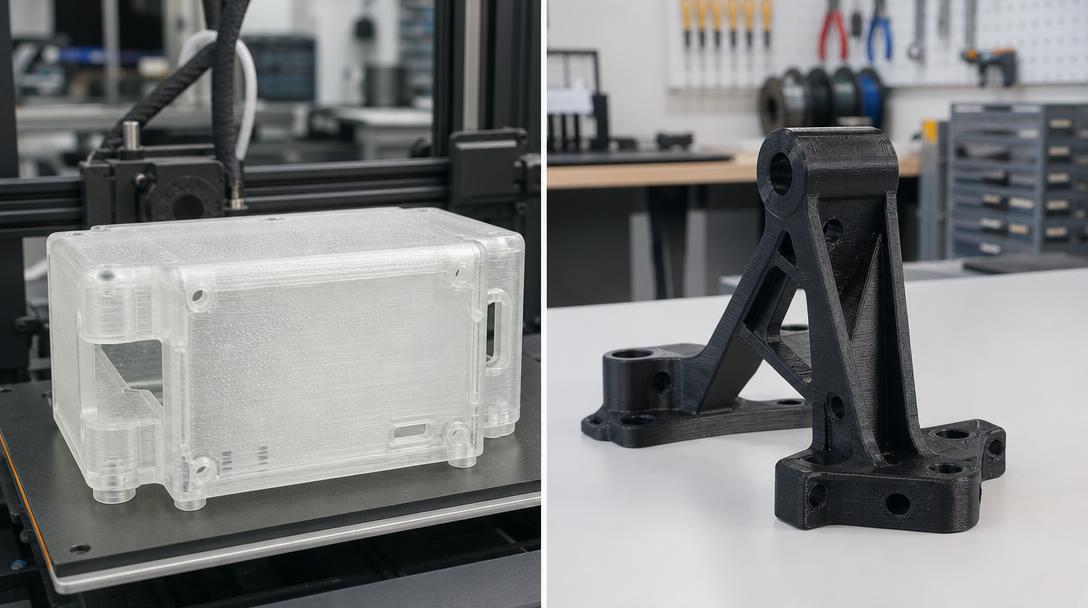
TPE or Polycarbonate? Flexible Protection or a Rigid Part Exposed to Heat?
There is no single answer to the question of TPE or Polycarbonate in FDM printing. TPE stands out for its ease of production and low process risk, while Polycarbonate may be considered when higher heat and impact resistance are required; however, the two materials differ significantly in terms of printability, heat behavior, performance under impact, and equipment requirements. When choosing for your part, you should consider not only the material’s theoretical strength, but also the production conditions and the actual use case.
When does TPE make sense?
TPE is a strong choice for those looking for a balanced option between durability and an accessible printing process. It is often considered for mechanical enclosures, connectors, fixtures, protective covers, and light outdoor applications. Its ease of printing, low tendency to shrink, and broad printer compatibility can be advantageous. However, TPE is not completely trouble-free; stringing may occur, and retraction and cooling settings may need to be adjusted carefully for a clean surface.
One of TPE’s strengths is that, on many desktop FDM printers, it offers a more accessible printing process than Polycarbonate. Bed adhesion, printing temperature, and ambient conditions are still important; however, an enclosed chamber and very high temperature capacity may not be essential for every project. As a result, when moving from a prototype to a low-volume functional part, the cost and production risk can remain more predictable.
What requirements does Polycarbonate address?
Polycarbonate is an engineering thermoplastic considered for technical parts where heat and impact demands are higher. It may be a suitable candidate for brackets used around machinery, load-bearing enclosures, fixtures near hot areas, and parts exposed to impact. However, the term “stronger” does not automatically mean “better” for every design. The part’s geometry, layer orientation, wall structure, and print settings have a significant effect on the result.
PC printing generally requires more process control than TPE. A high printing temperature, good bed preparation, maintaining the ambient temperature, and, in many situations, an enclosed chamber may be necessary. In large or asymmetric parts, the risk of shrinkage and corner lifting can influence the design decision. If your printer’s hotend, bed, and chamber capacity cannot process this material reliably, its performance advantage on paper may disappear in practice.
Comparing heat resistance, impact resistance, and rigidity
- Heat: PC may be a stronger candidate for parts exposed to continuously high temperatures. TPE may remain the more sensible choice under moderate temperature conditions; parts intended for use in direct sunlight or inside a closed vehicle should be evaluated for the actual environment as well.
- Impact: Both materials can behave in a tough and resilient manner when used in properly designed parts. PC may offer an advantage where high impact resistance is expected, while TPE may deliver sufficient results with easier production.
- Rigidity: Rigidity is not determined by filament choice alone. Since the number of walls, print orientation, and connection geometry are critical, the same material can produce different results.
- Printability: TPE is generally a more accessible starting point. PC can be more demanding when it comes to printer and environmental control.
Which material should you choose for each part?
For a regularly used electronics enclosure, workshop fixture, or enclosure exposed to moderate heat, starting with TPE often involves lower production risk. If the part is close to a hot area, is exposed to repeated impacts, or requires higher heat resistance, PC may be considered. Even so, for critical safety parts, do not rely solely on general material information; produce validation samples for the actual load, temperature, chemical exposure, and print orientation.
To view the material options together, you can visit the engineering materials 3D printing page. If you would like to move the part you need into production, you can submit the details through the 3d printing service. To make the decision together with your budget, review the price per gram model; if your file is ready, you can evaluate the pre-production options using the online 3d printing tool.



 Türkçe
 العربية
 Русский
 فارسی
فارسی Deutsch