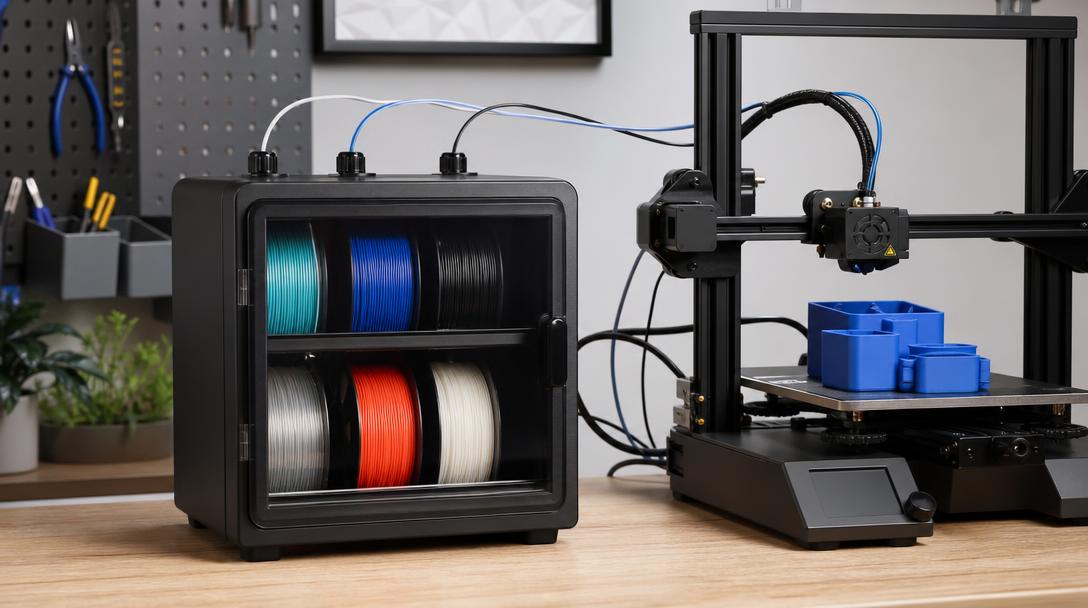
Why Is SUNLU FilaDC i10 Attracting Attention? How Could Keeping Filament Dry Without Heating It Change the FDM Workflow?
SUNLU and INSLOGIC announced the FilaDC i10 filament storage cabinet on 1 September 2026. Instead of continuously heating the filament, the product aims to keep it dry through desiccant- and molecular-sieve-based moisture management. This approach, reported in the VoxelMatters article, is worth following, especially for workshops that frequently use moisture-sensitive FDM materials such as PETG, TPU, and Nylon.
What is the main point of the news?
Filament absorbing moisture is not a new problem, but the solution is not always limited to drying the spool before printing. If a spool is left in the open air after being dried, it may absorb moisture again. The FilaDC i10 aims to maintain storage and feeding during printing in the same dry environment. This could eliminate the need to put the spool through a separate drying cycle before every production run.
The important distinction here is that the device offers a different operating principle from conventional high-temperature filament dryers. The product announcement emphasizes moisture management with desiccant and molecular sieves at conditions close to room temperature, automatic desiccant regeneration, and filament feeding during printing. This information is based on the manufacturer’s announcement and industry coverage; it is important to consider that actual performance may vary depending on the filament type, ambient humidity, spool usage time, and measurement conditions.
What benefits could it provide in FDM printing?
- Reduced waiting time: A dry-stored spool may reduce the need for additional preparation before an urgent print.
- Consistency with flexible materials: Keeping the filament path between the spool and the printer dry when using filaments such as TPU may help limit moisture-related printing problems.
- A more controlled workflow for Nylon: Since PA materials can be more easily affected by moisture, enclosed storage may simplify production planning.
- Workshop organization: Managing multiple spools in the same cabinet may reduce the number of rolls left exposed.
These benefits do not mean that print quality will automatically be flawless. If the filament has already absorbed a significant amount of moisture, simply keeping it in a dry cabinet may not be enough; the drying conditions recommended by the manufacturer should also be applied. If you observe popping, steam, an uneven surface, or weak layer adhesion, check the material and printer settings together.
Who could find it useful?
For a user who prints only PLA daily and stores the spool in a sealed container, the FilaDC i10 may offer limited additional value. In contrast, it could be a more meaningful solution for small production workshops working with different materials, running prints over several days, or wanting continuous feeding from a drying cabinet to the printer. Designers who use PETG and TPU may also find it practical to keep the spool from absorbing moisture from the environment during printing.
When making a purchase decision, examine the cabinet capacity, spool dimensions, the compatibility of the feed outlets with your printer, the need for heat-based drying, and the desiccant maintenance method. The FilaDC i10’s approach to managing moisture without heating does not replace every scenario that requires high-temperature drying. For engineering materials such as Nylon in particular, the material manufacturer’s drying instructions take priority.
The conclusion for Ucuz3D readers
The FilaDC i10 brings forward the idea of turning filament drying from a one-time process into a continuous storage and feeding discipline. This could be useful for repeatable FDM production, especially with materials that are highly sensitive to moisture; however, when evaluating the product’s real-world results, it is best to compare the manufacturer’s claims with independent user experiences and your own print tests.
Even with proper moisture management, you still need to choose the right material for the part. You can share your production needs on the 3D printing service page, and evaluate affordable 3D printing prices together with the per-gram pricing model when deciding on a material. Visit the our printing materials page to compare FDM options; if your file is ready, you can get an instant quote through the online 3D printing tool.
Source and date: VoxelMatters, “SUNLU and INSLOGIC launch FilaDC i10 filament drying cabinet”, 1 September 2026. The product features have been summarized only from the information reported in the announcement and industry coverage.


 Türkçe
 العربية
 Русский
 فارسی
فارسی Deutsch