What Could Stanford’s Multimaterial 3D Printing Study Change for FDM Designs?
In a report dated 31 August 2026, Stanford Report examined the new possibilities that multimaterial 3D printing could open up for design and manufacturing. The article highlights the idea of moving beyond producing a single part with just one plastic and combining different material properties within the same physical design. This development is particularly worth following for those preparing prototypes and looking to produce functional parts with less assembly.
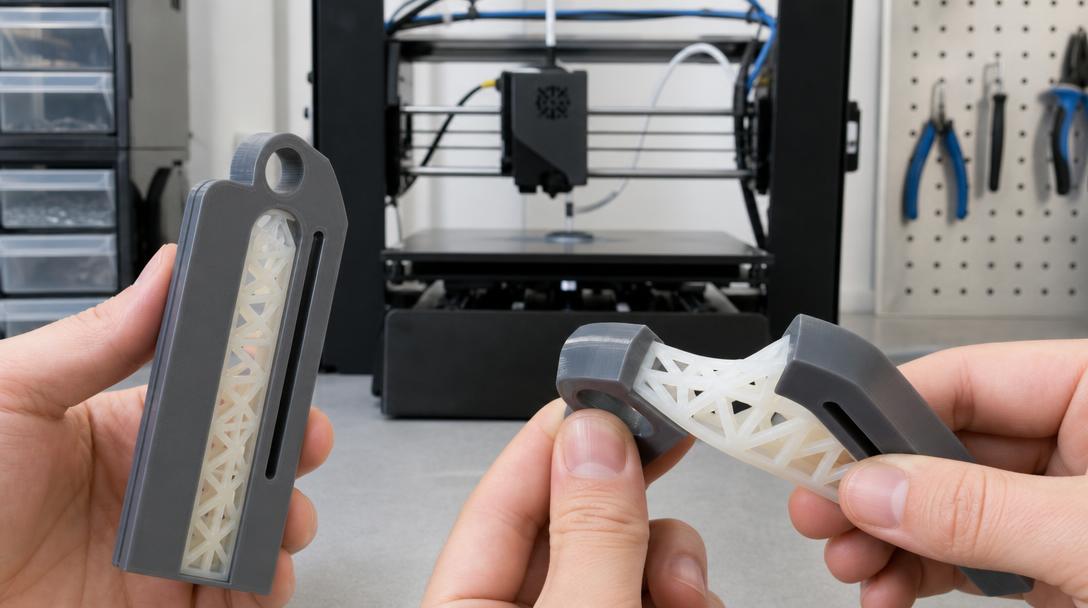
The critical point here is that “multimaterial” does not simply mean using different colours in the same print. When a part needs a rigid body, a flexible seal or an impact-resistant section within the same production workflow, material selection becomes a direct design decision. The study announced by Stanford makes the limits and potential of this approach more visible; however, a laboratory-scale research project should not be treated as a ready-made feature that can be applied smoothly on every desktop printer today.
Why is multimaterial printing important?
In a conventional FDM workflow, when a part needs to have different properties, post-print assembly, adhesive bonding or the use of a separate part is often required. The idea of multimaterial manufacturing offers the possibility of reducing these steps and assigning different functions to different areas of a part. For example, the load-bearing section of an enclosure could be designed to be rigid, while the contact surface could be softer. This makes it possible to consider functions such as grip, sealing or vibration reduction within a single geometry.
Another advantage of this approach for prototyping is that design decisions can be tested more quickly. Testing areas with different levels of hardness on a single model during product development can help you assess assembly tolerances, ergonomics and the part’s feel in real use at an earlier stage. Nevertheless, the outcome depends on details such as material compatibility, interlayer bonding, the precision of the print head or tool change, and how effectively the slicer software manages these transitions.
How should Ucuz3D readers interpret this?
This news also serves as a reminder not to look only at print volume and speed when buying a home or workshop FDM printer. Before moving to a multimaterial system, define which two properties you want to combine in the same part. Colour change and actual material change are not the same thing. Combining flexible and rigid filaments may require more experimentation in terms of bed adhesion, temperature, cooling and the feeding system.
Similarly, using more than one material in a single part is not always more economical. Print time, waste during transitions, additional hardware and the risk of failed prints can increase the total cost. For a simple part, two separate prints and mechanical joining may be more practical. When making your decision, you should consider the preparation time and the need for post-processing as well as the price per gram.
What is the sensible step today?
The practical message of the Stanford report is to view multimaterial manufacturing less as a solution to buy immediately and more as a research direction showing how design could change in the future. For everyday fixtures, boxes, prototypes or spare parts, first assess whether the part can be produced reliably with a single material. You can review the options on our printing materials page for guidance on material selection; instead of producing the print yourself, you can request manufacturing support through our 3D printing service.
Once your model is ready, you can submit your file through the online 3D printing process and evaluate the appropriate material and production option. Multimaterial printing is not yet an automatic solution for every part, but Stanford’s study dated 31 August 2026 shows that the idea of combining functions within a single geometry is gaining momentum in the research community.



 Türkçe
 العربية
 Русский
 فارسی
فارسی Deutsch