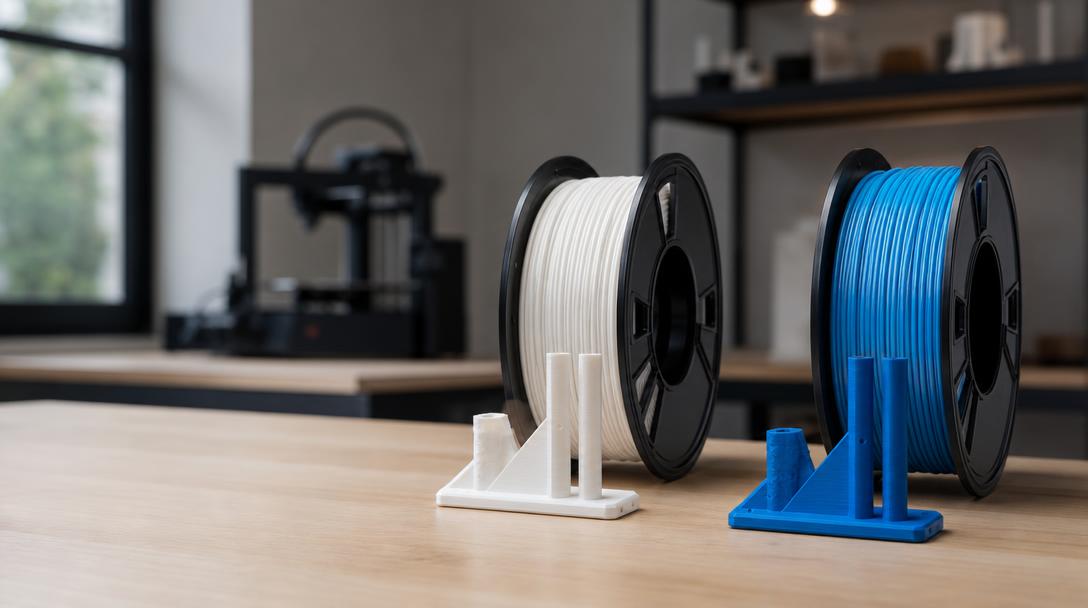
ABS+ or PVA? Rigid Functional Part or Clean Support?
ABS+ and PVA are not two filaments designed for the same purpose. ABS+ is intended for FDM parts that need to withstand impact, remain rigid, and function in everyday use. PVA, on the other hand, is mainly a water-soluble support material printed together with another material. Therefore, when choosing between them, you should consider not only material strength but also the role the part plays during printing.
What is ABS+ used for, and what is PVA used for?
The name ABS+ refers to an ABS formulation that varies by manufacturer. Its general purpose is to offer more balanced printing behaviour, impact resistance, or interlayer adhesion compared with standard ABS. Since exact properties may vary depending on the brand and print settings, you should check the technical data sheet. It can be considered for rigid functional parts such as boxes, protective covers, fixtures, mounting brackets, and automotive interior components.
PVA’s primary purpose is not to become the model itself, but to provide support in areas that are difficult to reach. Its ability to dissolve when it comes into contact with water can make it easier to clean complex cavities and internal channels. However, PVA is a filament that absorbs moisture quickly; dry storage and proper drying before printing can be critical for achieving good results.
Differences in outdoor use, heat, and impact resistance
The ABS+ side
- Impact: With the correct print temperature, an enclosed chamber, and good layer adhesion, it can be a more suitable option than PLA for everyday impacts.
- Heat: It may be a more sensible choice than PLA in hot environments; however, its actual limit depends on the product formulation, geometry, and operating conditions under load.
- Outdoor use: ABS+ can be used for short-term or controlled outdoor applications. For parts that will be exposed to sunlight and weather conditions for extended periods, ASA is often a safer candidate.
The PVA side
- Outdoor use: It is not suitable as a permanent outdoor part because it is sensitive to water.
- Heat and impact: Since it is used as a support material, it does not determine the main part’s heat or impact performance on its own.
- Cleaning: Its ability to dissolve in water can provide a significant advantage in complex geometries and multi-material prints; the dissolution time varies depending on water temperature, flow, and support density.
Printability and cost considerations
When printing ABS+, bed adhesion, shrinkage, and corner lifting must be managed. An enclosed chamber, a suitable build surface, and a draft-free environment can improve printing reliability. PVA may appear mechanically simple to print, but it requires care because of moisture control, dual-material compatibility, and support settings. Not every printer can feed PVA with the same level of reliability; the extruder path and the printing temperature ranges of both materials must be compatible.
In a cost calculation, ABS+ is usually the material cost of the main part. PVA can increase the budget as the volume of support used grows; however, it may reduce total labour costs by eliminating supports that cannot be removed by hand and shortening post-processing time. Checking the slicing data before printing is more reliable than comparing spool prices alone. You can evaluate the amount of material together with the part geometry by reviewing the price per gram approach.
Which one for which part?
If you are printing a rigid enclosure, fixture, or impact-prone mounting component, ABS+ is the more meaningful starting point. If your ABS+ model contains a long channel, complex protrusion, or a cavity that is difficult to remove, you can consider using PVA as a support material. Choosing PVA on its own as if it were a durable product material would mean misunderstanding the material’s intended role.
If the part needs to remain outdoors for an extended period, compare options such as ASA instead of ABS+ among the general material options. Once the production decision is clear, you can share the geometry and material requirements through the 3D printing service and start the quotation process using the instant price tool. This allows you to plan a durable main part with ABS+ and, when necessary, a clean support workflow with PVA.


 Türkçe
 العربية
 Русский
 فارسی
فارسی Deutsch