HIPS or Polycarbonate? Lightweight Prototype or Heat-Exposed Technical Part?
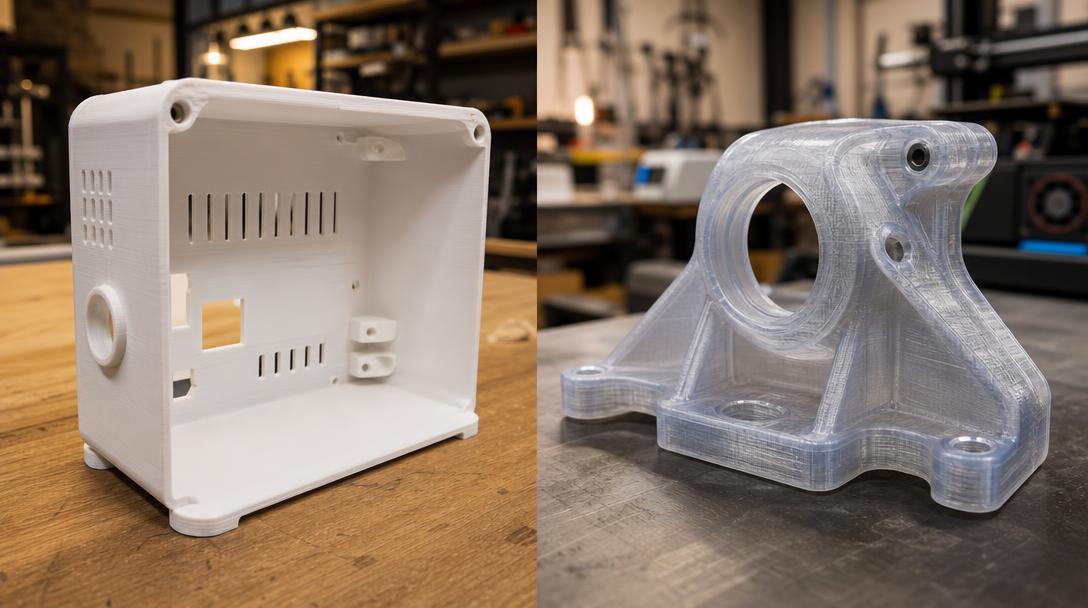
Material selection in FDM printing cannot be explained simply by whether a part needs to be rigid or durable. Your production purpose, printing environment, and the part’s operating temperature should be evaluated together. In this respect, HIPS and polycarbonate address two different needs: HIPS can stand out in easier-to-manage prototyping and support-focused applications, while polycarbonate is better suited to technical parts with higher heat and impact resistance requirements.
The first question to ask is how much stress the part will actually face. HIPS can be a sensible option for visual prototypes, lightweight enclosures, dimensional check models, or short-term testing. Polycarbonate, on the other hand, is considered for applications with higher mechanical demands, where rigidity and the ability to retain its shape under heat are important. However, polycarbonate’s advantages do not mean that it can be printed effortlessly on every printer or with every geometry.
What is HIPS used for, and when does polycarbonate stand out?
Because HIPS is a relatively easy-to-process thermoplastic, it can be used for prototypes, boxes, fixtures, and certain support scenarios. Its surface can be machined and painted afterward, which can be an advantage for presentation models. Nevertheless, HIPS is not automatically the right choice for parts operating at high temperatures or carrying heavy loads continuously. The part’s actual operating conditions must always be examined separately.
Polycarbonate is one of the engineering materials chosen when high-temperature and impact resistance are required. It can be a suitable candidate for protective enclosures, robust connection parts, technical fixtures around machinery, and rigid components that may be exposed to heat. Print orientation, wall count, infill structure, and interlayer bonding are just as influential as the material choice; it is not correct to guarantee final strength based solely on the filament name.
Comparison of outdoor use, heat, and impact resistance
- Heat: Compared with HIPS, polycarbonate is generally a more suitable starting point for applications with higher temperature requirements. Continuous operating temperature varies depending on the brand, print settings, and part design.
- Impact: Polycarbonate is a stronger candidate for technical parts exposed to impact. HIPS can work for lightly impacted prototypes, but it should not be treated as a critical safety component.
- Rigidity: Both materials can produce rigid parts, but polycarbonate is intended for parts with higher performance expectations. Design-related flexing may occur in thin, elongated HIPS components.
- Outdoor use: When factors such as sunlight, temperature cycling, and humidity are involved, the material name alone is not enough. HIPS may not be the first choice for outdoor use; polycarbonate also does not provide unlimited outdoor durability without UV protection and a suitable design.
Printability and the logic of cost
For prototyping, HIPS can offer a lower processing burden and more manageable printing requirements. Polycarbonate may require a high nozzle temperature, good bed adhesion, a suitable printing environment, and controlled thermal conditions for most geometries. In large parts or parts with sharp corners, an enclosure, proper bed preparation, and part orientation become important for reducing the risk of warping. Therefore, before considering the material cost of polycarbonate, you should also include failed prints and setup time in your cost calculation.
If your goal when choosing HIPS is rapid validation, a lightweight prototype, or a model that can be machined afterward, it may offer advantages. When choosing polycarbonate, the requirements for heat, impact, and technical use should be genuinely significant. Switching to polycarbonate simply because it appears stronger can increase total production time if your printer and design are not suitable.
Which material is suitable for which part?
HIPS can be considered for a simple presentation model, a dimensional check housing, or a lightweight fixture used for a short period. For a machine enclosure exposed to heat, an area around a connection component at risk of impact, or a technical part where rigidity is important, polycarbonate is a more logical candidate. For applications involving food contact, electrical safety, or high levels of responsibility, the relevant standards and the manufacturer’s technical data should also be checked.
If you are having difficulty deciding on the right material for your part, you can review the production options on the 3D printing service page. Comparing engineering material alternatives according to the project’s material and geometry is particularly useful for options such as polycarbonate that require more demanding printing conditions. When evaluating your budget, consider the price per gram approach together with the overall printing risk; uploading your file to get an instant price can also speed up your initial comparison.


 Türkçe
 العربية
 Русский
 فارسی
فارسی Deutsch