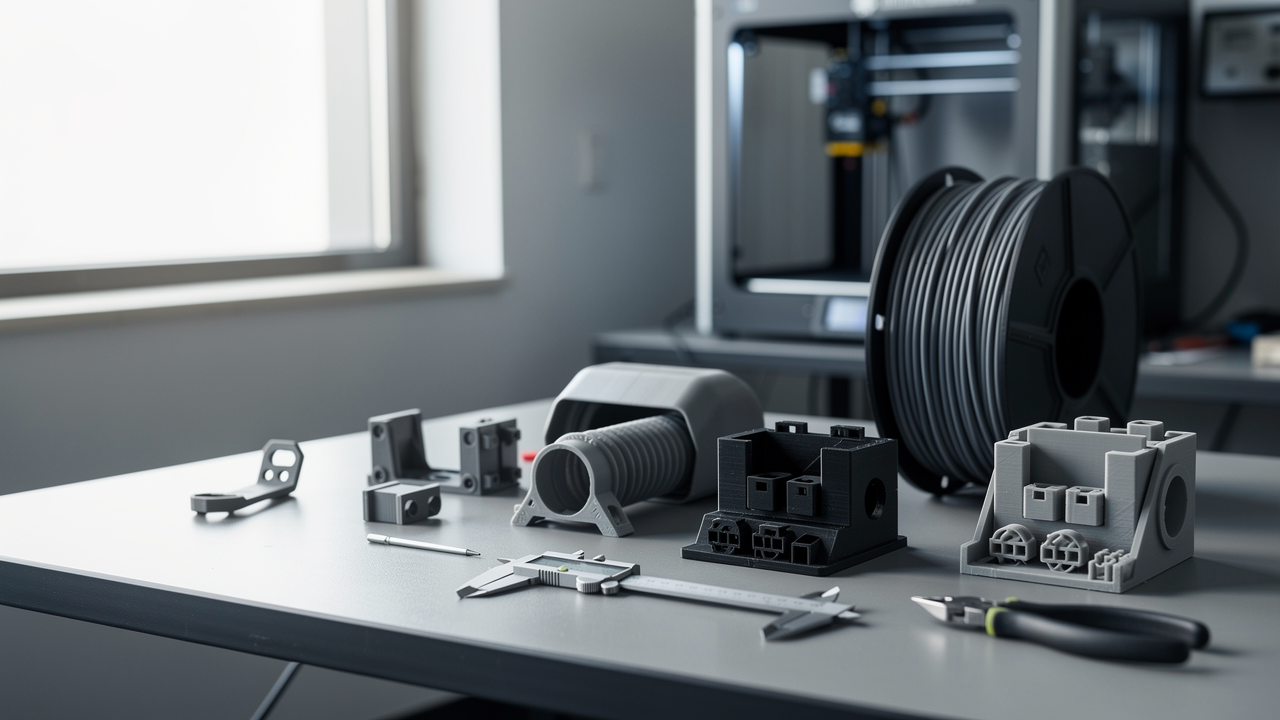

Why Is In-House 3D Printing Growing at an Air Base? The 101st Air Refueling Wing Speeds Up Maintenance Parts
According to VoxelMatters’ August 14, 2026 report, the 101st Air Refueling Wing machine shop in Maine is expanding its in-house 3D printing capacity for aircraft maintenance and similar operational needs. The report states that systems capable of producing both plastic and metal parts have been added to the shop; however, from Ucuz3D’s perspective, the most striking point is how practical an advantage plastic/FDM-based production creates in maintenance workflows. Especially for low-volume, urgent, and impractical-to-stock parts, the value of 3D printing becomes clear once again.
According to the report, the equipment investment has significantly shortened production times for certain components. This is a familiar scenario not only for large industry, but for any business focused on workshops, service, prototyping, and spare parts. Instead of waiting weeks for procurement of a part, producing a testable version the same day with the right material is now a more realistic approach. For this reason, professional 3d printing service is meaningful not only for visual prototypes, but also for applications such as fixtures, covers, housings, clips, ducts, guides, and temporary spare parts.
Why is this news important?
The first reason is that 3D printing has long since moved beyond being a “hobby tool” and has become an operational process tool. The 101st example shows how in-house printing is positioned in environments where the time between a digital file and a physical part is critical. The second reason is that this capability can support not only a single unit but also other facilities. The report notes that the same shop supplies parts to different Air Force locations and other units as well. In other words, 3D printing here is not just about buying a machine, but about establishing a distributed manufacturing logic.
For the Ucuz3D reader, the practical takeaway is this: not every part requires injection molding or conventional machining. If the part volume is low, the geometry changes frequently, or you need to see a trial part first, FDM can often be the more rational option. In this type of work, the total decision is not made based only on material cost; delivery time, ease of repeat production, and geometric freedom must also be considered. That is why, when planning a project, instead of looking only at catalog cost, it is necessary to think about the logic of affordable 3d printing prices together with the balance between per-gram cost and labor/application requirements.
What lessons stand out on the FDM side?
1) For low-volume parts, speed can sometimes matter more than the material itself
This news reminds us once again that, for maintenance teams, the most valuable factor is sometimes not absolute mechanical performance, but being able to get the part today. Being able to iterate within hours for a broken clip, assembly guide, protective cover, or temporary fastening part is a major advantage.
2) Material selection is as critical as part selection
In these types of applications, PLA may not always be enough. If there is heat, UV, impact, or chemical exposure, PETG, ASA, nylon, or other engineering materials become more logical choices. On the other hand, if only form validation is needed, easier-to-print materials can speed up the process.
3) The digital inventory logic is becoming more valuable
One of the most important underlying messages in the report is the idea of producing when needed instead of holding physical stock. Rather than keeping every part on the shelf, storing the verified file and printing it when required can reduce storage, waiting time, and supply risk.
4) Design speed and quotation speed are becoming important together
Today, many teams do not want to make a final production decision before seeing the first trial. For this reason, getting a quick price from the file and checking print suitability shortens the workflow. Even if your part is not intended for mass production, getting the first cost/visual validation early through an online 3d printing workflow can significantly reduce decision time.
A short comment from Ucuz3D’s perspective
The 101st Air Refueling Wing story ties the value of FDM not so much to the question of “who has the most powerful machine,” but to “how quickly can you get the right part up and running?” This is the right perspective for the Ucuz3D audience: in spare parts, fixtures, custom holders, service aids, and prototypes, the winning side is usually the team that can validate faster. That is why this news matters; it shows that the real power of 3D printing is not only making parts, but accelerating maintenance and production decisions.


 Türkçe
 العربية
 Русский
 فارسی
فارسی Deutsch