
Why Is a 3D-Printed TPU Funnel Important in KC-46 Engine Maintenance? The Practical Value of Developing Field Equipment
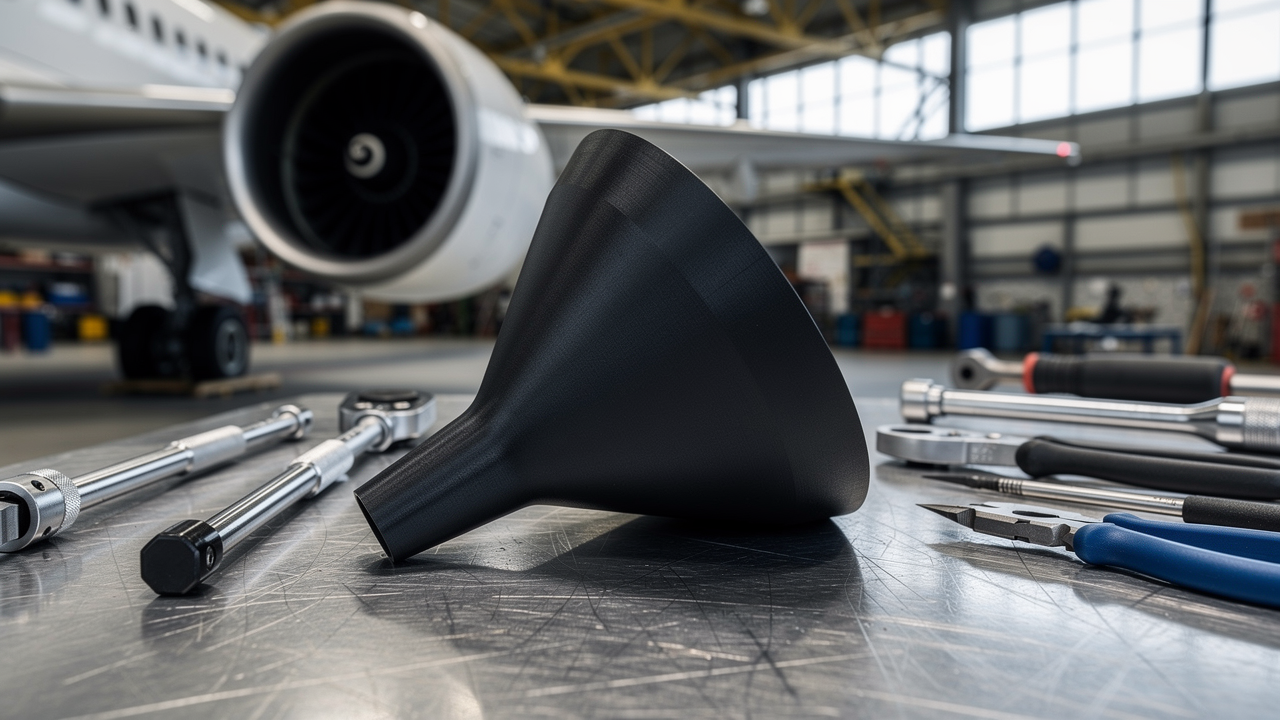
One of the notable application stories from the last 30 days stood out in a VoxelMatters post dated July 31, 2026: an innovation lab at McConnell Air Force Base improved the on-site maintenance workflow by developing a special funnel used in KC-46 engine maintenance with 3D printing. At first glance, the story may look like a small tool update; however, when it comes to low-volume maintenance equipment, service tools, and support parts with custom geometry, this example clearly shows why FDM-based production is being preferred more and more.
In the reported case, the problem was quite concrete: the existing method used in engine starter maintenance was dripping oil, slowing down the workflow, and required more controlled guidance. When the team could not find a ready-made product on the market that would do the job directly, they took measurements, created a CAD model, produced the first prototypes on a desktop FDM printer, and chose TPU for the final part. In other words, this is a classic “prototype first, then revise for field use” cycle. That is exactly why a 3D printing service can create serious value not only for final-part production, but also for auxiliary tools used in maintenance and operational processes.
Why is this story important?
Because the real power of 3D printing often appears not in a single expensive final part, but in small, hard-to-find yet critical components. A custom funnel, guide, guard, holder, or assembly fixture—each of these can save time on a production line, at a maintenance bench, or in field service. For needs like these, opening a mold does not make sense, and a standard product often does not fit properly. This is where FDM offers the advantage of “made exactly for the need, with fast revision, in low-volume production.”
For the Ucuz3D reader, the main takeaway is this: if you have a part that is not difficult to draw technically but cannot be solved with a standard product, testing it first through a few iterations is often the most sensible route. In such scenarios, uploading the file through an online 3D printing infrastructure and validating the geometry at an early stage can help prevent costly revisions later. When evaluating the project budget, instead of memorizing exact figures, it is more accurate to look at the logic of price per gram.
Why might TPU have been chosen?
According to the VoxelMatters report, after printing the first prototypes in PLA, the team switched to TPU for the final part. This choice seems logical. Because in a tool like this, shape alone is not enough; slight flexibility, impact resistance, and not breaking during use also matter. In addition, in environments where the material comes into contact with oil and fuel, material behavior becomes critical. Not every TPU formulation is the same; however, when selected in the right grade, it can be a strong candidate for flexible parts designed for demanding use. Ucuz3D’s engineering materials page also offers a good starting point for understanding which material makes more sense in exactly these kinds of use cases.
What lessons can be drawn for Ucuz3D?
- FDM is highly suitable for producing custom service tools.
- Thanks to repeated prototyping, geometry can be improved quickly before going into the field.
- Material selection should be based not only on hardness, but also on chemical contact, flexibility, and service life.
- For low-volume needs, 3D printing is often a more agile solution than traditional manufacturing.
This approach is especially relevant in Turkey for maintenance, spare-parts support, assembly aids, and prototype validation. In many businesses, the real need is not “thousands of parts,” but single solutions with the right dimensions that can be tested quickly and, if necessary, updated in the next revision. That is why the TPU funnel example in the story matters: sometimes the value of 3D printing appears not in large and flashy projects, but in small yet well-designed parts that genuinely make everyday work easier.


 Türkçe
 العربية
 Русский
 فارسی
فارسی Deutsch