
What Is Polycarbonate (PC) Filament? What Is It Useful For in High Heat and Impact Applications?
Polycarbonate, or PC filament, is one of the materials most commonly mentioned alongside phrases like ‘high durability’ on the FDM side. This reputation is not undeserved; PC is genuinely one of the strong options against high heat, impact, and demanding usage conditions. However, for the same reason, it is not a ‘top-tier general-purpose filament’ that should be used for every job. If your part will operate near a hot environment, face mechanical stress, or go beyond the ordinary limits of PLA/PETG, PC becomes a sensible candidate when getting 3d printing service.
When does PC stand out?
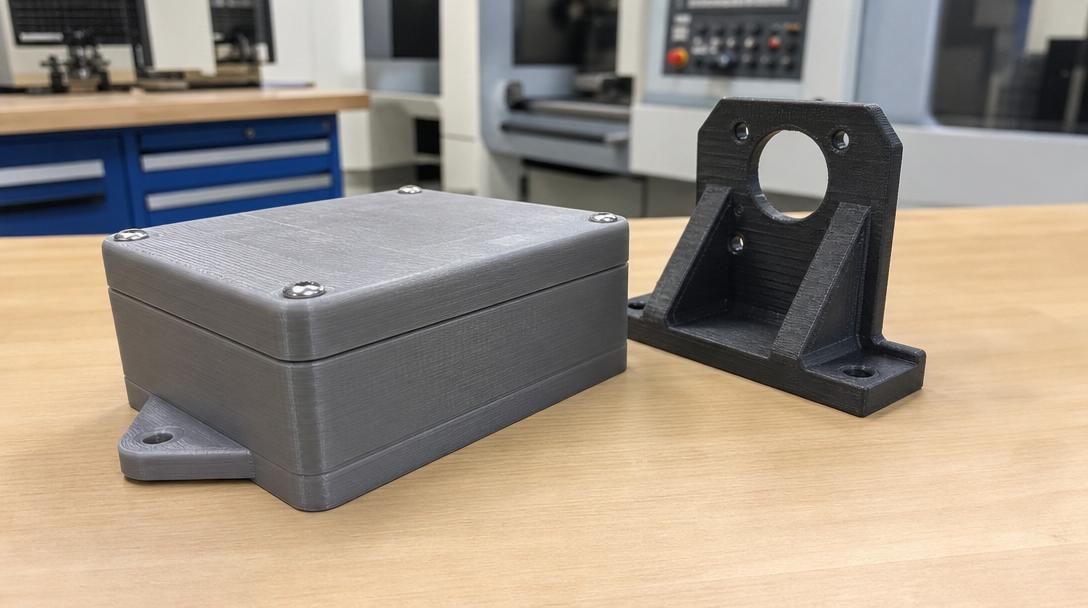
PC is especially considered for enclosures, fastening elements, technical fixtures that may take impact, and parts working around heat. In other words, it is more a material for functional parts that will actually be used than for a visual prototype sitting on a desk. For this reason, it can provide serious advantages in electronics boxes, durable mounting feet, machine-side parts, and mechanical components that require temperature tolerance. Within Ucuz3D’s focus on printing with engineering materials, PC is generally evaluated for FDM jobs where a ‘high safety margin’ is desired.
Why is PC not suitable for every project?
Because PC is not only strong, but also a material that favors production discipline. The printing process is more sensitive; it requires proper drying, correct temperature management, and an approach suited to the part geometry. For a small desktop concept model, a quick design trial, or a cost-sensitive prototype, it is often unnecessary. For some uses, PETG may be more practical, nylon may be tougher, and ASA may be the more logical choice for outdoor conditions. In other words, PC should not be chosen with the logic of ‘if it is the most expensive, it must be the best,’ but when the real need is on the heat and impact side.
Strong, but not magical
The advantage of PC is that it offers a high-performance technical material; its disadvantage is that it does not forgive design and production mistakes as easily as PLA does. Just as the wrong material choice can create unnecessary cost, the expected service life may still not be achieved if the right material is chosen but the geometry is designed incorrectly. Issues such as dimensions, assembly tolerance, and part orientation are especially important. To better understand the relationship between design and material, the guide What Is Tolerance? How Should Interlocking Parts Be Designed? is useful at this point.
When should it be chosen, and when is it overkill?
- Should be chosen: Parts expected to face high heat, impact, and functional technical use.
- Should be chosen carefully: Large-volume geometries that are difficult to produce.
- May be unnecessary: Low-cost prototypes, visual models, short-life test parts.
In short, polycarbonate is an extremely powerful tool for the right project; however, it can also be inefficient when chosen only because of the label ‘the strongest filament.’ Once you define how much heat the part really sees, how it takes impact, and what service life is expected, it quickly becomes clear whether PC is necessary. To get a rough idea of the cost, the affordable 3d printing prices page is a good starting point; then uploading your model through online 3d printing for an evaluation based on the actual part will give more accurate results.


 Türkçe
 العربية
 Русский
 فارسی
فارسی Deutsch