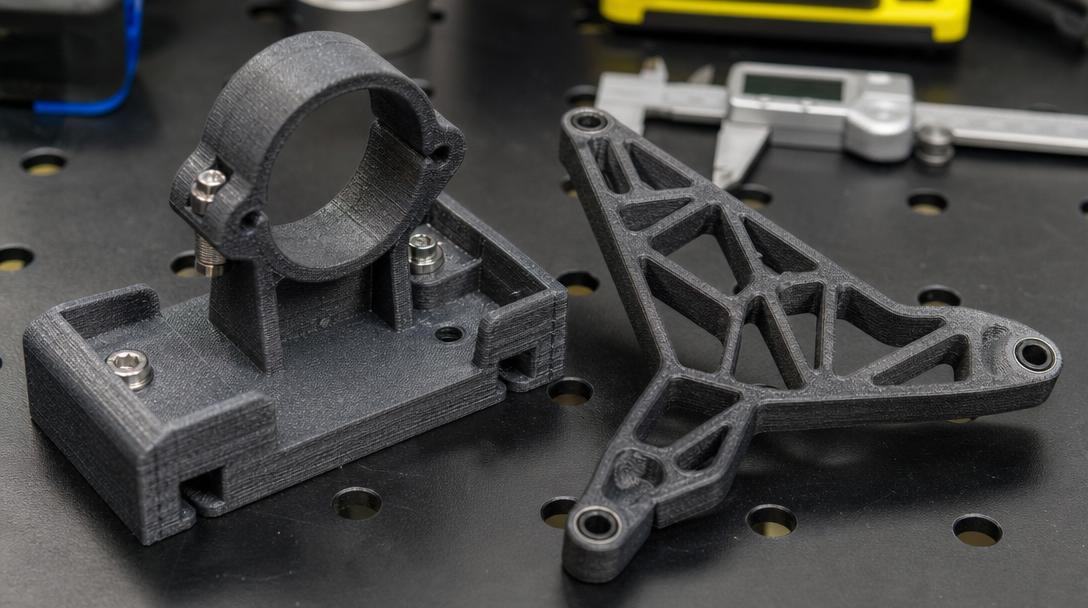

What Is Carbon Fiber Reinforced Filament? When Does It Really Provide an Advantage for Rigid Parts?
Carbon fiber reinforced filaments have become one of the most talked-about material classes on the FDM side in recent years. The reason is not just marketing; in the right part, they truly deliver results that feel stiffer, more solid, and often more professional. However, the critical point here is this: carbon fiber reinforced filament is not the same thing as a true continuous carbon composite part. In other words, it is not the ‘strongest’ in every case; especially in thin clips that take impact or in parts that need to flex, it can sometimes feel overly brittle instead. That is why, when getting 3d printing service, you should not choose this material based on its name alone.
What is its real advantage?
The real strength of these materials is the sense of high stiffness, more controlled deformation, and good performance in lightweight structural parts. They make a lot of sense for fixtures, jigs, drone accessories, measurement holding parts, and connections that should not bend too much under load. On the Ucuz3D side, in scenarios that require printing with engineering materials, carbon fiber reinforced materials stand out especially when the expectation is ‘light but rigid.’
Where do unrealistic expectations come from?
Not every filament with carbon fiber content automatically becomes the top choice for impact resistance. For example, for a hinge that needs tough behavior, a snap-fit clip that flexes continuously, or a part that needs to absorb impact, nylon- or TPU-based solutions may be more sensible. Likewise, upgrading to this material just because the surface looks stylish is unnecessary in many jobs. Carbon fiber reinforced filaments also create a risk of nozzle wear; in other words, on the production side they require a more disciplined equipment approach. So the cost includes not only the material, but also the production conditions.
What is it good for, and what is it not good for?
- Where it performs well: Fixtures and structural helper parts that require stiffness, lightness, and dimensional stability.
- Where it falls short: Parts that need to flex, are expected to absorb impact, or require the ‘toughest’ behavior.
- Wrong use: Creating unnecessary cost in a simple prototype just because the name sounds premium.
To understand the material’s real behavior in a broader context, the Carbon Fiber Reinforced Filaments guide provides a good background. It is especially important for breaking the misconception that ‘carbon fiber = always the strongest.’
What should you look at when deciding?
If your main goal for the part is to reduce bending, keep the weight relatively low, and achieve a stiffer behavior with an engineering feel, carbon fiber reinforced filament is a strong candidate. But if your goal is low cost, high flexibility, or easy printing, other materials are more suitable. For this reason, you should first define the function, and only then choose the material. As a starting point, the healthiest method is to look at the price per gram approach, then evaluate your model through online 3d printing and interpret it together with the part geometry.



 Türkçe
 العربية
 Русский
 فارسی
فارسی Deutsch