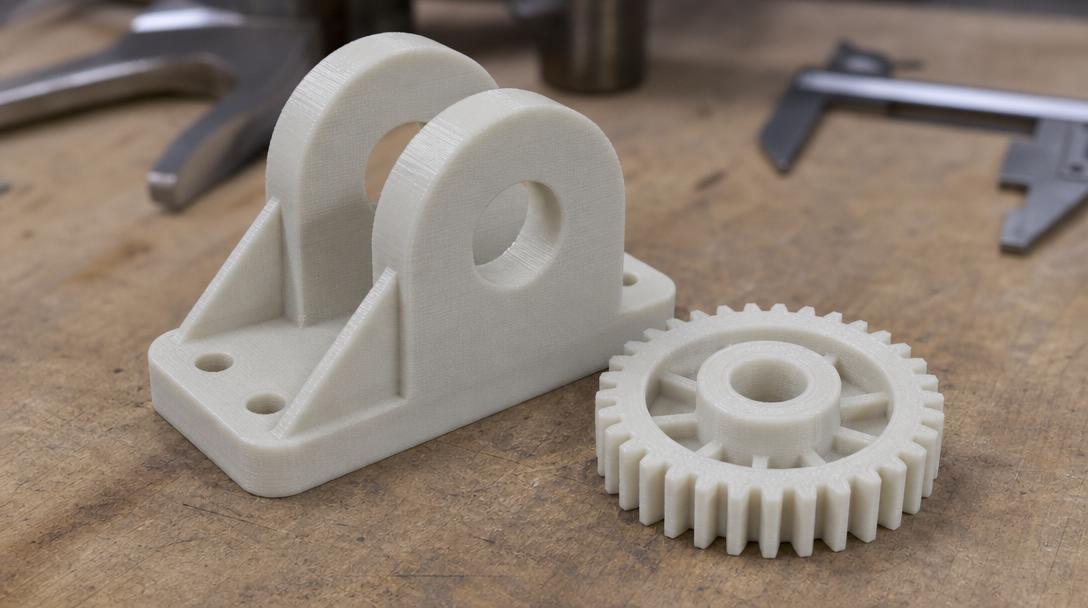

What Is Nylon (PA) Filament? When Should It Be Chosen for Wear-Prone and Load-Bearing Parts?
Nylon, in other words PA-based filaments, is one of the materials most often mentioned in the desktop FDM world, yet one that many users either praise more than necessary or fear unnecessarily because of its sensitivity to moisture. In reality, nylon’s value lies in not being brittle under impact, resisting friction better, and behaving far more reliably than PLA in load-bearing parts. That is why, when getting 3d printing service for bushings, sliders, hinges, mounting feet, functional clips, and continuously operating mechanical auxiliary parts, nylon is one of the serious candidates.
Where nylon is strong
Nylon’s biggest advantage is not simply that it is ‘strong’; it is that it can absorb impact and behave more tolerantly under repeated loads. Rather than brittle, model-like parts, it stands out in technical components that do real work, are tightened and removed repeatedly, experience friction, or need to behave flexibly. It can be especially effective in terms of service life for replacement parts exposed to mechanical movement or workshop fixtures. For jobs at Ucuz3D where printing with engineering materials is being considered, nylon is often a sensible choice for parts that need to bear loads but keep working without breaking.
So when is it not a good idea?
Nylon is not always the easiest choice. First of all, it absorbs moisture; this can directly affect print quality, surface appearance, and dimensional consistency. In addition, a user expecting a very stiff, glass-like rigid result may misinterpret nylon’s tougher and slightly more ‘working’ structure at first glance. It may be unnecessary for jobs that require a fine cosmetic surface, very sharp edge detail, or only a cheap trial prototype. In such cases, PETG, PLA+, or in some scenarios PC may be more sensible.
The cost of nylon is not just the price
When deciding on engineering materials, looking only at the cost per gram can be misleading; production conditions, moisture management, and part design are also part of the picture. Nylon delivers very strong results when produced in the right environment; but with improperly stored filament or the wrong geometry, the expected performance may not be achieved. For this reason, drying and storage are especially important. To better understand the effect of moisture, the guide How Should Filament Be Stored? Moisture and Drying is directly useful.
For which parts does it make sense, and for which does it not?
- Sensible: Technical parts that experience friction, carry loads, work under impact, and are expected to have service life.
- Conditional: Parts that require very high dimensional accuracy but also need some toughness.
- Not sensible: Cheap visual prototypes, quick trials that do not require dry-environment management, and overly rigid, aesthetics-focused jobs.
In short, nylon is not a material that ‘makes every part premium’; it is a technical tool that reduces maintenance, breakage, and wear problems when used in the right place. If the part is not just going to be shown once but will actually work, nylon should often be on the list. For your part, the best approach is first to understand the logic of price per gram, then evaluate your STL file through the online 3d printing workflow and decide together with the geometry.



 Türkçe
 العربية
 Русский
 فارسی
فارسی Deutsch