
What Is ASA Filament? When Does It Make Sense for Outdoor Use, UV, and Heat?
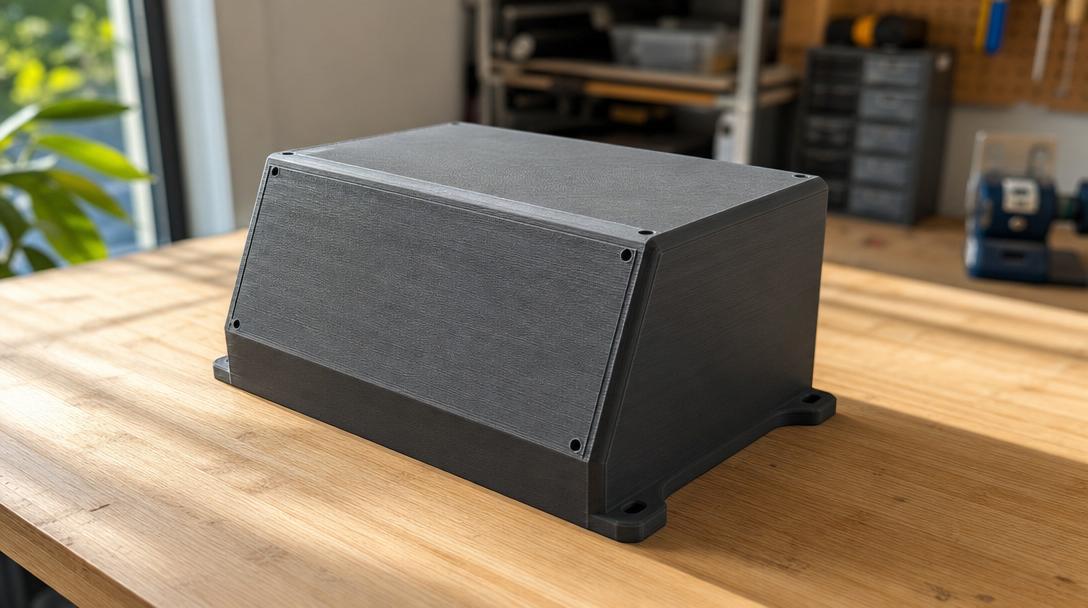
ASA filament is often described as an ‘ABS alternative suitable for outdoor use’; while that definition is roughly correct, it is not enough on its own when making a decision. The main strength of ASA is not just that it is rigid, but that it behaves more consistently against sunlight, weather conditions, and long-term temperature fluctuations. That is why ASA should be seriously considered when getting 3d printing service for jobs such as enclosures, sensor boxes, roof-mounted fixtures, and sign connection parts that will operate outdoors.
What is ASA used for?
ASA preserves its color and mechanical performance under UV much better than PLA. PETG may be sufficient for everyday use; however, if the part will stay outdoors year-round, especially on a surface exposed to direct sun, ASA is often the safer choice. For this reason, it makes sense for roof-mounted connections, outdoor electronics enclosures, garden equipment attachments, and functional parts used around motorcycles or automobiles. In Ucuz3D’s printing with engineering materials approach, ASA is generally evaluated in the ‘long-lasting outdoor part’ category.
Is ASA right for every job?
No. For a model that will only sit on a desk, a display object, or a simple prototype exposed to low heat, ASA often creates unnecessary cost and unnecessary printing difficulty. PLA may be a faster, cleaner, and more economical solution. Likewise, ASA is not the right answer for applications that require a very flexible part; materials like TPU should be considered there. Another important point is the printing process: ASA is not as forgiving as PLA. The risk of shrinkage and edge lifting is higher. If you choose the material based only on the reflex of ‘let it be the most durable,’ you may end up taking an unnecessarily difficult production route depending on the part geometry.
Its limits should be understood as well as its advantages
The advantages of ASA are UV resistance, outdoor weather resistance, more professional functional use, and more confidence-inspiring behavior than PLA on the heat side. Its disadvantages are that it requires a more controlled environment during printing, the risk of warping increases with poor settings, and it is not as practical as PETG in every scenario. If you look not only at the material but also at the part shape and service life when making a printing decision, this balance matters. Especially to better understand edge lifting and production stability, the guide What Causes Warping (Edge Lifting), and How Can It Be Prevented? is also a good reference.
When should ASA be chosen, and when should it not?
- Should be chosen: Technical parts that will stay outdoors, be exposed to sunlight, and go through hot-cold cycles.
- Use caution: Large, flat-bottomed geometries prone to warping.
- Should not be chosen: The cheapest prototype, a decorative low-risk part, or a need for a flexible product.
In short, ASA is not a filament that ‘everyone needs for every job’; but when used in the right place, it can deliver results that outlast PLA and standard PETG. If you clearly define how long your part will work outdoors, how much heat it will face, and whether it is more function-focused than aesthetic-focused, material selection becomes much clearer. For such a part, the most practical starting point is first to check the affordable 3d printing prices, then upload your model in the online 3d printing flow and evaluate it quickly.


 Türkçe
 العربية
 Русский
 فارسی
فارسی Deutsch