
How Many Walls (Perimeters) Should You Use? What Really Affects FDM Part Strength?
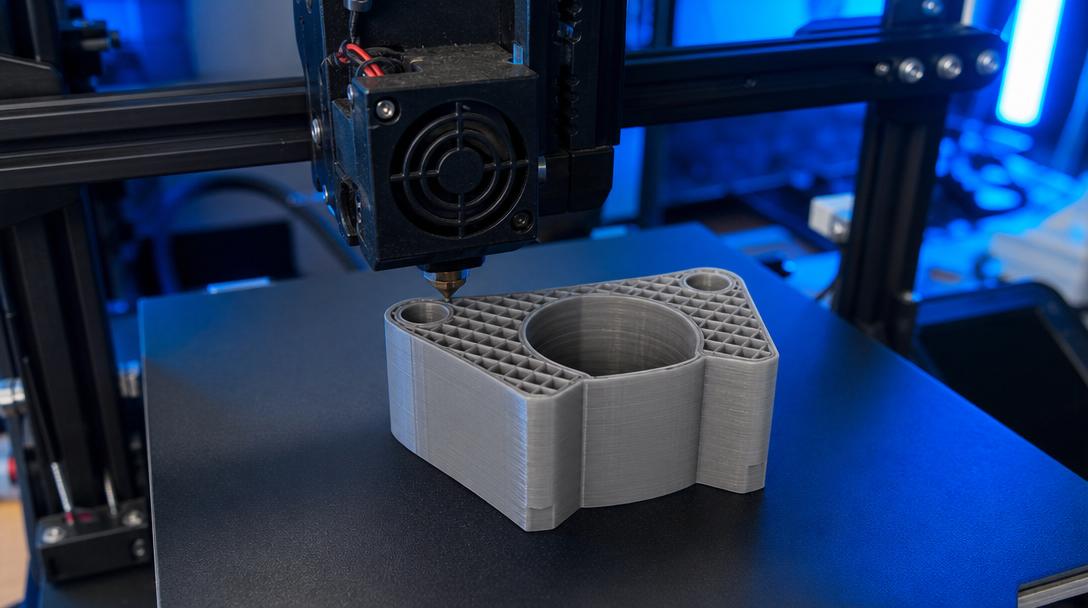
Wall count is the number of perimeter layers that form the outer shell of a part in FDM printing, and in most parts it affects strength more directly than infill percentage. Especially around screws, clips, thin arms, and impact-prone areas, choosing the right wall count instead of simply increasing the infill percentage gives more balanced and more predictable results.
Why is wall count so important?
In FDM parts, most of the load is first carried by the outer shell. That is why the difference between a print with 2 walls and one with 4 walls is not just “a slightly thicker surface”; crack initiation, edge stiffness, and the crushing behavior around screws also change. Many users increase infill from 20% to 60% when they need more strength; however, on the same part, using 4 walls instead of 2 is often the more sensible improvement. If you are planning to use a 3d printing service for a functional part, not only the material but also the wall-perimeter choice directly affects the result.
How many walls should be preferred for which part?
There is no single magic number; the right value depends on the job the part needs to do. Still, in practice, these ranges provide a good starting point:
- 2 walls: Light decorative parts, prototype appearance checks, and mock-ups under low load.
- 3 walls: General-purpose covers, boxes, simple fixture bodies, and mid-level functional parts.
- 4 walls: Parts with screw holes, snap-fit covers, enclosures that may be exposed to impact, and products handled by hand.
- 5+ walls: Arms that need to be thin but strong, mounting feet, structures that may remain weak because of print orientation, and applications that require higher stiffness.
The important point here is to consider wall count together with nozzle diameter and actual wall thickness. For example, with a 0,4 mm nozzle, 4 walls mean an outer shell of about 1,6 mm. If the total wall thickness of the part is 2 mm, very little room remains for infill; in some designs this can be an advantage, while in others it may mean unnecessary material consumption.
Should you increase infill percentage or wall count first?
In most functional FDM parts, it is more efficient to think about wall count first and infill percentage second. That is because infill fills the internal volume; it does not directly strengthen the outer surface, corners, and connection points. Especially around screws or in thin load-bearing areas, going from 3 walls to 4 walls may be more beneficial than increasing 20% infill to 40%. For this reason, when calculating part cost before printing, you should consider not only infill but also shell thickness; if you want, you can upload your model and get an instant quote to evaluate different production scenarios more clearly.
Which problems indicate the wrong wall choice?
After printing, some signs show that the perimeter count was insufficient. Whitening around the area when tightening a screw, easy crushing on the side wall, splitting along the layers in thin arms, and the infill pattern showing clearly beneath the surface are among the main ones. On the other hand, more walls than necessary are not always better; they increase print time, add weight, and create unnecessary cost in some parts. To choose the right wall count, it is also useful to take a look at the guide What Is Infill Percentage? Which Percentage Should You Choose?; because the best result is usually achieved by considering walls, infill, and print orientation together.
In short, one of the most practical ways to increase strength in FDM printing is not to blindly raise the infill percentage, but to choose the wall count that matches the job of the part. Especially in functional parts, this small adjustment can seriously change the service life of the print.


 Türkçe
 العربية
 Русский
 فارسی
فارسی Deutsch