
What Is Glass Fiber Reinforced Filament? What Does It Add in Dimensional Stability and Rigidity?
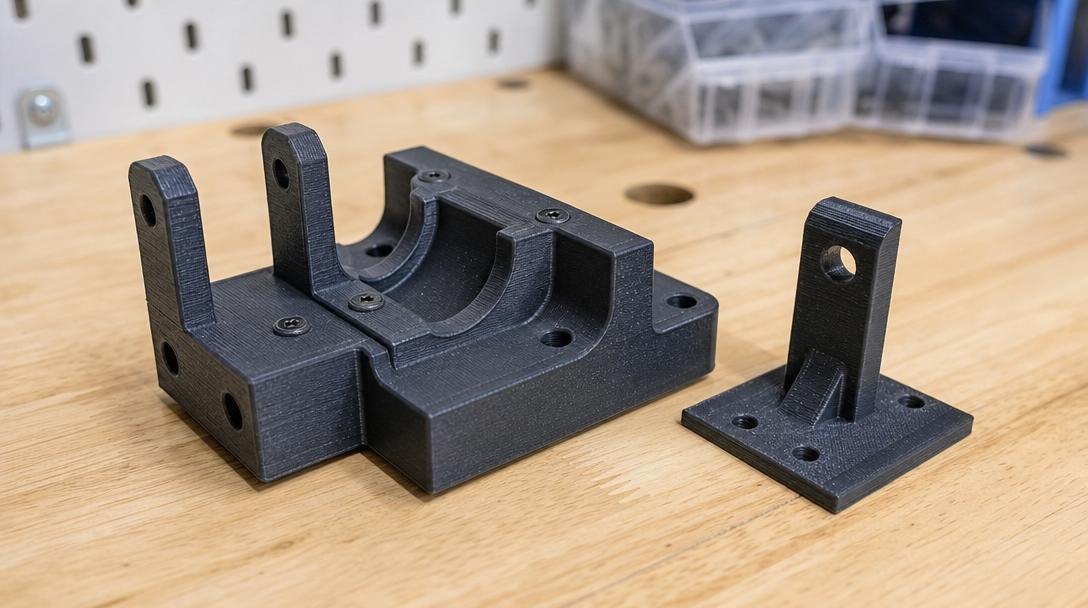
Although glass fiber reinforced filaments may not seem as popular as carbon fiber, they are an important category to pay attention to for technical parts. The real promise of these materials is not simply to be ‘stronger’; it is to provide more rigid behavior, more controlled form, and in some applications, more reassuring dimensional stability. That is why glass fiber reinforced options can make sense when getting 3d printing service for fixtures, apparatuses, gauge-holding parts, and structural support elements that are not supposed to flex.
What does glass fiber reinforcement do?
Reinforcement does not magically transform the behavior of the base polymer on its own; but in the right formulation, it can increase the sense of rigidity and reduce how much the part bends under load. This matters especially for parts such as alignment tools, assembly aids, jigs, or technical brackets that are expected to ‘hold their shape during use.’ In Ucuz3D’s approach to printing with engineering materials, glass fiber reinforced filaments are generally considered in the category of ‘more controlled, more technical FDM parts.’
So is it right for every job?
No. A glass fiber reinforced filament is not always the toughest, most impact-resistant, or most flexible solution. Especially in thin geometries such as snap-fit clips, constantly bending parts, or components that need to absorb impact, it may sometimes behave in the opposite way. In other words, choosing this material with the logic of ‘it looks premium, so it must be the best’ would be inefficient. If your goal is simply a quick prototype, a cosmetic mock-up, or a low-cost trial, standard materials may be a more sensible choice.
The production side also matters
With reinforced filaments, evaluation is not limited to part performance alone; nozzle wear, surface feel, and ease of processing should also be taken into account. In other words, the result is determined not only by the material’s name, but also by the production equipment and the discipline of the settings. To better understand where reinforced materials truly provide an advantage, the guide on Carbon Fiber Reinforced Filaments is also a useful reference in terms of logic, because it explains how the reinforced filament category should be approached.
When should it be considered?
- Should be considered: For jigs, apparatuses, and fixing parts where rigidity, shape retention, and a technical character are expected.
- Use caution: In thin geometries that need to absorb impact or flex continuously.
- May be unnecessary: For simple prototypes, visual models, or fast budget-sensitive trials.
In short, when used correctly, glass fiber reinforced filament can provide a more serious engineering feel that standard material cannot offer; but it does not automatically make every part better. Does the part need to resist bending, or does it need to absorb impact? That is exactly where the choice becomes clear. For the cost side, you can check the affordable 3d printing prices page, or upload your model through the online 3d printing flow and choose the right material based on your usage scenario.


 Türkçe
 العربية
 Русский
 فارسی
فارسی Deutsch