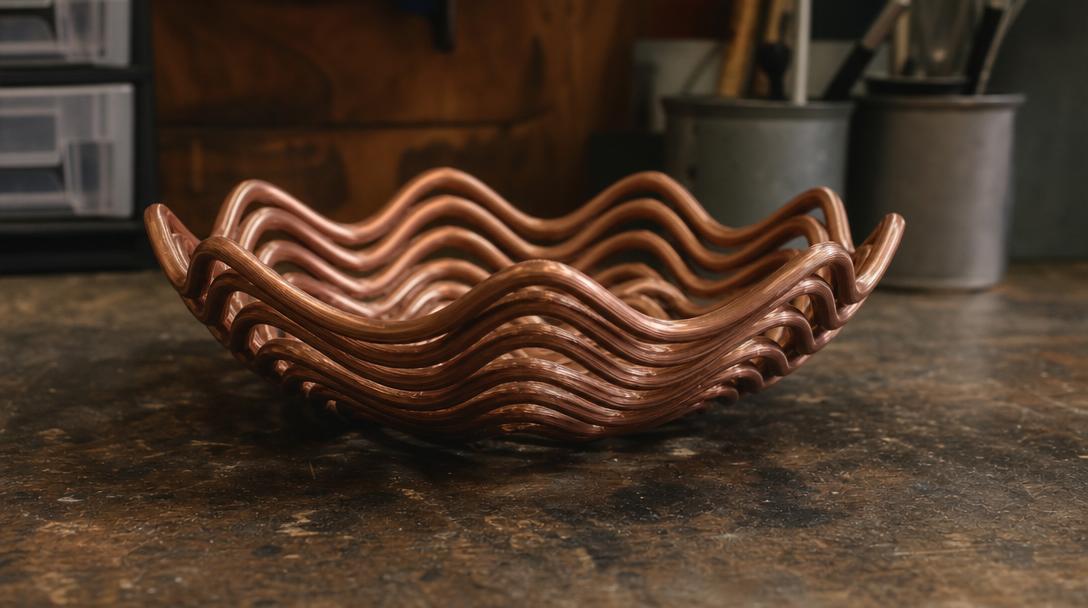

What Is Copper PLA and Metal-Filled Filament? What Is It Useful For in Decorative Parts?
Copper PLA and similar metal-filled filaments are among the materials most often misunderstood in the FDM world. The most common mistake is to think of these filaments as a ‘real metal part.’ In reality, what is being done here is adding additives to a PLA-based material that give it a metallic feel and visual character. As a result, you get a metal-looking FDM print, not a fully metal part produced by laser manufacturing. Once you make this distinction clearly, metal-filled options become very meaningful when getting 3d printing service for sculptures, decorative objects, custom presentation pieces, and aesthetic prototypes.
What is it useful for?
The strength of these materials is mostly on the aesthetic side: they provide a fuller look, a richer surface feel, and a character different from standard PLA. They can produce impressive results in vases, figurines, desktop objects, display products, exhibition prototypes, or visual samples to be presented to clients. Among Ucuz3D’s 17 material options, this class stands out in projects where ‘appearance and feel matter more than function.’
What is it not useful for?
The most important fact here is this: metal-filled filament is not a substitute for a real engineering part operating at high temperature. It creates unrealistic expectations for load-bearing structural elements, connections that will take heavy impact, or mechanical components expected to behave as rigidly as real metal. Also, choosing it just so it feels heavier is not always logical; because if the part’s use case calls for function rather than aesthetics, PETG, ASA, nylon, or PC will be the better choice.
The appearance advantage requires production discipline
In decorative filaments with metal additives, surface finishing, layer height, and final touches have a major effect on the result. When applied to the right part, it delivers a stylish outcome; when chosen with the wrong expectations, it leads to the question, ‘why didn’t it behave like metal?’ For this reason, the best approach is to think of this class not as a technical tool, but as a decorative and presentation-focused one. To read the topic in a broader context, the guide Wood PLA and Decorative Metal-Filled Filaments is a good complement.
When does it make sense?
- Makes sense: Decorative objects, aesthetic prototypes, gift products, display, or presentation pieces.
- Limited: Parts with light functional use but where appearance matters more.
- Doesn’t make sense: Hot, load-bearing, or safety-critical technical parts where real metal behavior is expected.
In short, Copper PLA and metal-filled filaments are very powerful tools for achieving a different surface language with FDM; but they are not engineering solutions to be used in place of real metal. If your goal is visual impact rather than technical performance, this material class creates serious value. You can first look at the price per gram approach, and then upload your model in the online 3d printing workflow to decide correctly based on whether it is decorative or technical.



 Türkçe
 العربية
 Русский
 فارسی
فارسی Deutsch