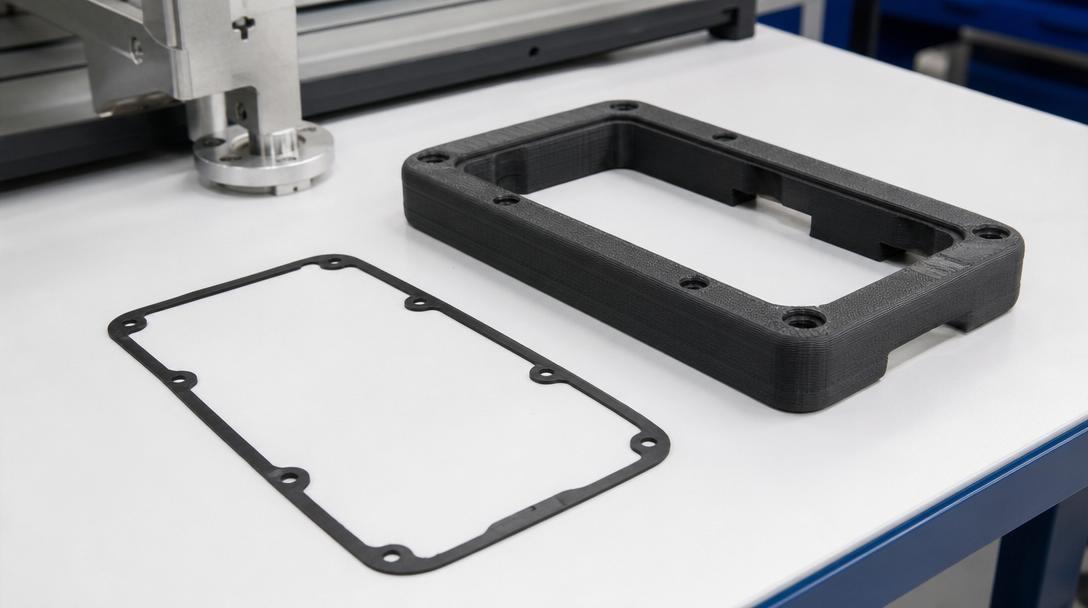

What Is TPC Filament? When Does It Make Sense for Flexible and Wear-Prone Parts?
TPC filament is generally not as popular as TPU, which is usually the first material that comes to mind when people think of flexible materials; but that does not make it unimportant. The value of TPC is not only that it can bend; in some scenarios, it can offer a more technical, more durable, and longer-lasting approach to flexible parts. That is why, when it comes to gaskets, cable protectors, impact-absorbing bumpers, flexible feet that work under friction, or semi-elastic technical support parts, TPC may come up when getting a 3d printing service.
What is TPC used for?
TPC is considered for applications that require flexibility, recovery, and a certain degree of wear resistance. In other words, it is not just about the idea of a soft phone case. It can make sense for some industrial bumpers, protective corners, flexible connector spacers, and support parts that remain in continuous contact. In Ucuz3D’s material approach, this type of work is often evaluated under flexible technical solutions within our 17 material options.
Why choose TPC when TPU exists?
Not every flexible part needs the same behavior. TPU is more common and a strong starting point for most jobs; however, in some scenarios, TPC can offer a more technical balance against friction and fatigue. How much the part really needs to flex, whether it will work under constant load, whether it will rub against a surface, and how much heat it will see all affect the choice. The critical point here is this: flexible material selection should not be based only on Shore feel, but on the actual way the part will be used.
Not the right answer for every flexible job
TPC is not always the easiest material to print or the most economical option. For a simple, low-risk flexible part made mainly for visual purposes, it can often be unnecessary. If the expectation is for an extremely soft product that instantly changes shape when squeezed by hand, different material families may be needed. In addition, in flexible filaments, extrusion behavior, feeding stability, and part geometry choice seriously affect the result. That is why choosing only the material name is not enough; the production method must also be compatible. For a broader look at the topic, the guide TPU and Flexible Filaments: Where Are They Used? provides a good foundation.
When does it make sense, and when is it unnecessary?
- Makes sense: Flexible but technical support parts exposed to friction or impact.
- Use caution: Very thin-walled geometries that require control during printing.
- May be unnecessary: Low-risk visual products that only seek a simple soft feel.
In short, TPC is not just ‘a cooler name for TPU’; it is a niche tool with serious advantages in the right job. If the part will flex continuously, make contact, or need to work not just once but repeatedly, TPC is worth evaluating. As a first step, it makes the most sense to look at the price per gram logic, then upload your model in the online 3d printing flow and describe your flexibility needs.


 Türkçe
 العربية
 Русский
 فارسی
فارسی Deutsch