What Does the Visitor Increase at Formnext Asia Shenzhen 2026 Tell Us? Additive Manufacturing Is Moving Closer to Production in China
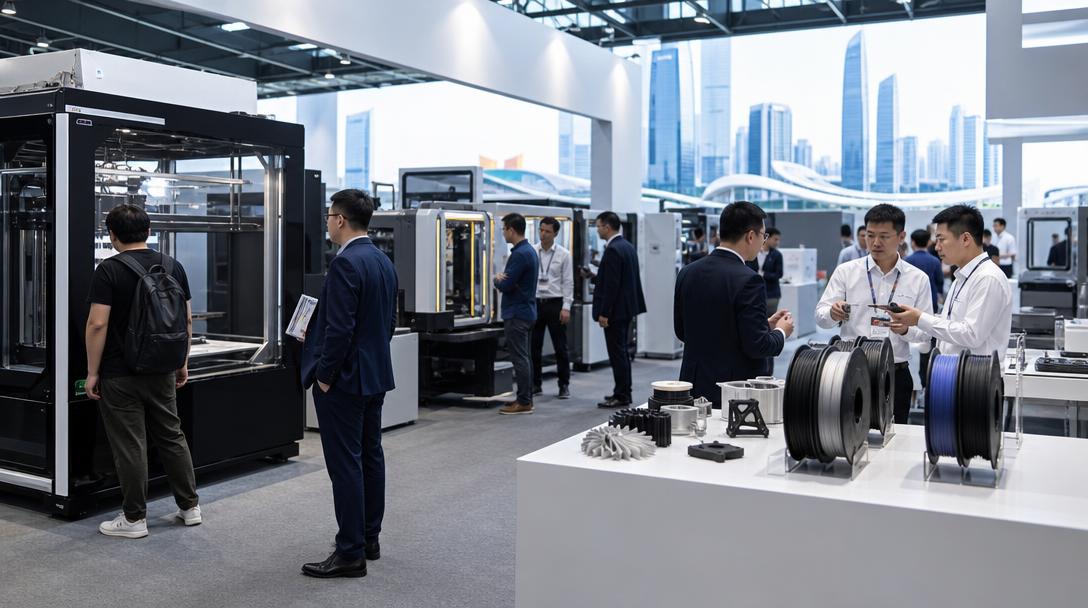
Formnext Asia Shenzhen 2026 brought additive manufacturing back into focus on Asia’s production agenda through attendance figures released after the event, which ended on 28 August. According to a 3D Printing Industry report dated 9 September 2026, the trade show attracted 34,202 visitors from 113 countries and regions. This represents a 65% increase compared with the 2025 edition, while the number of international visitors rose by 157% to 1,887. The figures alone do not prove sales or technological success, but they provide a strong industry signal that FDM and other additive manufacturing solutions are being evaluated within a broader production ecosystem.
The real significance of the increase: diversity among decision-makers, not just more visitors
Formnext Asia Shenzhen is not simply a showcase for new printers. The event brings machine manufacturers, filament and granule suppliers, software developers, production service providers and end users together on the same platform. For this reason, the rise in attendance may indicate that additive manufacturing is no longer being assessed solely as a decision to purchase a single device, but rather in combination with the production line, material supply and quality management.
For Ucuz3D readers, the practical takeaway is this: Evaluating a printer solely by its build volume or print speed is becoming increasingly inadequate. Filament consistency, the verifiability of material profiles, access to spare parts and service, and how repeatable the workflow is from file to finished product are also becoming part of the decision. Even with desktop FDM systems, this approach determines the difference between a prototype and a functional part used regularly.
Which signals should be monitored on the FDM side?
The event data does not indicate that any particular FDM model is better. Nevertheless, growing international interest highlights several areas that FDM users should follow. The first is the material ecosystem: For PLA, PETG, ABS, ASA, TPU and reinforced filaments, it is important to look beyond catalogue claims and consider the profile provided by the manufacturer, drying requirements and conditions for use after printing. The second is production repeatability. If you are going to print the same part multiple times, bed consistency, temperature control, filament diameter stability and the slicer profile are more valuable than a single attractive print.
The third area is service and cost calculation. Not every part has to be printed on a desktop printer; depending on the geometry, quantity, tolerances and material requirements, a professional 3D printing service may be a more rational option. Before placing an order, understanding the price per gram approach and the impact of part design on the total cost provides a healthier comparison than looking only at the price of a filament spool. If your file is ready, you can also make a quick preliminary assessment through the online 3D printing process.
What does the news mean for users in Turkey?
The increase in attendance in Shenzhen should not be interpreted as meaning that the Turkish market will grow at the same rate tomorrow. The event’s figures may have been influenced by regional trade-show dynamics, company announcements and visitor-counting methods. However, the rise in international participation suggests that supply chains and production partnerships are gaining greater visibility. This could make it easier to compare different material and service options, particularly for low-volume production, rapid prototyping and spare parts.
When choosing an FDM material, you can review our printing materials as a basic reference, then make your decision based on the part’s requirements for outdoor use, heat, impact and rigidity. Ultimately, the most important message from Formnext Asia Shenzhen 2026 is not a single new printer: Additive manufacturing is moving beyond the prototyping desk and toward a broader ecosystem where production decisions are made. For users, the right response is to define their needs and production workflow using measurable criteria before focusing on the latest device.


 Türkçe
 العربية
 Русский
 فارسی
فارسی Deutsch