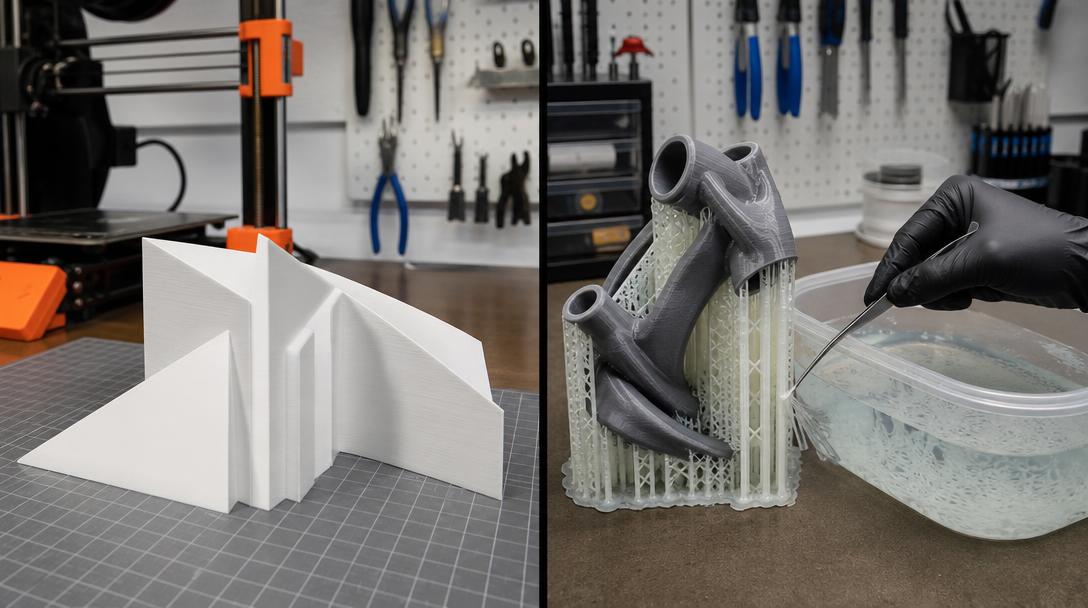
PLA or PVA? Main Part or Clean Support?
PLA and PVA are two materials that serve different purposes in FDM printing. PLA is a rigid, easy-to-print option for models, prototypes, decorative objects, and everyday accessories, while PVA is mainly used to create clean supports for complex geometries. Therefore, the choice should depend on whether you are producing the part itself or the support structure that holds it up.
What is PLA used for?
PLA is a filament frequently used by those new to FDM, thanks to its low tendency to shrink and broad printer compatibility. It is suitable for visual prototypes, boxes, dimensional inspection models, and lightweight functional parts that are not exposed to high temperatures. Its rigid structure makes dimensional control easier; however, it should be remembered that it may soften in hot environments and may not be ideal for continuous outdoor use.
PLA’s main strength is its ease of printing. When the bed is properly calibrated, surface quality and detail reproduction are generally satisfactory. Nevertheless, parts exposed to impact, high heat, or prolonged sunlight may require an alternative material. The part’s actual operating conditions should be the deciding factor.
What is PVA used for?
PVA is a water-soluble support filament. It is especially used to support internal channels, complex overhangs, or areas where you do not want marks from contact between the main material and the support. Its ability to be removed with water under suitable conditions after printing provides a significant advantage for geometries where breaking away supports by hand is difficult.
PVA is generally not chosen as a main part material. Since it tends to absorb moisture, dry storage and drying before printing are very important. Wet PVA can cause bubbles, irregular flow, and weak support structures. In addition, the dissolution time varies depending on the part geometry, water temperature, support density, and amount of material.
Comparison of outdoor use, heat, impact, and rigidity
PLA produces a rigid part that retains its shape, but it carries a risk of deformation at high temperatures. Since PVA’s primary function is to support the part, comparing it in terms of outdoor use, impact, or structural load is usually not meaningful. Because PVA can dissolve in water, it should not be considered a permanent part material for damp or rainy environments.
If you are looking for flexibility between these two options, PVA is not the solution. PVA is intended as temporary support that will be removed with water, while PLA is used for a rigid and permanent model or lightweight accessory. If high heat or impact resistance is required, consider a different engineering material.
Printing ease and cost considerations
PLA offers an easier, lower-risk starting point on single-nozzle printers. PVA, on the other hand, usually requires dual-material or multi-tool support, compatible temperatures, and properly dried filament. Support removal may become faster; however, moisture management and additional material consumption can increase the total cost of PVA.
The economic rationale for using PVA is that it allows you to print an expensive part in a single run and cleanly remove supports that cannot be detached by hand. PVA may create an unnecessary cost for a simple geometry. For a complex model, however, it can reduce failed prints or lengthy post-processing.
Which one for which part?
- Choose PLA: If you are printing a rigid prototype, model, decorative object, or lightweight accessory that will operate at low temperatures.
- Choose PVA: If you need supports beneath or inside the main part that can be removed cleanly.
- Use both together: If you want to combine a PLA part with complex support geometry in a single printing workflow.
To view suitable products, you can browse our printing materials. To send your model for production, you can proceed through the 3d printing service page and evaluate the price per gram model. If your file is ready, you can get an instant quote through the online 3d printing tool.
In summary, PLA is a practical and rigid choice for the part itself, while PVA serves as temporary support in complex FDM prints. It is more accurate to view these two materials not as competitors, but as options that complement each other in the right design.


 Türkçe
 العربية
 Русский
 فارسی
فارسی Deutsch