How Could EWI’s $13.2 Million INSITE Project Transform Quality Control in Additive Manufacturing?
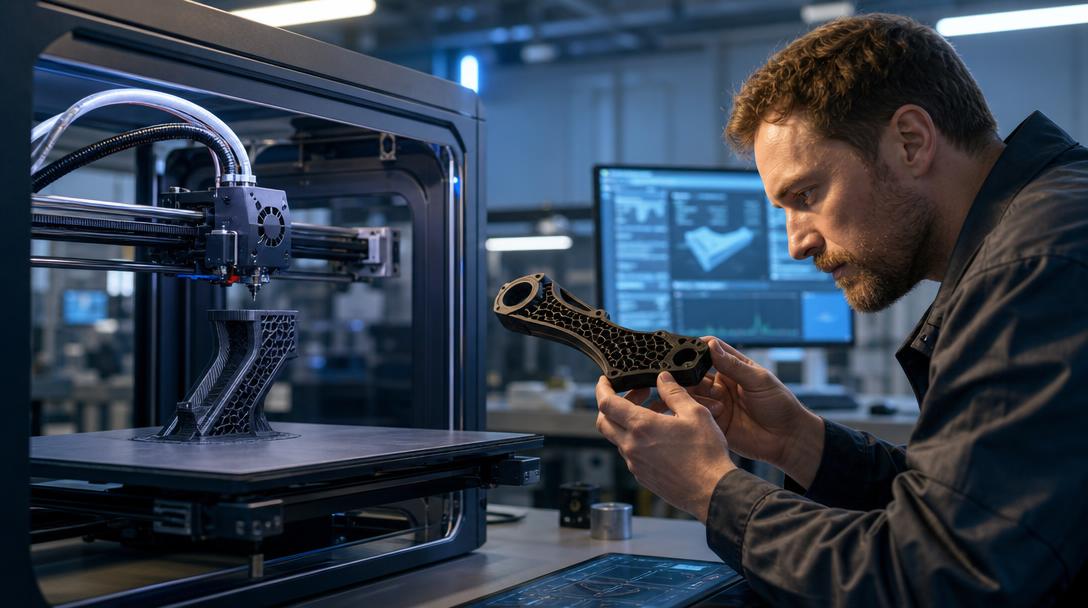
One of the most important questions when moving additive manufacturing to the production line is how reliable a part is during and after printing. America Makes and the National Center for Defense Manufacturing and Machining (NCDMM) have selected EWI as the lead organization for a new $13.2 million project aimed at answering this question. Called INSITE, the project seeks to combine real-time monitoring of additive manufacturing processes with post-production assessment within a unified quality assurance approach.
Source and date: VoxelMatters, “EWI to lead $13.2 million America Makes AM quality assurance project”, September 9, 2026. The project announcement states that EWI will develop an integrated system combining in-process monitoring and quality assessment.
What is the INSITE project trying to solve?
In an FDM part, interlayer bonding, temperature balance, cooling behavior and geometric deviations can affect the production result. In industrial systems, checking these variables only after printing is complete can lead to errors being detected too late and the part having to be manufactured again. The INSITE approach focuses on reducing this delay by linking data collected during production with quality assessment.
The report indicates that the project aims to establish a quality assurance infrastructure that can be applied to different additive manufacturing processes. This points to a broader goal than a simple camera inspection system designed for a single printer: a common framework that links process data with part acceptance criteria and production decisions.
What it means for FDM users and production teams
The project does not directly offer a new profile or settings package for desktop FDM printers. Nevertheless, its results could be important as FDM progresses from prototyping to functional parts and low-volume production. In particular, monitoring small differences between printers becomes critical for maintaining quality in production farms where many copies of the same part are printed.
- Errors could be detected earlier: The goal is to identify abnormalities caused by layers, temperature or movement while printing is still in progress.
- Repeatability could improve: Measurable process data can be used to help the same part produce similar results on different machines.
- Traceability could increase: Production records can be assessed together with material and machine information to support quality decisions.
- Reproduction costs could decrease: Instead of detecting every error at the end of the print, a problematic process could be stopped or separated at an earlier stage.
What does this development mean for someone placing an order today?
For a part made at home or in a workshop, relying solely on an expensive monitoring system is not the right approach. Keeping the material dry, verifying bed and temperature settings, observing the first layer and checking dimensions are still essential steps. However, as production volume increases, recorded process data and standardized acceptance criteria become more meaningful alongside manual inspection.
If the intended use, load and operating environment of your part are clear, you can review engineering materials options to determine the appropriate material and production method. When ordering a professional 3d printing service for a prototype, fixture or spare part, it is also important to share your expectations regarding print orientation, tolerances and quality control from the outset.
During the quotation stage, do not make the price per gram approach your only decision criterion; part geometry, production time and inspection requirements can affect the total cost. If your file is ready, you can upload the model through the online 3d printing process and evaluate the available options.
Which data will be important in practice?
Collecting images alone may not be sufficient for a quality assurance approach to deliver value. Print temperature, bed conditions, layer time, machine identity, material lot and part measurements should be considered together. This makes it easier to investigate whether a deviation originated from the printer, the filament, the design or environmental conditions. Such a record-keeping system can strengthen process discipline even for non-critical but repeatedly produced fixtures and enclosure parts.
Conclusion
The EWI-led INSITE project aims to accelerate additive manufacturing’s transition from simply printing parts to data-driven and verifiable production. The project’s practical results will become clearer over time; however, its $13.2 million scale shows that quality assurance is no longer a secondary concern in additive manufacturing, but is being treated as a fundamental component of the production line.


 Türkçe
 العربية
 Русский
 فارسی
فارسی Deutsch