
What Determines 3D Printing Cost?
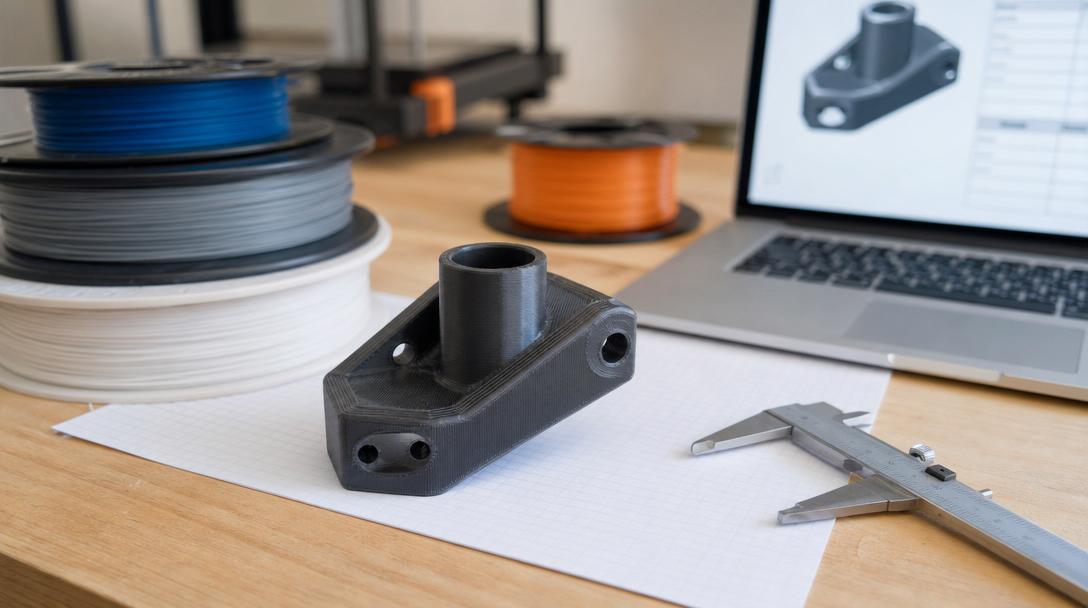
How is 3D printing cost calculated? First, it is important to know this: the cost is determined by the part’s weight, the filament used, print time, support requirements, and how urgent the job is. The most accurate price comes from reviewing the model itself and calculating the technical details; that is why an instant price calculation is always more reliable than a random estimate.
Especially in FDM printing, cost is not tied to a single item. Two parts of the same size can be priced very differently if one has thin walls and no supports, while the other has thick walls and needs a lot of support. For that reason, the question “how many grams will it be?” is important, but it is not enough on its own.
Main factors that determine the cost
- Part weight: The most basic item is filament consumption. As the grams increase, the total cost rises.
- Material type: Filaments such as PLA, PETG, ABS, TPU, nylon, or polycarbonate create different price points and levels of processing difficulty depending on the intended use.
- Infill ratio: Low infill may be enough for decorative parts, while functional parts may require a higher infill.
- Support structures: Complex geometry means more support and a longer print time.
- Print time: When the machine runs for hours, it affects the overall production cost of the job.
The most critical point here is this: a model that looks cheap can actually end up being more expensive because of support and reprint needs. The reverse is also possible; a smartly designed part can reduce cost by using less material.
When does the price go up?
The price usually increases when the part is very large, requires high precision, contains fine details, needs a flexible or engineering material, or has a very short delivery deadline. Another important point is whether the design is suitable for printing. A poorly oriented model may require too much support and surface cleanup.
That is why reducing cost calculation to only the question “how much is the filament?” is not correct. The part’s function, its operating environment, and the expected durability level also directly affect the price. For example, a fixture, a cover, and a prototype may all have the same weight, yet they will not be priced the same way.
Making the part suitable for printing is the invisible side of cost. If hole tolerances, wall thickness, orientation, and surface quality are considered from the start, the amount of support decreases, print time shortens, and the risk of failure drops. In FDM-focused production like Ucuz3D, a well-prepared file is often the fastest way to improve cost efficiency.
What should the practical approach be?
The cleanest method is to first define the part’s purpose, then choose the appropriate material and print settings. If you only want a rough idea, you can quickly see an initial estimate with the instant price calculator. To see the transparent approach based on grams, our per-gram prices are also a good reference.
For jobs such as functional parts, prototypes, enclosures, or spare parts, choosing the right service area is important; that is why the 3D printing service page is useful for understanding what kinds of jobs can be produced with FDM. If you want to see the logic of cost from a more technical perspective, the guide How Is 3D Printing Cost Calculated? also explains the topic step by step.
In short, 3D printing cost is not random; it is the result of a balance between dimensions, material, time, and labor. The right design and the right material choice mean both a better part and a more controlled budget.



 Türkçe
 العربية
 Русский
 فارسی
فارسی Deutsch