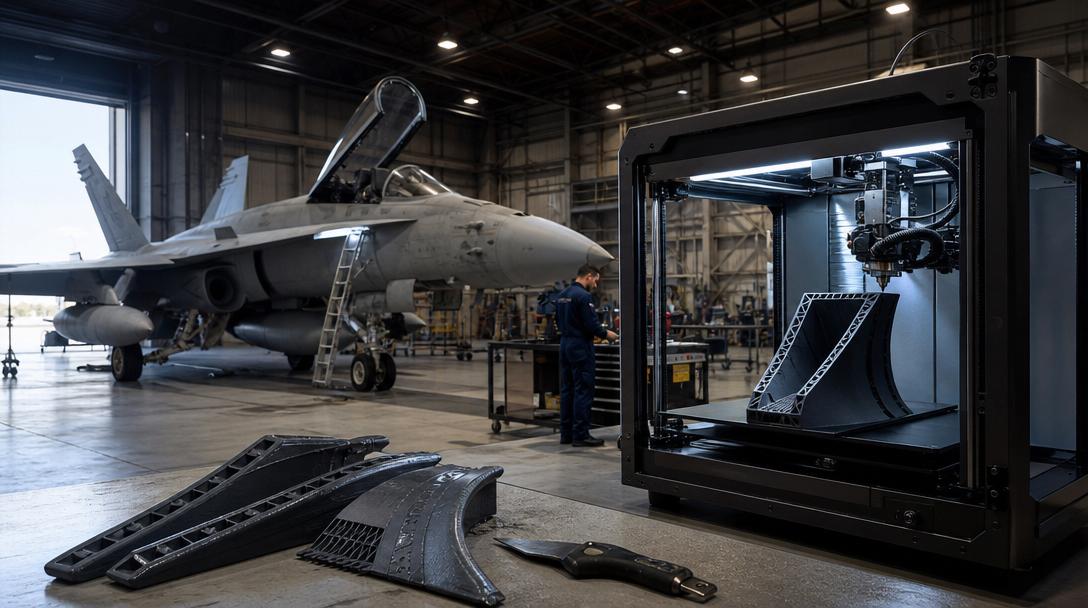

What Do 3D-Printed Composite Repairs Change on F/A-18 Super Hornets?
The U.S. Navy’s flight testing of 3D-printed composite repairs on F/A-18 Super Hornets once again shows that additive manufacturing is no longer just about making prototypes. The main message in the report is very clear: forward-deployed 3D printers can cut some tasks in half by producing parts and repair solutions that speed up the maintenance process.
This development explains why additive manufacturing in the defense industry is growing so quickly. Especially on platforms with high operational tempo, the time between waiting for a part and producing it on site directly affects mission readiness. Even a few hours gained on fighter jets like the F/A-18 can change maintenance planning, inventory management, and fleet availability.
Why does it matter?
- Maintenance cycles get shorter: Instead of waiting for parts from distant depots, suitable solutions can be prepared faster.
- The digital inventory model gets stronger: For low-volume but critical parts, production-ready digital models come to the forefront instead of physical stock.
- Repair flexibility increases: Parts such as covers, ducts, brackets, and maintenance aids can be turned around much faster.
- Field operations become easier: As the logistics chain gets shorter, maintenance teams can work more agilely.
There is an important distinction here: not every 3D-printed part has to be a final flight part on the aircraft. Most of the time, the real value appears in measurement verification, assembly aids, test fixtures, cable-routing parts, protective housings, and maintenance support components. In other words, the real significance of the news is that the technology is moving beyond a “demo” level and becoming an operational tool.
The same approach also works on the daily production side. The 3D printing for spare part production approach follows a very similar logic when reproducing a broken cover, bringing a discontinued part back to life, or quickly printing an intermediary part needed in the field: shorten the time, speed up the job, keep the system running.
What does this say about FDM?
News like this also reminds us why FDM is still so powerful. Metal end-part production and desktop FDM are not the same thing; however, when it comes to rapid iteration, part fit, maintenance tooling, and production aids, FDM offers a very serious advantage. Especially for durable prototypes, fixture solutions, covers, duct parts, and service support components, FDM is still one of the most practical options.
That is why anyone looking to get 3D printing service for similar work needs to think about the entire workflow, not just the final part. Measuring, design validation, material selection, and, if needed, re-production are what create the real difference in fast solutions. Sometimes the most valuable output is not the part itself, but the right workflow that shortens production time.
In short, the F/A-18 Super Hornet tests show how strategic 3D printing has become in defense maintenance. This story is a strong example of how 3D printing can create value not only at the prototype table, but right in the middle of operations as well. If the goal is to reduce waiting and speed up part access, the role of additive manufacturing will only continue to grow.


 Türkçe
 العربية
 Русский
 فارسی
فارسی Deutsch