What Could the 3D Systems and Savannah River National Laboratory Partnership Change for Energy and Manufacturing in Additive Manufacturing?
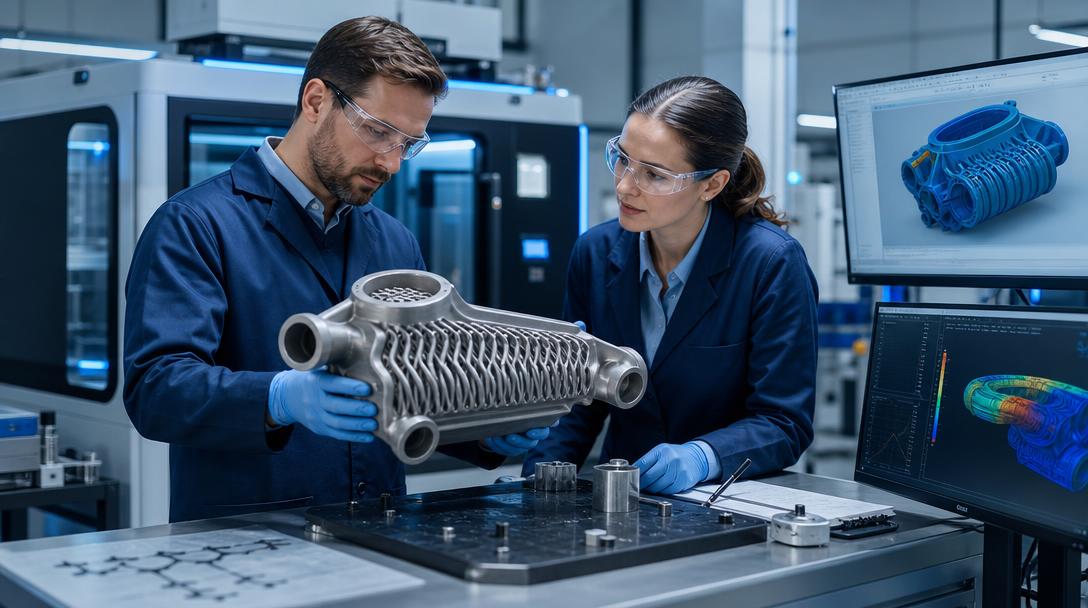
3D Systems and Savannah River National Laboratory (SRNL) have signed a collaboration agreement aimed at bringing additive manufacturing technologies to advanced energy production and high-responsibility industrial applications. Announced by TCT Magazine on September 7, 2026, the Cooperative Research and Development Agreement (CRADA) seeks to shorten the gap between laboratory research and production-ready processes.
What is the focus of the partnership?
The work will be carried out through the Advanced Manufacturing Collaborative facility at SRNL. According to the announcement, the two organizations will work together on areas including materials development, equipment improvement, process optimization supported by artificial intelligence and machine learning, production systems, cybersecurity, and workforce training.
This scope is broader than simply introducing a new machine or material. The aim is to transform ideas validated in the laboratory into traceable, repeatable, and scalable production processes. Supporting the work with the facility’s equipment and expertise could also enable research results to be tested under real production conditions.
Why is this important for energy components?
In advanced energy systems, parts such as heat exchangers, pumps, valves, and reactor components may require complex internal channels, high-temperature resistance, or specialized alloys. Additive manufacturing has the potential to address such geometries with greater design freedom than traditional manufacturing methods. However, being able to print a part in a laboratory is not the same as putting it into reliable production. Material behavior, the process window, measurement, quality assurance, and validation under operating conditions must all be evaluated together.
This is where the notable aspect of the 3D Systems and SRNL partnership emerges: rather than focusing on a single prototype, the announcement points to a roadmap that addresses materials, process control, and production infrastructure within the same framework. The installation of the company’s equipment at the Advanced Manufacturing Collaborative facility indicates that production-focused demonstrations could be carried out in later stages; however, it is not yet clear when commercial results will emerge or which parts they will involve.
What can FDM users learn from this development?
This work is not directly about choosing desktop FDM filament; nevertheless, it offers an important lesson for those who use FDM printing. Better results come not only from a printer capable of reaching higher temperatures, but from combining the material profile, temperature management, interlayer bonding, measurement, and process monitoring. Even when producing a small fixture or prototype, you should consider the print orientation, wall structure, tolerances, and the part’s actual operating environment from the beginning.
Especially for functional parts, do not choose a material based solely on the strength claim in the catalog. When reviewing printing options with engineering materials, evaluate heat, impact, rigidity, moisture, and printability together. If you need a simple prototype, enclosure, fixture, or replacement part, you can clarify the right material and production orientation with a 3D printing service.
Conclusion: The transition from research to production will be decisive
The 3D Systems–SRNL agreement shows that additive manufacturing is being approached not merely as printing hardware but as an end-to-end production system in challenging fields such as energy infrastructure. In the coming period, the main criterion will not be the announcement of new materials, but whether parts produced with these materials can deliver verifiable quality, reliability, and continuity of supply.
To assess whether the part you want to have produced with FDM is suitable, you can review the per-gram pricing model on the affordable 3D printing prices page, then upload your file to the online 3D printing tool to get an instant quote. For a broader understanding of the subject, the Additive Manufacturing Glossary is also a useful starting point.


 Türkçe
 العربية
 Русский
 فارسی
فارسی Deutsch