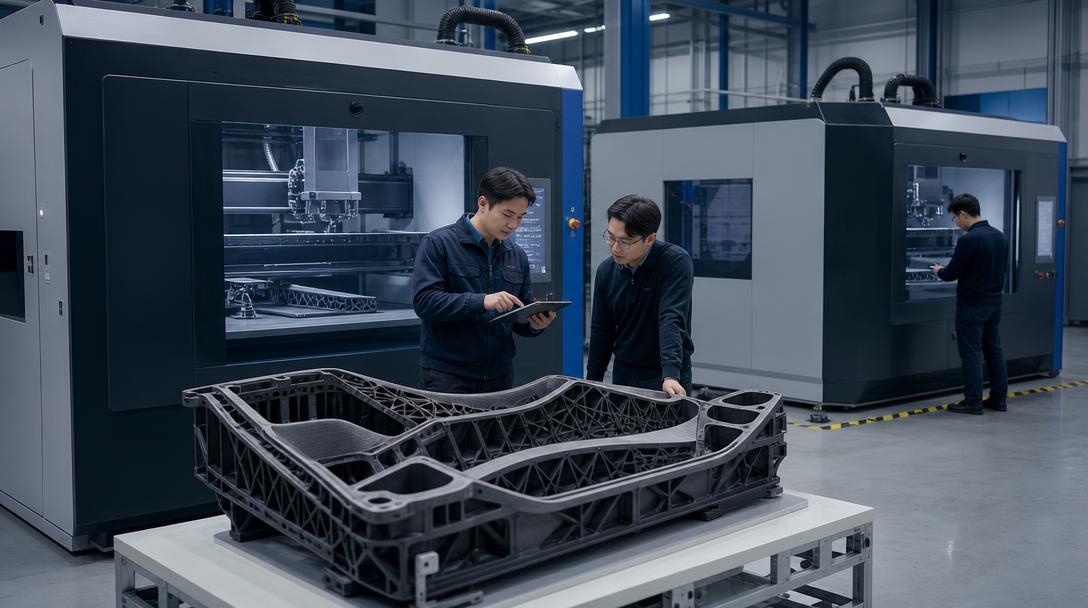
Hyundai Moves into HSS Polymer Production with Two ExOne VX1000 Printers: What Does It Mean for 3D Printing in Automotive?
Hyundai has announced that it has installed two ExOne VX1000 high-speed sintering (HSS) systems to prepare large and complex polymer parts more quickly in automotive manufacturing. According to a TCT Magazine report dated September 8, 2026, the technology will be used particularly to produce large parts that could reduce assembly work and limit issues such as tolerance stack-up. This development shows that 3D printing is being evaluated not only at the prototyping stage but also in more functional parts of the automotive production flow.
Why is Hyundai turning to HSS-based polymer printing?
Unlike conventional FDM printers that create layers by melting filament, the ExOne VX1000 is a production system that operates on a polymer powder bed. For this reason, the technology described in the report is not directly part of the FDM category; however, it is an important example for understanding which manufacturing needs 3D printing can address in the automotive industry. The HSS approach offers the potential to produce parts with large surfaces or complex geometries in a single production flow, nest parts together and reduce assembly steps.
In Hyundai’s announced use case, the main value is not simply being able to print a part. Reducing the number of parts, preventing tolerances from accumulating across connected components and testing design changes without investing in moulds may provide more tangible benefits for production teams. Of course, the actual benefit will vary depending on the part geometry, material selection, surface requirements and post-processing needs.
What is the practical impact on automotive manufacturing?
- Large and complex parts: Designs that combine multiple parts into a single body can reduce connection and assembly work.
- Less tolerance stack-up: The total dimensional deviation of components produced separately and assembled later can create problems in some designs. A single-part approach may help reduce this risk.
- Faster design validation: Changes made to a prototype or production tool can be tested through shorter iterations than with the traditional moulding process.
- Low- and medium-volume production: Additive manufacturing can be a more flexible option for specialised parts, customised components or production-line equipment where mould costs are not justified.
These points also reflect a familiar decision-making logic for workshops using desktop FDM printers: the goal is not merely to produce a print, but to simplify the part’s overall manufacturing and assembly process. When designing a fixture, jig or cover to be produced with FDM, reducing the number of parts is often a step that should be considered before material selection.
What can FDM users learn from this development?
Hyundai’s investment does not mean that every part needs to be produced with a high-speed sintering system. FDM remains an accessible method for affordable and fast prototypes, measurement-checking fixtures, cable-routing parts, enclosures and low-volume replacement parts. The choice between PLA, PETG, ABS, ASA or engineering materials should be made by evaluating the environment, heat, impact, rigidity and printing conditions together.
When preparing a part for production, you can review our printing materials and choose the FDM option suitable for your use case. The part’s print orientation, number of walls, connection points and post-processing requirements are at least as important as the printer technology. When you want a professional result, you can leave the production process to an expert team through our 3D printing service, review the per-gram pricing model and start by evaluating your model through the online 3D printing tool.
Conclusion: The production flow matters more than the printing technology
Hyundai’s adoption of two ExOne VX1000 systems shows that the value proposition of additive manufacturing in the automotive industry is not limited to rapid prototyping. The goals of reducing assembly, limiting tolerance accumulation and responding more quickly to design changes are making 3D printing part of production engineering. The same approach applies to FDM: with the right material and design, printing is not a product on its own; it can be a tool for creating a shorter, more flexible and more manageable production flow.


 Türkçe
 العربية
 Русский
 فارسی
فارسی Deutsch