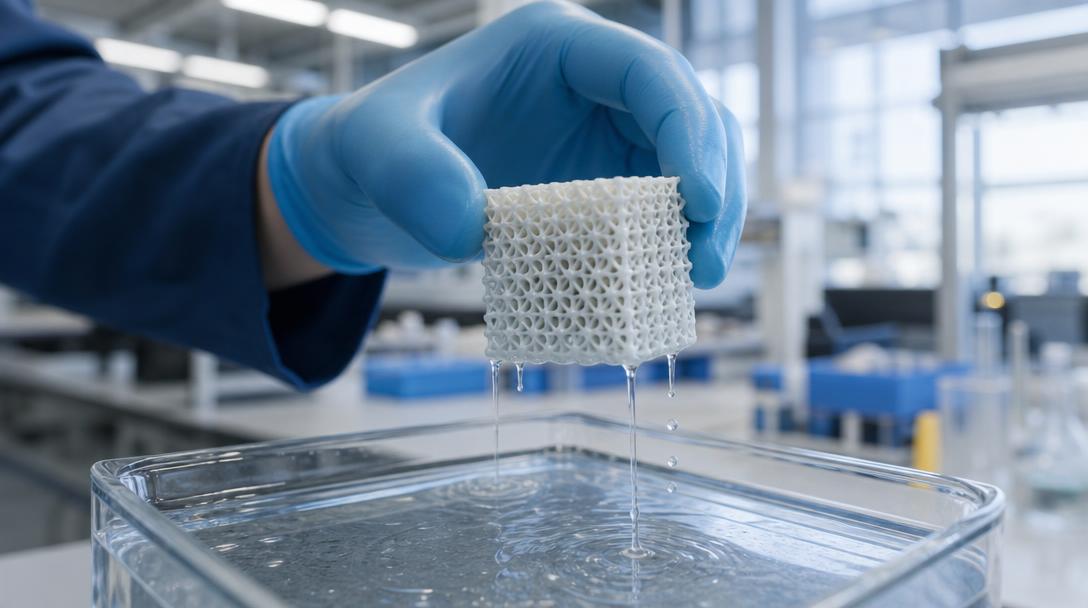
Waterloo’s 3D-Printed Water Filter Aims to Capture 90% of Microplastics
A 3D-printed water filter developed by University of Waterloo researchers is a noteworthy example of how pore geometry can be used to separate microplastics from water. According to a 6 October 2026 report by 3D Printing Industry, the study reports capturing 90% of microplastics using a specially designed grid structure and a support that keeps the part oriented correctly. This result is a performance figure reported under laboratory conditions; on its own, it does not mean the filter is a certified product that makes drinking water safe.
Why is 3D printing useful for the filter’s design?
Filtration performance depends not only on the material used but also on the shape of the paths water flows through. The approach highlighted in the study uses offset grid geometry to direct the flow and increase the likelihood of particles being captured. Defining complex channels like these in a digital model and producing them as a single part is a good example of the flexibility additive manufacturing offers for research prototypes.
With traditional methods, producing small, repeating channels may require a mould or several operations. 3D printing can make it easier to quickly modify the design and compare different geometries. However, being printable does not automatically mean a part is cheaper, longer-lasting, or ready for mass production. Clogging behaviour, flow rate, pressure drop, cleanability, and prolonged contact between the material and water must also be evaluated.
How should the 90% result be interpreted?
The 90% figure reported in the article is presented as the microplastic capture rate achieved by the study under specific test conditions. Factors such as particle size and shape, water flow rate, filter usage time, and the test setup can affect the result. Therefore, the figure should not be interpreted as a guarantee of the same performance for every water source or household use scenario.
Further validation is needed before moving from a prototype filter to everyday use. This includes repeated tests with particles of different sizes, long-term use, performance after cleaning, and the transfer of substances from the printed part into the water. For drinking water applications in particular, suitability and health assessments are separate requirements in addition to geometric performance. The research report is not a product recommendation; it points to a design opportunity.
What can we learn from an FDM perspective?
The study does not show that every filter prototype can be produced directly with desktop FDM; the manufacturing technique and material details in the paper may vary depending on the application. However, at the concept stage, designing and rapidly prototyping parts such as flow channels, lattices, or supports using a 3D model is one of FDM’s strengths. FDM prototypes can be useful for testing a design’s dimensions and assembly, but fine filtration performance and suitability for food or drinking water require separate validation.
For similar projects, the right place to start is by defining the function and test criteria, then assessing whether the geometry can be manufactured. Transitions, wall thicknesses, and print orientation can affect both strength and channel formation. You can explore FDM printing materials and read the print orientation guide to learn how part orientation and layer arrangement affect the result.
From research prototype to functional part
The broader takeaway from the water filter example is that 3D printing can be used not only to test shapes but also to evaluate functions such as flow and assembly. Even so, testing and certification determine the difference between a research prototype and a product suitable for reliable use. If you would like to assess whether a part such as a filter, housing, or test fixture can be manufactured with FDM, see the process information on the 3D printing service page. If your file is ready, you can start a calculation on the affordable 3D printing prices page and use the 3D printing price calculator there. You can also discuss whether your model is suitable for FDM with a free consultation before production.


 Türkçe
 العربية
 Русский
 فارسی
فارسی Deutsch