TPE or ASA? Flexible Protection or a UV-Resistant Rigid Part?
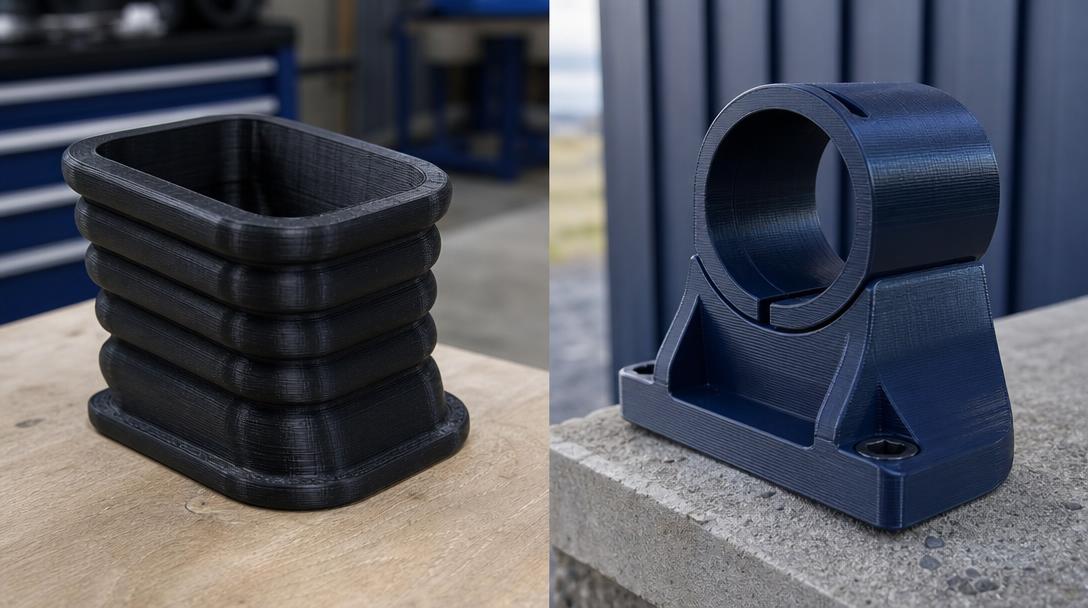
TPE or ASA? These two filaments are designed for different purposes: TPE is used for flexible protective parts, while ASA is a strong choice for rigid parts intended for outdoor use. Rather than asking only “which one is more durable?”, decide whether the part needs to flex or retain its shape, and whether it will be exposed to sunlight.
TPE: for parts that need flexibility
TPE is the general name for a family of thermoplastic elastomers. It is used to produce rubber-like, bendable parts after printing. Protective feet, vibration-damping spacers, flexible covers and lightweight bumpers are examples of applications where it may be worth considering. However, hardness and flexibility vary between TPE products, so two filaments with the same name may not feel alike. Wall thickness and gaps in the design also affect how much a part can flex.
Printing flexible filament can be slower and more sensitive to settings than printing rigid PLA or ASA. The filament path, extruder design, print speed and retraction settings all matter. Designs with very thin sections or long unsupported overhangs can cause problems during printing. As a starting point, it is better to think of TPE as a component that softens impacts or protects a surface, rather than as a rigid structural body.
ASA: rigidity for outdoor use
ASA is an FDM material considered for rigid parts exposed to sunlight outdoors. It is known as a more suitable candidate than many general-purpose plastics in terms of UV resistance; even so, its actual service life depends on the formulation, color, geometry and environmental conditions. ASA may be suitable for an enclosure, fixture or connector intended for outdoor use. If the part will carry a continuous mechanical load, its design and print orientation should also be checked.
ASA may not be as easy to print as PLA; temperature, warping and bed adhesion vary depending on the printer and the product. Large parts may require a suitable printing environment and the right profile. It is misleading to rank TPE and ASA by saying “one is stronger in every way”: flexibility and UV exposure are separate requirements.
- For a flexible bumper, protective sleeve or vibration-damping surface: consider a TPE grade.
- For a rigid outdoor part exposed to sunlight that needs to retain its shape: ASA may be a more suitable candidate.
- If you need both flexibility and outdoor suitability, consider dividing the part into sections or designing it to combine different materials.
Make the right choice: define the operating conditions
First, specify how much the part needs to bend, the direction in which it will be loaded and how long it will remain in the sun. For TPE, the required hardness is a key factor; for ASA, dimensions and printing conditions matter. Do not design a critical connection based only on the filament name; if possible, test compatibility with a sample print. Sharing the part’s function can help with material selection for Ucuz3D’s 3D printing service.
You can review the per-gram pricing approach on the affordable 3D printing prices page and check your file using the online 3D printing tool. This helps you consider appearance, function and production cost together.
Account for design limitations
Leave enough clearance for a flexible part to move; TPE forced to bend in a tight corner may wear over time. With ASA, large, thin surfaces may be more prone to warping during printing. Corner radii, wall thickness and layer orientation can affect the result with both materials. For a product made of multiple parts, it may be possible to make the rigid main body from ASA and the soft contact bumper from TPE; however, material compatibility and the assembly method should be verified separately. A small prototype can help you identify issues before moving on to full production.
If high precision, temperature or chemical exposure is involved, do not rely on general polymer knowledge alone. Review the filament manufacturer’s technical data, the actual operating environment and the safety requirements. This helps ensure that broad labels such as “outdoor” or “flexible” are not mistaken for a performance guarantee on their own.


 Türkçe
 العربية
 Русский
 فارسی
فارسی Deutsch