Nylon (PA) or HIPS? A Wear-Prone Mechanical Part or a Lightweight Prototype?
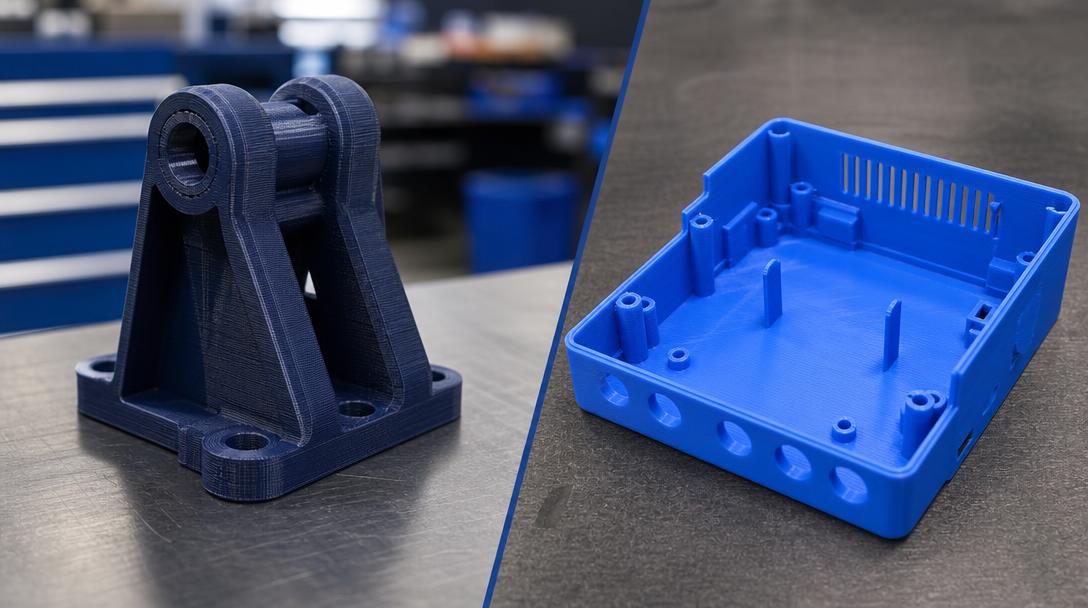
Nylon (PA) or HIPS? These are not interchangeable filaments. Under the right conditions, nylon may be considered for parts that need to withstand wear and perform a mechanical function; HIPS is associated with lightweight prototypes and certain support applications. Before choosing, clarify the part’s load, friction, exposure to moisture, and whether it actually needs support material.
Nylon (PA): expectations for mechanical parts
PA is a family of nylon polymers; the properties of different PA types can vary. In FDM, nylon may be considered for functional components that could be exposed to friction and impact. For examples such as a bushing, small fastener, or part of a moving mechanism, material choice alone is not enough: load direction, clearance, wall thickness, and print-layer orientation all affect performance. Filament moisture can also impair print quality, so storage and drying conditions matter.
PA is not automatically the best engineering solution for every part. The material can absorb moisture, print settings may require more attention, and some parts may need tolerance testing. For a precision-fit connection, printing a sample with the actual printer and filament is more useful than relying on general catalogue specifications.
HIPS: a role in prototyping and support
HIPS is a polystyrene-based filament that can be used for lightweight prototype housings or as a support material in some multi-material printing setups. Its use as support depends on the printer’s dual-material capability, print setup, and compatible main material. So generalizations such as “HIPS is water-soluble support” are inaccurate. If an application requires solvents or post-processing, also review the manufacturer’s safety and usage instructions.
HIPS suitability should be assessed based on whether it needs to bear the main part’s load. For a lightweight visual prototype, ease of processing or support geometry may be an advantage; for a part exposed to continuous friction, heat, or mechanical loads, other engineering materials such as PA may be more suitable candidates. Switching to PA also requires addressing moisture management and print conditions.
- If friction or mechanical function is a priority, assess the PA type alongside the actual load and print orientation.
- If you need a lightweight visual prototype or compatible multi-material support, consider HIPS.
- Include moisture, dimensional tolerances, support removal, and post-processing conditions in your cost calculation.
Define the need, then choose the material
First determine whether the part is a prototype or a working component. For PA, moisture and print settings are key considerations; for HIPS, compatibility with the main material and the support strategy are critical. For more information about the differences between these two filaments, see the 3D printing with engineering materials options.
Assess whether your project can be manufactured through our 3D printing service. You can review prices per gram and upload your file for an instant price quote. Sharing the intended use environment and expected load helps us recommend the right FDM option.
Pre-print checklist
If you plan to use PA, check your plan for keeping the spool dry, its moisture condition before printing, and the recommended nozzle profile. Moist filament can cause surface defects and layer-quality issues. For HIPS, decide from the outset whether the part will be support material or the finished product; the multi-material printer, interface settings, and method of removing supports all affect the result. This distinction matters because it is not reasonable to expect a material selected for support to deliver the main part’s full mechanical performance.
For a mechanism component, verify clearance and movement with a small test sample. For a prototype housing, focus first on dimensions and assembly fit. If the part will be machined after production, its wall thickness and accessible surfaces must allow for that. A more realistic comparison includes the cost of failed attempts, drying, and support cleanup for both filaments.



 Türkçe
 العربية
 Русский
 فارسی
فارسی Deutsch