CityUHK and Cambridge Establish Centre for Advanced and Smart Manufacturing: Why It Matters for 3D Printing
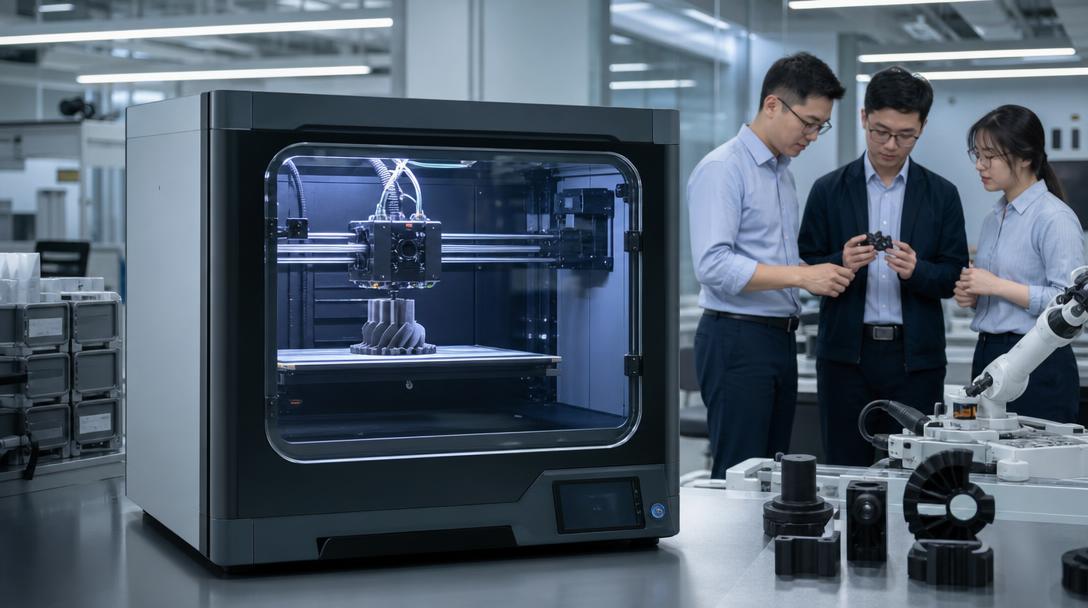
City University of Hong Kong (CityUHK) and the University of Cambridge have announced the establishment of a joint centre focused on advanced and smart manufacturing. According to CityUHK’s announcement dated 21 September 2026, the Centre for Advanced and Smart Manufacturing will operate as part of Hong Kong’s Industry 5.0 goals. This is not a new product launch in the desktop printer market; rather, it is news worth following for its implications for manufacturing research and collaboration, including additive manufacturing.
What is the new centre aiming to do?
CityUHK’s announcement highlights the centre’s name and the partnership between the two universities. The “smart manufacturing” approach brings together design, production processes, data use and automation. In this context, additive manufacturing can be considered not as a standalone technology, but as part of a broader production workflow. However, the announcement does not provide verified details about any specific FDM printer, filament, production capacity or commercial service, so it would be premature to conclude that the centre will launch a particular product soon.
The value of centres like this, which focus on collaboration between academia and industry, lies in their ability to bring different manufacturing methods and digital processes together under a shared research agenda. Potential areas of work relevant to 3D printing could include assessing a part’s manufacturability at an early stage, moving from prototypes to functional parts, and using production data to inform design decisions. These are not specific deliverables promised in the centre’s announcement; they are broader topics that help explain why the smart manufacturing focus is worth following across the sector.
What it could mean for FDM users and businesses
For Ucuz3D readers, the practical takeaway is not to view 3D printing solely as a way to produce rapid prototypes. Whether an FDM part will perform as intended depends not only on the material, but also on its geometry, print orientation, tolerances and actual operating conditions. In the long term, research centres that look at production processes as a whole could help make decisions between prototyping and low-volume production more data-driven. However, this announcement does not support conclusions about specific cost reductions, performance improvements or the inevitable widespread adoption of FDM for mass production.
When preparing a part for production, first clarify its intended operating conditions, then select the right material and design. Ucuz3D’s our printing materials page is a good starting point for exploring FDM options. To assess whether your design can be manufactured, visit our 3D printing service page. When planning the scope of the job, you can also use our price per gram approach and online 3D printing calculator.
Why is collaboration valuable when making production decisions?
Collaboration between universities can bring different areas of expertise together to address the same manufacturing challenge. For example, when a part’s digital design, production method and quality control are considered together rather than in isolation, there may be less risk of problems identified during prototyping carrying over to later stages. One strength of additive manufacturing is its ability to support complex geometries and on-demand production; however, requirements for materials, part validation and scaling up vary by application. That is why the value of research infrastructure depends not only on new machines, but also on bringing production data and design knowledge together. Concrete projects shared by the CityUHK-Cambridge centre will show which methods are actually being used in these areas.
Why is this development worth following?
The significance of this news lies less in a new FDM machine and more in showing where additive manufacturing stands in the smart manufacturing and inter-university research agendas. Research, joint projects and practical applications published by the centre in the future could help clarify which technologies address which manufacturing challenges. For now, the verified information is limited to the establishment of the Centre for Advanced and Smart Manufacturing by CityUHK and Cambridge, and the initiative’s connection to Hong Kong’s Industry 5.0 direction. Any new technical findings or FDM-specific applications should be assessed separately if and when they are announced.
Source and date: City University of Hong Kong, “CityUHK and University of Cambridge establish Centre for Advanced and Smart Manufacturing to shape Hong Kong’s Industry 5.0 future”, 21 September 2026.


 Türkçe
 العربية
 Русский
 فارسی
فارسی Deutsch