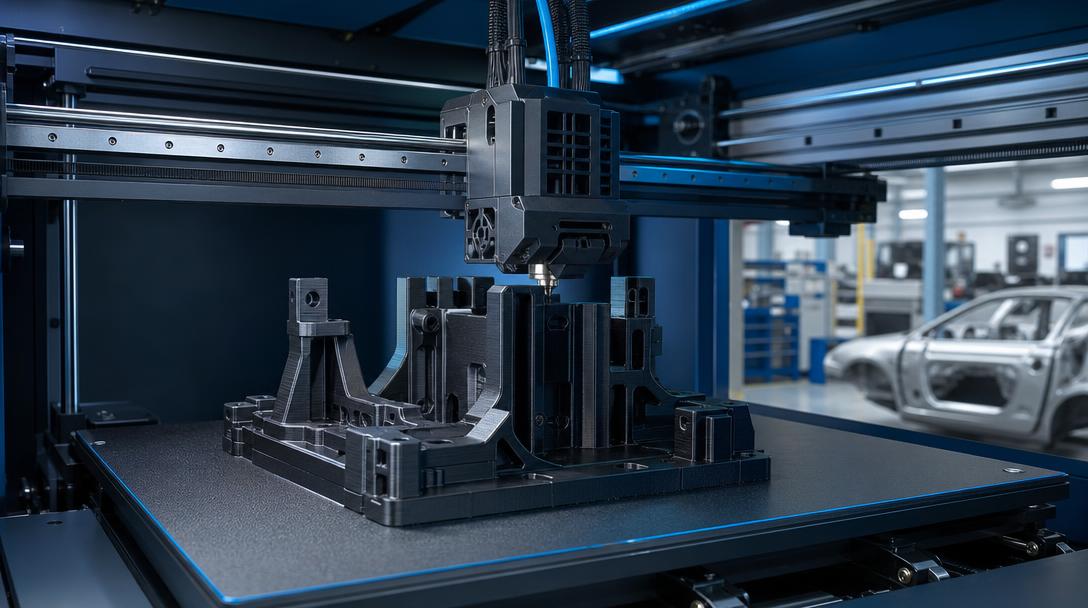
Stratasys Unveils New FDM Printer and Automotive Applications at IMTS 2026
The new FDM printer and automotive applications announced by Stratasys at IMTS 2026 show why production parts, fixtures, and prototypes are all closely followed in the field of FDM 3D printing. According to a 3DPrint.com article dated September 23, 2026, the company showcased its new printer and 3D-printed automotive applications at the trade show. The practical significance of this development has less to do with announcing a new machine alone and more with how the technology is positioned for different tasks in vehicle development and manufacturing.
What does the trade show announcement tell us?
IMTS is a major industrial trade show where manufacturing technologies are showcased. Stratasys’s announcement brings together two topics: the introduction of a new printer and examples of automotive applications. Since the article’s headline does not detail the new model’s technical specifications or production performance, it would not be appropriate to make assumptions about speed, build volume, material compatibility, or cost advantages. What can be confirmed is that the company brought its new machine to the trade show alongside real-world application examples.
This approach matters to professional users: a printer’s value is measured not only by its listed specifications, but also by how its intended parts fit into a workflow. In automotive, needs vary, including design-validation models, assembly aids, inspection fixtures, and low-volume plastic parts. Requirements and validation levels differ from one application to another, so no single technology or material will suit every task.
The role of FDM in automotive
FDM produces parts by depositing thermoplastic filament in layers. The method can be used at stages such as turning a design into a physical model, checking dimensions and assembly, or preparing a fixture for a specific task. When a production team wants to modify a part, preparing a new iteration from a suitable design file may be more straightforward than going through tooling processes. However, print time, surface finish, material behavior, and production volume should all be considered together; the final choice depends on the part’s intended conditions of use.
Design validation is especially important for a functional component intended for use in a vehicle. Loads, temperature, vibration, chemical exposure, and safety requirements all influence material selection. The trade show presentation should not be interpreted to mean that every part in mass production will be made with FDM. A more realistic takeaway is that additive manufacturing is evaluated for tasks where it is suitable within development and production processes.
How should the new printer announcement be assessed?
Avoid drawing firm conclusions until a technical datasheet and independent tests are available. Before making a decision, it is useful to consider the following:
- Build volume and part size: Can the component you are designing be produced as a single piece?
- Material profiles: Are the filaments you need supported by the manufacturer?
- Repeatability: How are dimensional and quality consistency verified across multiple prints?
- Workflow: Do slicing, monitoring, and post-processing fit your existing production setup?
- Total cost: Are maintenance, consumables, operator time, and waste included alongside the machine price?
These questions apply not only to automotive, but also to product development and small-batch production. For a broader overview, explore 3D printing applications in the automotive industry; you can also compare different filament options on our printing materials page.
What this means for Ucuz3D users
This news is not a recommendation to buy a desktop printer; it is an example of how industrial-scale 3D printing is presented with a focus on applications. If you have a part that could be made with FDM, such as a prototype, enclosure, or production aid, the file and conditions of use should be assessed first. You can have your part reviewed and discuss material choices with an advisor through our 3D printing service. To get an estimate in advance, use the calculator on our affordable 3D printing prices page; you can also learn about cost components in our guide to how 3D printing costs are calculated. The most reliable approach will be to assess the new model based on its technical specifications once they are published.



 Türkçe
 العربية
 Русский
 فارسی
فارسی Deutsch