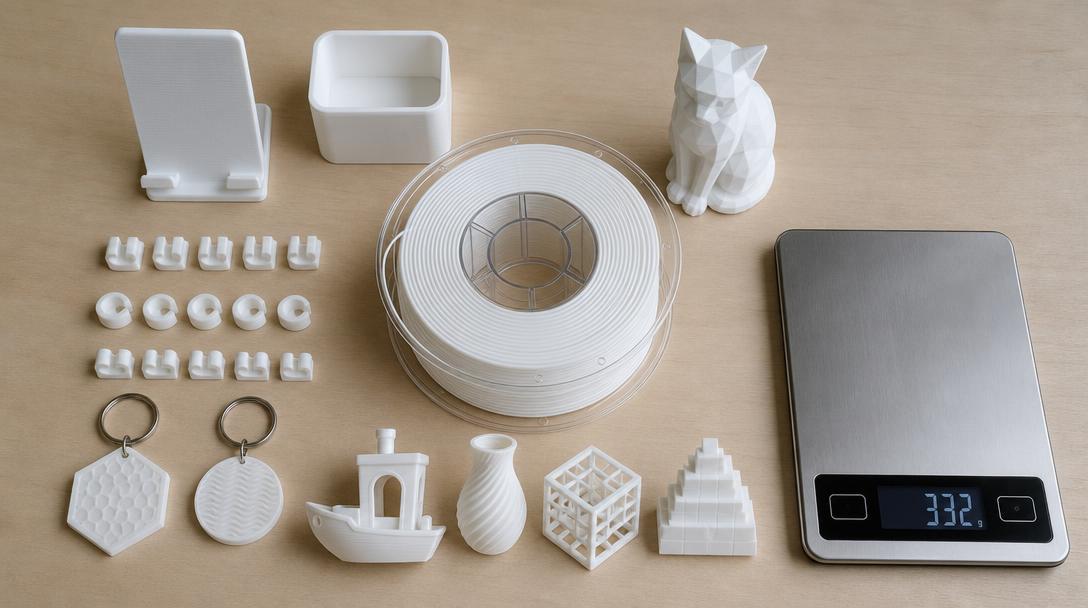
How many parts can 1 kg of filament make?
One kilogram of filament can produce roughly 10–200 parts, depending on design; tiny clips may yield several hundred, while large enclosures may yield only 5–15. The slicer’s part weight is the useful figure. FDM service pricing for PLA/PETG/ABS is $0.046–$0.082 (VAT excluded).
Approximate weight and quantity examples
These are practical ranges, not guarantees. The quantity column divides 1,000 g by part weight and does not subtract failed prints or other waste.
| Part | Approx. weight | Parts per kg |
|---|---|---|
| Cable clip | 2–8 g | 125–500 |
| Keychain | 5–15 g | 65–200 |
| Phone stand | 30–80 g | 12–33 |
| Small box/enclosure | 50–150 g | 6–20 |
| Figurine | 80–250 g | 4–12 |
| Drone arm | 25–100 g | 10–40 |
Dimensions, hollow spaces, shape and intended strength all affect the result. A 20 g clip suggests a theoretical 50 pieces per kilogram, but that is not a production promise.
What changes the number of parts?
Infill adds material inside the shell; higher infill usually means heavier parts, though 100% infill is not necessary for every use. Wall or shell count can be especially significant on broad, thin parts. Supports for overhangs also consume filament, even when removed afterward.
Layer height often changes print time more noticeably than weight when other settings stay the same. A finer layer can require substantially more machine time. First-layer failures, test prints, colour changes and purge material also reduce the usable amount. Check the spool’s net filament weight rather than counting the spool itself, and allow a modest waste margin when planning a batch.
How much does a kilogram cost, and what does service include?
A kilogram of filament has no single universal price: material type, quality and seller make the spool price vary, so a fixed figure would be misleading. Buying filament is not the same as paying for a finished part. A printing service accounts for material, machine time, file preparation, slicing, production monitoring and labour.
If you do not own a printer, paying for the grams your file actually needs avoids buying a whole spool and storing the remainder. Example PLA estimates for 20, 100, 250 and 1,000 g are shown by $1.22, $6.11, $15.28 and $53.62. The actual estimate depends on the model and settings.
Find the weight before printing
Visual estimates are unreliable. Upload an STL to the 3D printing price calculator; actual slicing estimates the grams and print time for the selected material and settings. Changes to the model or settings can change the result.
If the file is not ready, share its dimensions and intended use to learn about the 3D printing service. In FDM printing, infill and wall count should suit the part’s function.
Frequently asked questions
How many keychains can one kilogram make?
At about 5–15 g each, the theoretical range is roughly 65–200. Supports, design and failed prints can reduce the count.
Does higher infill mean fewer parts?
Usually. For the same design, more infill generally raises part weight and reduces the quantity from a fixed amount of filament.
Is the calculator’s weight exact?
It is an estimate based on slicing the submitted file with selected settings. A changed model or production setup can alter material use and time.


 Türkçe
 العربية
 Русский
 فارسی
فارسی Deutsch