Thermally Conductive, Electrically Insulating Polyamide with FDM: What Does the New Research Tell Us?
Two ceramic-filled polyamide compounds developed by researchers from Politecnico di Milano and LATI seek to address two needs at once in FDM printing: transferring heat while remaining electrically insulating. According to a 3Druck.com report dated 10 September 2026, the study presents a notable material approach for thermal management in electronics housings and lightweight cooling components.
Why use an FDM material that conducts heat but remains insulating?
Copper or aluminum is commonly used to dissipate heat in electronics. However, choosing metal is not easy for every application; the risk of corrosion, weight, and electrical conductivity can create problems in some designs. The polyamide compounds at the center of the research aim to improve heat transfer through ceramic fillers while preventing the flow of electrical current.
The PA–32BN compound examined contains approximately 32% boron nitride platelets. In addition to boron nitride, PA–32BN–MgO also contains magnesium oxide. These are not actual metal parts, but ceramic-filled engineering polymer formulations that can be processed using FDM. For this reason, the results should be evaluated as a specialized materials study rather than compared directly with everyday PLA or standard PETG.
What results were observed in the FDM printing trial?
The filaments were processed on an enclosed Prusa i3 MK3S using a 0.6 mm nozzle and a 0.3 mm layer height. The printing temperature was reported as 250 °C. Despite the high filler content, the researchers report that they experienced no nozzle clogging during printing; however, these values should not be treated as a direct starting profile for every printer and every manufacturer’s filament.
For PA–32BN, thermal conductivity was measured at 1.97 W/mK in the printing direction and 0.69 W/mK perpendicular to the printing direction. In the magnesium oxide variant, these values were 1.22 and 0.64 W/mK, respectively. This difference shows that orientation in FDM parts can affect not only mechanical strength but also how heat travels through the part. The potential of MgO filler to make the properties more balanced between directions is also highlighted.
Electrical insulation and testing a real part
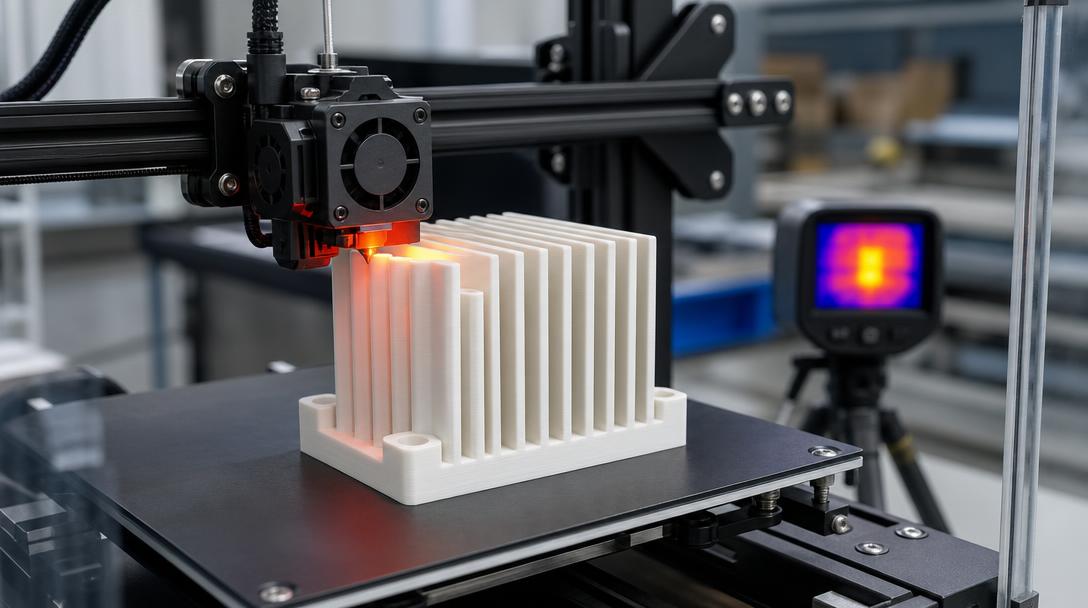
The volume resistivity of both compounds was reported at approximately 10¹² ohm-centimeters. This indicates that the materials fall on the electrically insulating side. The researchers also produced a pinned cooling prototype measuring 80 mm in diameter and 32 mm in height. In heating tests, the filled compounds transferred heat to the upper section of the cooler more effectively than the reference polymer.
This result could open up a field of research for lightweight channels that move heat away from specific areas in electronics enclosures, insulating spacers, or specialized cooling geometries. Nevertheless, since brittle fracture behavior was reported, it would not be appropriate to consider thermal conductivity alone in load-bearing parts exposed to vibration and impact. Thermal, mechanical, and long-term environmental tests need to be conducted together.
What this means in practice for Ucuz3D readers
These specialized polyamide filaments are not general-purpose options that can replace PLA, PETG, or TPU used in standard FDM services for every part. If ease of printing and cost are your priorities for a prototype, enclosure, fixture, or part near electronics, more common materials may be the sensible choice. When thermal management becomes critical, the printing orientation, wall structure, infill, enclosure conditions, and validation tests should all be evaluated alongside the material.
You can review the material options for your part on our printing materials page. When ordering a 3D printing service for an FDM-manufactured prototype or electronics enclosure, specifying the operating temperature and electrical requirements will help ensure proper guidance. Printing with engineering materials options can also be evaluated within this framework. If your part is ready, you can see how our per-gram pricing works, then upload your file to get an instant quote.



 Türkçe
 العربية
 Русский
 فارسی
فارسی Deutsch