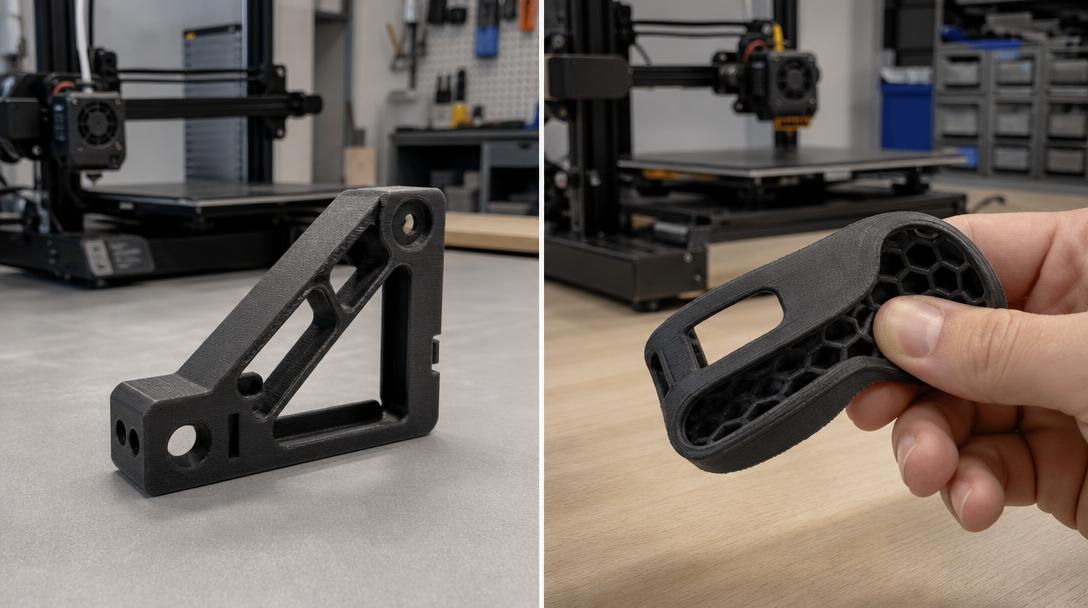
Glass Fiber-Reinforced or TPE? Rigid Technical Part or Flexible Protection?
Glass Fiber-Reinforced or TPE? The answer depends on whether the part needs to be rigid and dimensionally stable or flexible and capable of absorbing impacts. These two FDM materials do not serve the same purpose. Glass fiber-reinforced filament is more suitable for technical parts that require rigidity and dimensional stability, while TPE is more appropriate for parts that flex and come into contact with other surfaces.
What is glass fiber-reinforced filament used for?
Glass fiber-reinforced filament is produced by adding short glass fibers to a polymer base. The fiber reinforcement can increase the part’s rigidity and dimensional stability in certain directions. For this reason, it can be considered for mounting hardware, load-bearing brackets, housings that need to retain their dimensions, and technical parts expected to maintain their shape under vibration. The result depends on the polymer base used, the fiber ratio, the printing orientation, and the part design.
This material is not the right choice for producing flexible seals or soft protectors. Fiber reinforcement can make the surface more textured, and because it can be abrasive, a suitable wear-resistant nozzle may be required. Before printing, check your printer’s temperature, build plate, and nozzle compatibility. You can review the options on the engineering materials 3D printing page.
What is TPE used for?
TPE is an FDM material with an elastomeric character that can bend and deform when force is applied. It can be used for cable protectors, vibration-damping parts, soft contact surfaces, bumpers, and certain covers or grip components. If the part does not need to be completely rigid, TPE can offer the advantages of absorbing some impact energy and conforming to the surface.
The flexibility of TPE varies according to the product’s formulation and hardness grade. Therefore, you should not expect a definite performance outcome based solely on the material name. Thin walls and flexible sections can increase flexibility in the design, while thicker cross-sections can make the part noticeably more rigid.
Differences in outdoor use, heat, and impact resistance
The outdoor and heat performance of glass fiber-reinforced material is determined more by the properties of the polymer base than by the fiber itself. Products based on ASA, nylon, or PETG cannot be evaluated in the same way; the manufacturer’s technical datasheet and the conditions of use should be taken into account. TPE can also be used outdoors, but sunlight, moisture, oil, and temperature changes may affect the elastomer’s behavior over time.
In a rigid load-bearing part subjected to impact, a glass fiber-reinforced option may retain its shape better; however, fracture behavior and layer orientation must be considered. For a part that needs to absorb impact by flexing, TPE is the more logical choice. With both materials, remember that interlayer strength will be affected by the printing orientation.
Printability and cost considerations
Glass fiber-reinforced filament may require more preparation than standard filaments because of drying requirements, a wear-resistant nozzle, and controlled printing settings. TPE is easier to print with a printer setup that leaves no gaps in the filament path, preferably uses a direct drive, and allows low printing speeds.
When evaluating cost, look beyond the spool price and also consider waste, printing time, drying, and the design thickness required per part. When ordering 3D printing service for your project, specifying the intended use and expected load will help ensure accurate guidance. You can review the price per gram approach and evaluate your choice together with the total part cost.
Which one should you choose for each part?
- Glass fiber-reinforced: Rigid brackets, dimensionally stable fixtures, technical housings, and parts that need to retain their shape under load.
- TPE: Flexible protectors, bumpers, vibration dampers, grip surfaces, and parts that need to bend.
- Decision criterion: First ask whether the part will flex during operation or needs to retain its dimensions.
Before production, you can upload your file to the online 3D printing tool to clarify the appropriate material choice. In summary, if rigidity and dimensional stability are your priorities, glass fiber-reinforced filament is the better starting point; if flexibility, contact comfort, and impact absorption are more important, TPE is the more suitable choice.


 Türkçe
 العربية
 Русский
 فارسی
فارسی Deutsch