Impossible Objects’ $40 Million Move: Composite 3D Printing Moves Closer to Production
Impossible Objects has received a new $40 million investment for advanced manufacturing. The funding, which the company plans to use to scale its composite 3D printing approach, shows that moving from prototyping to serial production requires more than simply considering printer speed; materials, processes and part economics must be evaluated together. The news was published by Axios on September 11, 2026.
What does the technology behind the investment do?
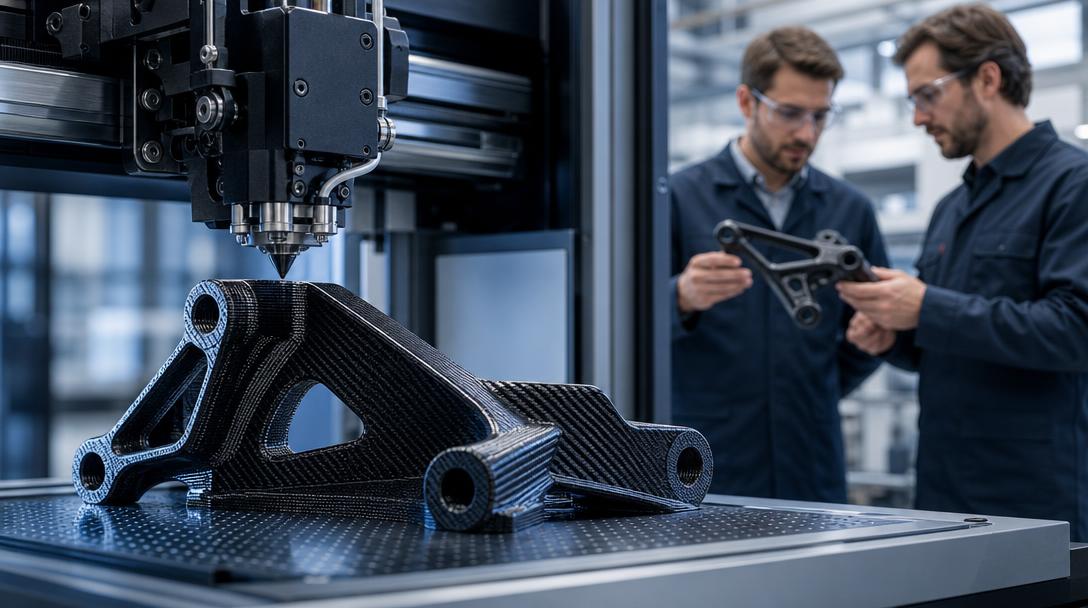
Impossible Objects focuses on producing composite parts that combine reinforcements such as carbon fiber or glass fiber with a thermoplastic matrix. The company’s method is based on placing the reinforcement material in the areas of the part where it is needed during the printing process. The goal is therefore not simply to produce a lightweight plastic part, but to establish a more controlled balance between stiffness, strength and weight.
This distinction is important for Ucuz3D readers: this development is not a promise that you can install a new filament in a standard desktop FDM printer and achieve the same result. Impossible Objects’ manufacturing approach should be considered part of the industrial composite 3D printing category. Therefore, the news should not be interpreted as a direct alternative to everyday FDM printing with PLA, PETG or engineering filaments.
Why is it attracting attention now?
The $40 million investment could strengthen the company’s goal of moving from laboratory demonstrations to a more consistent and repeatable production workflow. For industrial buyers, the critical question is not whether a single part can be printed, but whether the same part can be produced repeatedly with acceptable dimensional accuracy, surface quality and mechanical properties. This is why material placement, processing time and post-processing steps in composite printing are at least as important as build volume.
- Lightweight construction: Depending on the design, reinforced structures may offer a weight advantage over metal parts.
- Stiffness: The direction and position of the fiber can affect the axis in which the part performs best.
- Production flexibility: Methods that do not require investment in molds may become attractive for low- and medium-volume production.
- Need for validation: The actual load, temperature, fatigue and connection conditions must be tested separately for every application.
What can FDM users take away from this news?
The first lesson is that material selection cannot be based solely on the strength values listed in a filament’s catalog. The direction of the load, layer orientation, number of walls, connection method and operating temperature must be evaluated together. In desktop or service-based FDM printing, carbon-fiber-reinforced materials can provide stiffness and dimensional stability; however, abrasive additives may create additional requirements for the nozzle and feeding system. For this reason, “stronger” does not automatically mean “more suitable” for every part.
The second lesson is that the manufacturing method should be selected according to the part. For a visual prototype, enclosure, fixture or low-load part, accessible options such as PLA and PETG are often more practical. When high stiffness, low weight or repeated mechanical use are priorities, engineering materials and design validation become relevant. You can review the options for your application on our printing materials page.
How should you decide when ordering a part?
First, clarify the part’s dimensions, operating environment, expected load and required quantity. Then evaluate the appropriate manufacturing method and material together. For the production you need, you can get information from the 3D printing service page, assess your budget based on the price per gram model, and review your file through the online 3D printing workflow.
Impossible Objects’ investment move shows that 3D printing is not merely a rapid prototyping tool; the race to turn it into production infrastructure through the right materials and process control is continuing. However, the investment news does not mean that every composite part can be printed on every FDM printer. For Ucuz3D readers, the soundest approach is to select the method according to the technical requirements and always validate critical parts under real operating conditions.
This is why the investment’s real impact lies less in a single printed example than in encouraging production decisions based on data. Scaling up may not be sufficient on its own without design validation, traceability and batch consistency.


 Türkçe
 العربية
 Русский
 فارسی
فارسی Deutsch