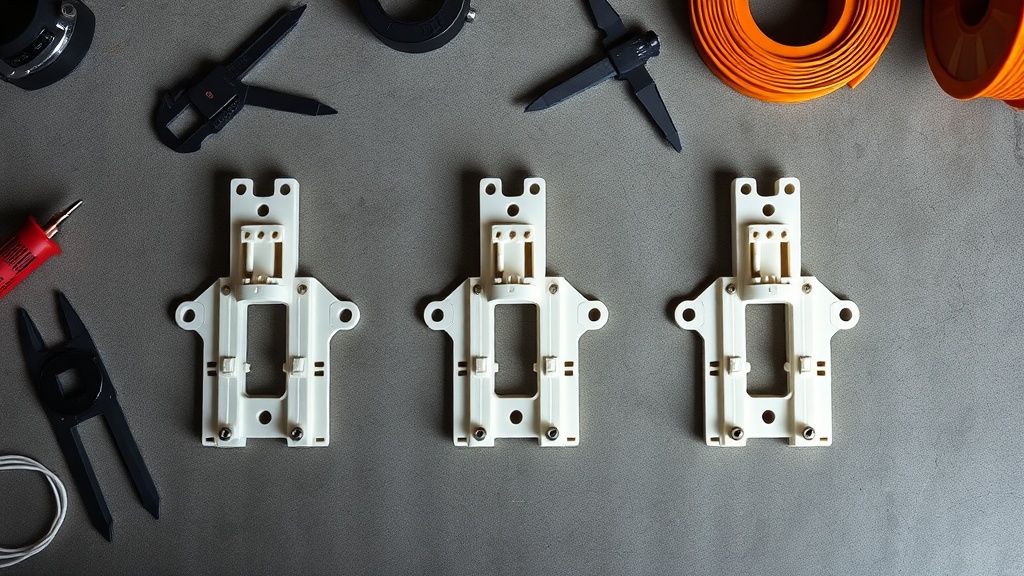

The Art of Part Orientation: Balancing Strength, Surface Quality, and Supports
When you place the same file on the print bed at two different angles, one will crack and break in your hands while the other barely bends; one will come out smooth as a mirror while the other fills with support marks. This is why part orientation in printing is the most powerful yet most overlooked decision you can make. Before you ever touch slicer settings, deciding which direction the part faces on the bed is usually the more decisive step.
A three-axis balance: strength, surface quality, supports
Orientation is never inherently good or bad — it is always a matter of balance. FDM parts are anisotropic, meaning they are strong along layer lines but weak perpendicular to them. You therefore need to consider the load the part will carry, the surface that needs to look good, and the amount of support it will require — all at the same time.
Strength direction
Whatever direction the greatest load comes from, position the layers so they run parallel to that load. If a hook or arm is printed in a direction where the force tries to separate the layers, it will fail much earlier.
Surface quality direction
Print visible surfaces facing upward or as vertical walls; bottom surfaces and overhanging areas are always rougher. Top layers generally produce the cleanest finish.
Amount of support
Support is required when overhang angles exceed 45 degrees. Supports increase both material cost and print time, and they leave marks on the surface where they are removed. Rotating the part to reduce support needs improves both price and surface quality.
- Identify the load direction first: If strength is critical, make all other trade-offs around that.
- Face the visible side upward: If aesthetics are the priority, put the best surface on top.
- Minimize support contact areas: Where possible, rotate bridges and overhangs to self-supporting angles.
- Think about holes and fits: Horizontally printed cylindrical holes can become oval; position critical holes on the vertical axis.
The best angle is different for every part
There is no single golden rule; strength may come first for a bracket, surface quality for a scale model, and speed and cost for a prototype. The right orientation also directly affects price because it reduces supports and print time — you can see this effect on our production pricing page.
Tell us how your part will be used, and our workshop will work with you to determine the best orientation — delivering a result that is both strong and clean.



 Türkçe
 العربية
 Русский
 فارسی
فارسی Deutsch