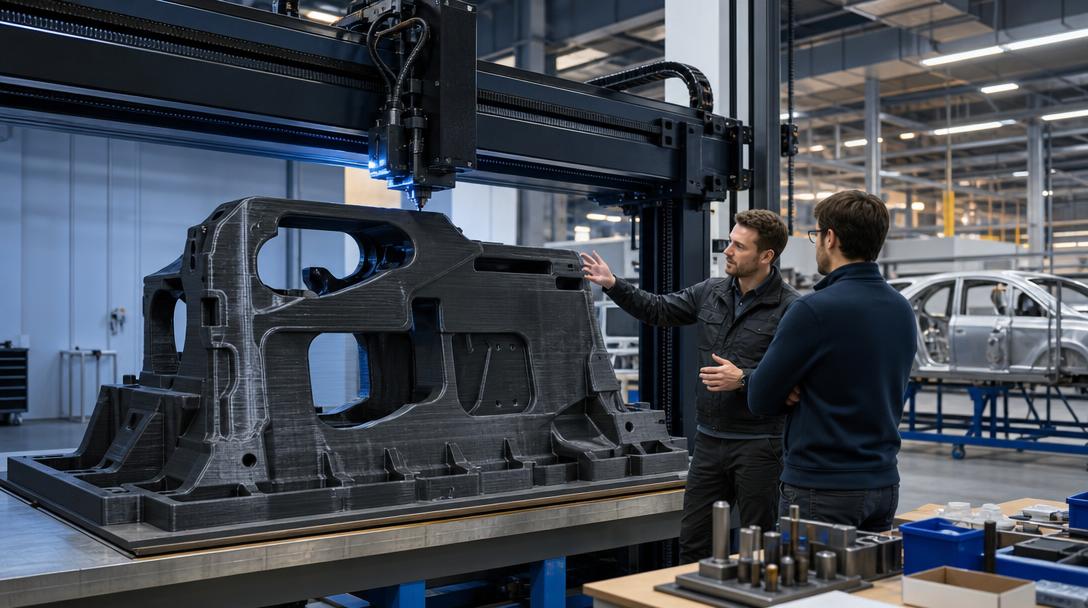
Stratasys F870 Unveiled: Large-Format FDM Printer Targets In-Factory Production
Stratasys announced its new F870 FDM 3D printer platform on 9 September 2026. Developed for large-part production aids, fixtures and prototypes, the system’s first users reportedly include Toyota Production Engineering and Rivian Automotive, bringing FDM use back into focus as it expands from desktop trials to in-factory production workflows.
The news information in this article is based on the Stratasys announcement and reports published on 9 September 2026 by TCT Magazine and VoxelMatters. Manufacturer data should be distinguished from real-world results; it should not be assumed that the F870 is automatically the best option for every part.
What makes the F870 stand out?
The F870 is an FDM printer positioned around a large build volume and a design intended for production environments. The technical information shared so far highlights a build area of approximately 1,000 x 610 x 610 mm and a heated chamber approach. These dimensions may increase the potential to produce larger fixtures, assembly aids and vehicle interior prototypes in a single piece. However, actual results depend on the part’s geometry, print orientation, layer structure and the material used.
The platform’s reference to engineering-focused thermoplastics such as ABS, ASA and Nylon 12CF is also noteworthy. These materials may be considered for applications that require greater heat resistance, impact resistance or rigidity than standard PLA can provide. Nevertheless, the effect of abrasive additives in reinforced filaments on the nozzle and feeding system, as well as print-environment temperature control and drying conditions, must be planned separately. A material’s value on its technical data sheet does not guarantee the same part performance for every geometry and print orientation.
Why do Toyota and Rivian matter?
The main message of the F870 announcement is not simply the printer’s size, but its use case closer to the production line. The fact that Toyota Production Engineering and Rivian Automotive are listed among its first users points to an approach aimed at producing parts such as fixtures, inspection jigs, assembly aids and prototypes closer to the facility, without waiting for external suppliers. For such parts, the goal is not always to print the final product. In many cases, auxiliary equipment that makes production workers’ tasks easier and makes measurement or assembly processes repeatable delivers value faster.
The lesson for Ucuz3D readers is that owning a large printer does not by itself provide a production advantage. The part’s dimensions, operating temperature, load direction, surface requirements and required quantity should be evaluated together. For a small-batch jig, using a 3D printing service may be more sensible than taking on the investment and maintenance burden of equipment. To clarify material selection for an FDM part, you can review the available engineering materials.
What it means in practice for FDM users
- Large part: Being able to print a part without splitting it can reduce assembly and bonding steps; however, heat management and bed adhesion become critical.
- Fixture selection: It is not enough for a jig to be merely rigid. Impact, repeated loads, surface friction and operating temperature must also be taken into account.
- Material preparation: Moisture control, a suitable nozzle and the manufacturer’s profile are important when using nylon and fiber-reinforced filaments.
- Economic decision: Print time, the risk of print failure, post-processing and part quantity should be calculated together.
For this reason, the F870 news does not show that every workshop needs to buy the same printer; it shows that FDM is being evaluated more systematically for in-factory auxiliary production. If you are also considering having a similar part produced externally, you can compare geometry and material options using the online 3D printing tool, then evaluate the per-gram pricing approach together with total production time and part durability.
Conclusion
The fact that the Stratasys F870 is being discussed alongside automotive manufacturers such as Toyota and Rivian indicates that large-format FDM is taking on a role closer to the production floor, moving beyond the prototype bench. The news covers the launch of a new printer; for long-term reliability, real part life and total cost of ownership, however, it is necessary to wait for independent field data to emerge. For now, the soundest approach is to define the part’s function and evaluate the printer investment against those requirements.



 Türkçe
 العربية
 Русский
 فارسی
فارسی Deutsch