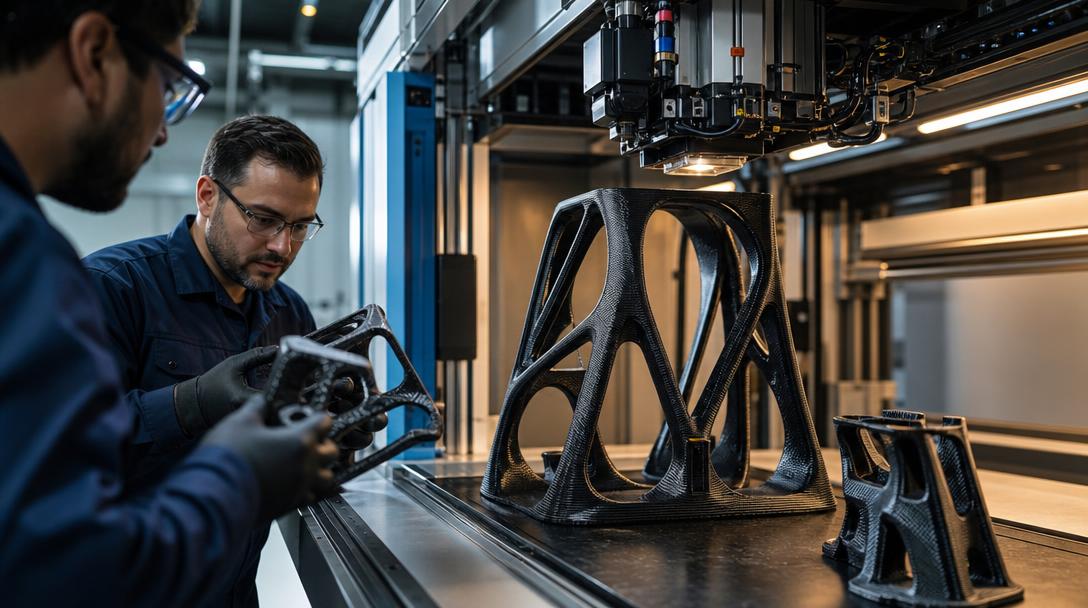
Impossible Objects’ New Investment Brings Composite 3D Printing to Production Scale
The transition of 3D printing from prototyping to real production lines has recently advanced not only through desktop printers but also through high-speed composite processes. With the new Series B investment it announced on September 11, 2026, Impossible Objects aims to scale its Composite-Based Additive Manufacturing (CBAM) technology and reach more customers. According to the company’s own announcement, the investment will be used to expand production capacity, on-site installations, and service operations in response to growing customer demand.
For Ucuz3D readers, this development is not a direct recommendation for a desktop printer; rather, it is an important industry story showing which problems manufacturers are genuinely trying to solve when selecting a production method. Impossible Objects’ official announcement dated September 11, 2026 states that CBAM focuses on producing strong, lightweight parts through high-speed manufacturing and composite materials such as carbon fiber.
What is the key point of the news?
The CBAM process uses composite reinforcement together with thermoplastic material. The aim is to produce certain parts that would otherwise require molds or extensive machining through a more flexible digital manufacturing workflow. The company says the technology is being deployed in customer environments in fields such as aerospace and advanced manufacturing. The real value here is not only printing speed; it also lies in reducing the need for mold preparation, making design changes easier in low- and medium-volume production, and producing parts on demand.
Impossible Objects reports that, following the launch of the CBAM 25 system in early 2025, deployments began at various organizations. The announcement also includes company data on layer production speed and the mechanical performance of composite parts. Such figures are manufacturer claims; in real projects, the material formulation, print orientation, part geometry, post-processing, and validation method can change the outcome. For this reason, a single catalog value should not be interpreted as a guarantee for every part.
What can FDM users learn from this development?
The same manufacturing logic also appears on a smaller scale in home or workshop FDM printing: the material, part geometry, and production volume should be evaluated together. While easy-to-print PLA may be sufficient for a prototype, PETG, ASA, nylon, or a reinforced filament may be more suitable for a load-bearing fixture. However, choosing a reinforced filament alone does not automatically make a part safe or unbreakable. Layer orientation, wall count, connection points, and operating temperature remain decisive factors.
Especially when production volumes increase, looking only at the cost per kilogram can be misleading. Mold investment, tooling changes, inventory holding, and part revisions are also part of the total calculation. When making decisions at the desktop scale, you can review our printing materials according to the conditions of use and define the stiffness and flexibility required for your part from the outset.
The practical implications for ordering a part
News like this does not mean that every part needs to be produced on an industrial composite system. Before ordering a 3D printing service through Ucuz3D, you should first clarify what the part is intended to do, whether it will be used outdoors, and whether it will be exposed to impact or heat. This makes it possible to select the appropriate FDM material and printing approach for a prototype, visual model, assembly fixture, or functional replacement part.
When evaluating your budget, do not make the price per gram logic your sole decision criterion; support requirements, printing time, post-processing, and the risk of a failed print are also important. If your file is ready, you can make a quick preliminary assessment through the online 3D printing process.
Conclusion: technology selection should start with the part
Impossible Objects’ announcement on September 11, 2026, shows that additive manufacturing is no longer limited to being a tool for validating ideas and is pushing production scale with composite parts. Nevertheless, every new technology is not the right choice for every part. From the perspective of Ucuz3D readers, the most sound approach is to define the expected load, environmental conditions, required quantity, and surface expectations together, and then select the FDM material and production method. Developments in large-scale production systems can also make material decisions in small workshops more informed.


 Türkçe
 العربية
 Русский
 فارسی
فارسی Deutsch