Mosaic Orion Introduced: A Belt-Based FDM Workflow for Custom Orthotic Production
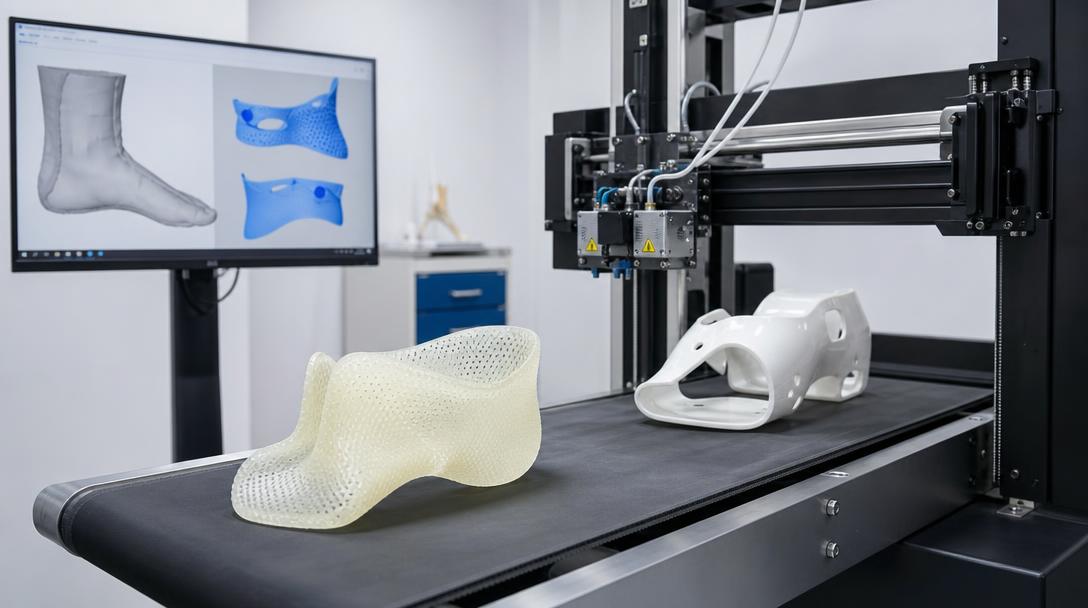
Mosaic Manufacturing has introduced the Orion 3D printing platform, designed to make custom orthotic production more consistent in laboratory and clinical settings. The news was published by TCT Magazine on 14 September 2026. The system stands out by handling both soft and rigid patient-specific devices within the same production workflow and by offering a process that extends from digital scanning to print management.
Orion’s key difference is its adaptation of a belt-based FDM/FFF architecture for orthotic production. The angled build surface is designed to allow parts to move continuously away from the build area. This approach could reduce reliance on conventional batch production for jobs requiring different dimensions and geometries for each patient. According to Mosaic, once production for one patient is complete, the next job can continue through automated queue management.
Two materials for soft and rigid orthoses
The Orion platform is offered with two specialised materials for different functions. Aero is intended to deliver EVA-like behaviour for soft-shell, comfort-focused orthoses. Align is positioned as a polypropylene-like material for more rigid corrective orthoses that require support. The manufacturer states that Aero has passed the ISO 10993-5 cytotoxicity test, while Align has been evaluated through more than three million fatigue cycles. Since these statements come from the manufacturer, it is important to remember that the relevant regulations, validation, and expert assessment are separately required for every clinical application.
This dual-material approach aims to reduce the need for laboratories to establish separate equipment, technicians, or production lines for soft and rigid products. In its report, TCT Magazine says Mosaic anticipates approximately 300 pairs per month per Orion, with a print time of about 1 hour 45 minutes per pair. Because these figures may vary depending on the application, geometry, post-processing, and workflow, they should not be treated as a general performance guarantee.
The practical meaning of the digital workflow
Orion works together with the Mosaic Stryde Software Suite. The aim is to transfer 3D scan data into design and production planning, reduce steps such as manual foam mould making, and track jobs through a single management layer. Integration options are also offered for businesses with existing CAD/CAM setups. In this way, 3D printing is being positioned not merely as a tool for producing a single part, but as a repeatable component of customised manufacturing.
This development does not mean that desktop users need to purchase an Orion directly. However, it demonstrates how FDM-based production can create value for customised, low-volume, and highly varied parts. For dimension-sensitive products such as clinical orthoses, the main benefit may emerge not only from print speed, but from managing data, design, materials, queues, and post-processing together.
Takeaways for Ucuz3D readers
For businesses that want to apply a similar approach on a smaller scale, the first step is to clarify the range of parts and material requirements. Not every flexible part can be solved with TPU, and not every rigid part with standard PLA; the flexibility, impact resistance, rigidity, and skin-contact conditions required during use should be assessed together. To produce the part you need, you can explore 3D printing service options, and review our printing materials when deciding on the material.
When making a production decision, look not only at the device price, but also at labour and material consumption per part. The price per gram approach provides a practical starting framework for comparing different geometries and quantities. If your model is ready, you can make a quick preliminary assessment using the online 3D printing tool.
The Mosaic Orion news shows that belt-based FDM can be positioned not only for long parts or multicolour printing, but also as part of a digital manufacturing chain. In clinical use, the factors that determine outcomes will include material validation, dimensional accuracy, traceability, and expert oversight, just as much as the printer itself.


 Türkçe
 العربية
 Русский
 فارسی
فارسی Deutsch