
Soluble Support Materials: Clean Surfaces with PVA and HIPS
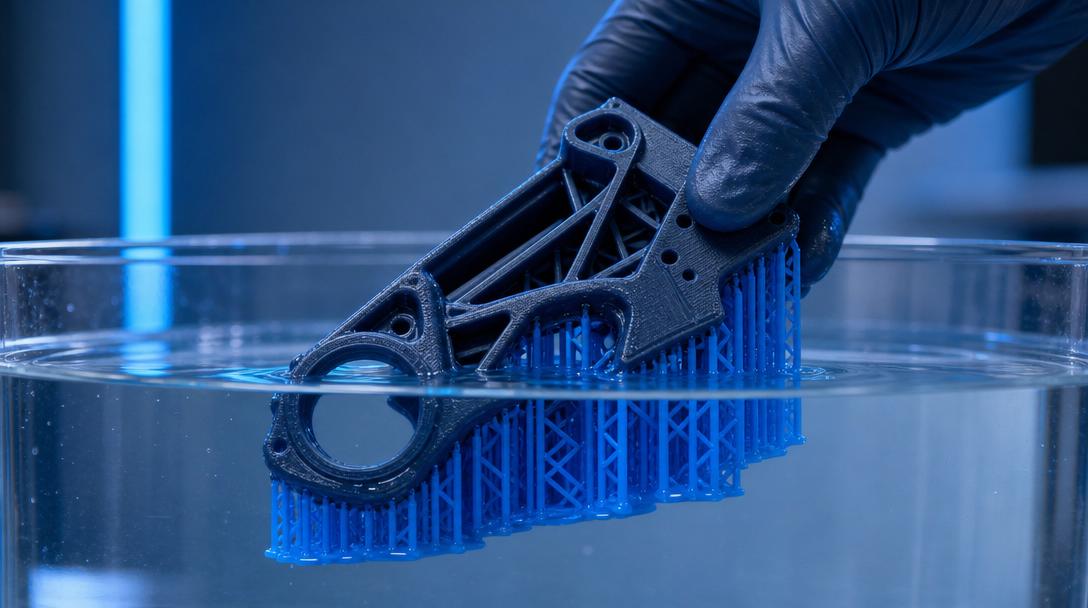
Support structures are unavoidable in complex geometries; but crushed, snapped, or sanded supports always leave marks on the part surface. That is exactly where soluble support materials come in: filaments like PVA and HIPS dissolve the supports in a chemical bath instead of requiring mechanical removal, revealing your part with a perfectly clean surface. In this article, we take a detailed look at the two most common soluble support materials, PVA and HIPS, and explain which one you should choose in different situations.
What is PVA (Polyvinyl Alcohol)?
PVA is a water-soluble filament. When soaked in warm water (40-60 °C) for a few hours, it completely dissolves and leaves no residue behind. It is perfectly compatible with low-temperature materials like PLA and PETG. Its biggest advantage is that no chemicals other than water are required; you can easily apply it in the kitchen or workshop. PVA also has aspects to watch out for: it absorbs moisture very quickly, so it must be stored in a dry environment and dried thoroughly before printing. Additionally, since it is printed at a lower temperature than PLA/PETG, there is a risk of nozzle clogging if temperature transitions are not set correctly.
What is HIPS (High Impact Polystyrene)?
HIPS is a filament that dissolves in an organic solvent called D-Limonene. Since it works at nearly the same printing temperature as ABS (230-245 °C), it is especially preferred as a support material for ABS parts. When you submerge the finished print in a limonene solution, the HIPS supports dissolve completely while the ABS main part remains unaffected. HIPS is more moisture-resistant than PVA, making storage conditions more forgiving. Its disadvantage is that D-Limonene has a strong odor and the solvent requires proper disposal.
PVA or HIPS? Decision Guide
When choosing between the two materials, consider the following factors:
- If your main material is PLA or PETG: PVA is the right choice. It works in the same temperature range and water solubility is the most practical method.
- If your main material is ABS: HIPS is the ideal match. It shares the same bed temperature and enclosed chamber requirements, and the solvent does not damage ABS.
- If you do not want to use chemicals: Choose PVA. Just warm water is enough.
- If long-term open storage is required: HIPS is more resistant to moisture than PVA.
Requirements for Using Soluble Supports
To print with soluble support materials, you need a dual-extruder or IDEX (independent dual-head) printer. In the slicer settings, you need to define the main material and support material separately, and set up the temperature profiles correctly. Cura, PrusaSlicer, and OrcaSlicer come with ready-made PVA and HIPS profiles; however, fine-tuning for your specific printer always yields better results. The interface layer distance can be kept slightly higher for PVA to compensate for the temperature difference.
Soluble supports are more expensive than standard filaments, so it is economical to use them only for internal channels, undercuts, and finely detailed bridges where mechanical removal is difficult. Printing flat support structures with regular filament and critical areas with soluble material provides a good balance between cost and quality.
When deciding on the right material for your project, we can help you choose the most suitable one from our 17 material options. If you are working on a complex model and want to experience the difference soluble supports make, you can upload your design and calculate the price instantly, and get your custom solution quickly.
To learn more about the differences between PVA and HIPS, check out our Water-Soluble PVA and HIPS Support Materials guide and decide which material fits your workflow.


 Türkçe
 العربية
 Русский
 فارسی
فارسی Deutsch