
PC or Nylon? Choosing the Right Filament for Engineering Parts
PC or nylon? Choosing correctly between these two engineering filaments — which anyone looking for the highest strength level in FDM printing will eventually face — directly affects the mechanical success of your part. While PC stands out for parts requiring high heat and impact resistance, nylon is preferred when wear and friction resistance are the priority. In this article, we will compare the technical properties of polycarbonate and nylon and examine step by step which material is right for which part.
When Should Polycarbonate (PC) Be Preferred?
PC filament has a high glass transition temperature, maintaining its shape up to approximately 110–120 °C. Thanks to this property, it is ideal for motor housings, enclosures operating in hot environments, and mechanical parts exposed to heat. It also offers exceptional impact resistance: a part printed in polycarbonate absorbs much more energy upon dropping or impact compared to PLA or PETG. If your part will constantly be under temperature or subject to strong impacts, polycarbonate is the right choice. However, due to its high printing temperature (250–290 °C), an enclosure and all-metal hotend are almost mandatory. Its moisture absorption sensitivity is also high, so the filament must be dried at 70–80 °C for a few hours before printing.
Which Parts is Nylon (PA) Suitable For?
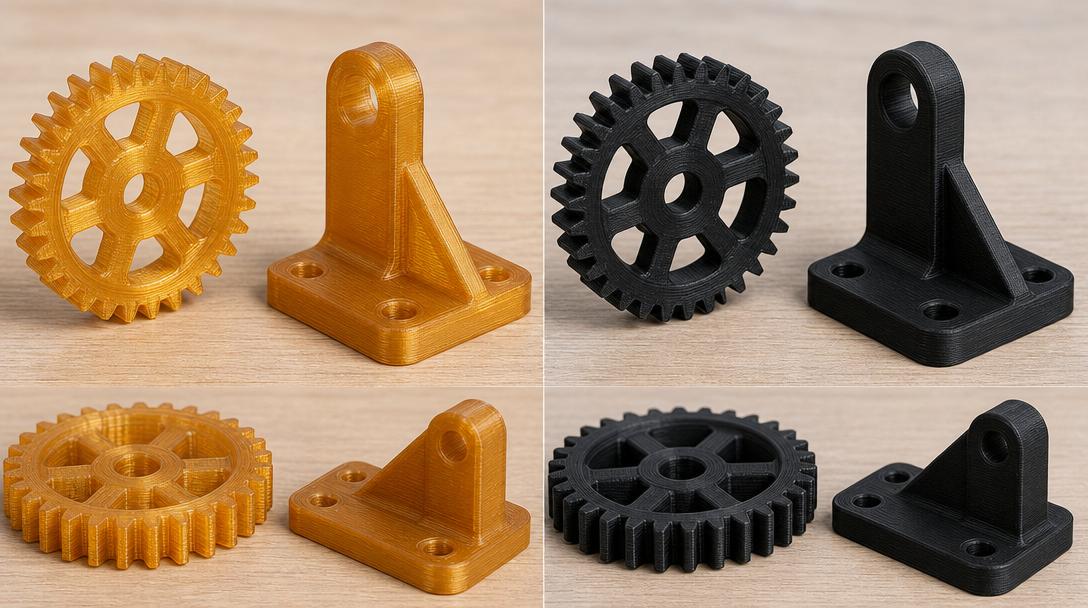
Nylon is the best option in the FDM category thanks to its superior resistance to friction and wear. It is ideal for gears, rollers, sliding bearings, and moving mechanical parts. With its low friction coefficient, it can operate for long periods without requiring lubrication. Nylon also has high toughness — rather than breaking, it distributes the load by flexing, which helps maintain the part’s integrity under mechanical stress. Additionally, nylon’s chemical resistance is quite good; it is resistant to oils, fuels, and solvents. Unlike PC, nylon has lower heat resistance (around 80–100 °C), so it may not be the first choice for extremely hot environments. Its biggest challenge is moisture control: nylon is one of the most hygroscopic filaments on the market and must absolutely be dried at 70–80 °C before printing. For a detailed review of all nylon’s properties, check out our Nylon Filament Guide.
Decision Criteria Between the Two Materials
The main differentiator to help you decide is this: Will your part be exposed to high heat or impact? Choose PC. Will your part operate under constant friction or require flexing/toughness? Choose nylon. Both materials are engineering-grade filaments and offer strength beyond standard PLA/PETG. In terms of price, both are more expensive than PLA, but nylon is generally a more economical option compared to PC. The printing difficulty level is high for both — these materials are suitable for experienced users. Alongside PC and nylon, you can also find other engineering options such as carbon fiber-reinforced filament on our engineering materials page and choose the most suitable material for your needs.
Which Material Stands Out in Which Industries?
The industrial application areas of PC and nylon differ from each other. Polycarbonate is frequently preferred for electrical/electronic enclosures, automotive interior parts, and jigs/fixtures exposed to heat. Nylon, on the other hand, shines in gearboxes, industrial rollers, cable channels, and friction-fit assembly parts. In high-standard industries such as aerospace and defense, both materials are used; the choice depends entirely on the part’s operating conditions. If you’d like, you can upload your STL file and calculate the instant price for both materials to see which option fits your budget.
Make your choice based on the conditions in which your engineering part will operate. If heat and impact resistance are the priority, PC is the right choice; if wear resistance and toughness are required, go with nylon.



 Türkçe
 العربية
 Русский
 فارسی
فارسی Deutsch