
Why Filament Diameter Tolerance Matters: 1.75mm vs 2.85mm Guide
One of the most common questions beginners face in 3D printing is why filament diameter matters and what difference exists between 1.75 mm and 2.85 mm. Yet filament diameter tolerance is directly related not only to which printer it fits, but also to print quality and reliability. In this article, we compare the two standards and explain the effect of tolerance on printing in plain language.
Two Standards on the Market: Why 1.75 mm Dominates
While 3 mm filament (later narrowed to 2.85 mm) was common in FDM printers for many years, today 1.75 mm diameter has become the standard choice for almost all desktop printers. There are several reasons for this:
- More precise flow control: The thinner filament allows the extruder to control material flow in smaller steps, which means finer detail and more consistent layers.
- Lower torque requirement: Pushing 1.75 mm filament requires less power from the extruder motor compared to 2.85 mm, which offers an advantage especially in Bowden systems for long-distance feeding.
- Market weight: The number of brands producing 1.75 mm filament and the variety of colors and materials is much greater. In terms of spool availability, 1.75 mm is far ahead.
On the other hand, 2.85 mm is still used in industrial applications with large nozzles (0.8-1.2 mm) that require high flow rates thanks to its thicker cross-section. However, these systems generally compete with pellet extrusion, and 1.75 mm is more practical for desktop users.
Why Is Tolerance a Critical Quality Parameter?
The “1.75 mm” value written on the filament gains meaning through how faithfully the diameter is maintained at every point during production — that is, through tolerance. The difference between a low-tolerance spool and a high-tolerance spool is visually apparent in the print result:
- ±0.05 mm tolerance (= good): Found in premium filaments. Extrusion flow is consistent, flow calibration is done once, and it gives the same result with every spool.
- ±0.10 mm tolerance (= average): Most affordable filaments fall in this range. There may be small fluctuations in flow; manageable with a simple flow calibration.
- ±0.20 mm and above (= poor): The diameter varies constantly throughout the spool. The extruder overfeeds at some points and underfeeds at others. This means degraded layer quality, poor adhesion, and even a risk of nozzle clogging.
Tolerance also interacts with your printer’s hotend and nozzle diameters. For example, when working with a 0.4 mm nozzle, a filament that drops to 1.65 mm cannot be fed properly and leads to underextrusion, while a filament that rises to 1.85 mm may jam at the nozzle entry.
How to Choose the Right Filament?
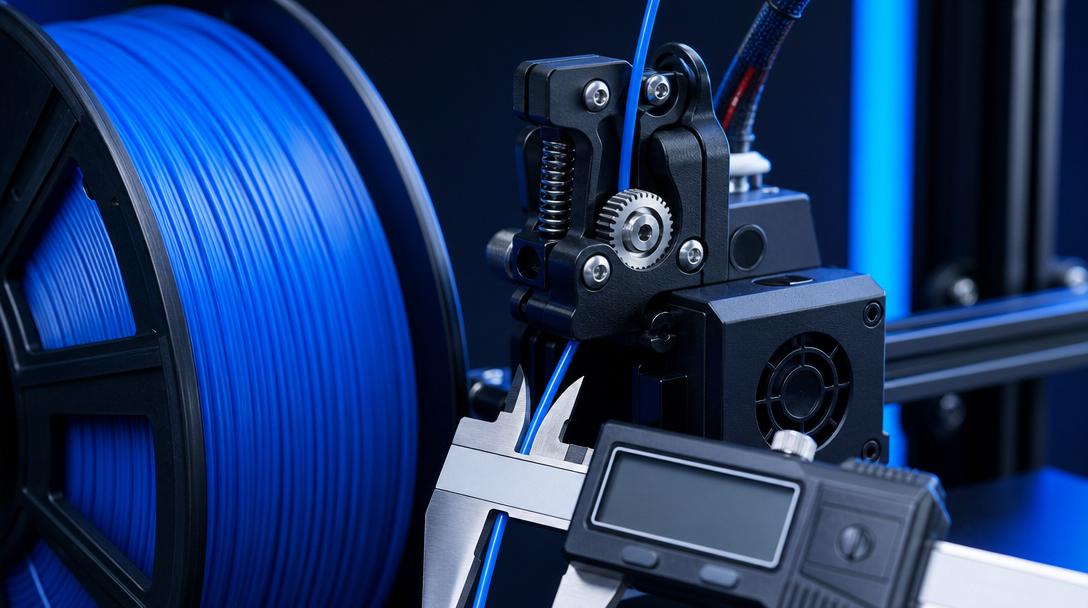
When choosing filament, you should look not only at the diameter but also at the tolerance value. Reliable manufacturers state the tolerance range in the product description (e.g., ±0.05 mm). Also, if the spool you purchase has a production batch number and tolerance information on it, that brand is a manufacturer that cares about quality. Measuring at three to five random points with a caliper on your first spool is the most practical way to see whether the brand actually delivers the tolerance it promises. At Ucuz3D, we produce with high-tolerance filaments suitable for every project, with 17 different materials to choose from. You can check out our printing materials and find the option best suited to your needs.
In short: 1.75 mm is the standard, 2.85 mm serves a niche area. But the real determining difference is not the diameter — it’s tolerance. If you want the best results for your project, make sure to use filament with a specified tolerance from a trusted supplier. If your design is ready, you can calculate your instant price and place your professional FDM print order, ensuring your project is in good hands.



 Türkçe
 العربية
 Русский
 فارسی
فارسی Deutsch