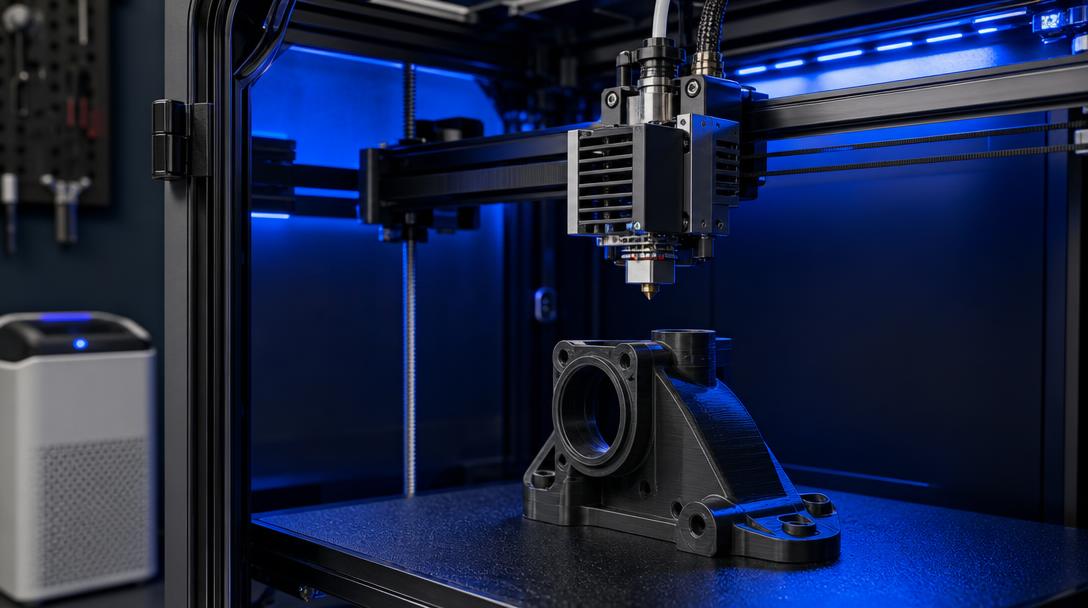
Prusa Research Introduces a High-Temperature Hotend for CORE One
Prusa Research’s high-temperature hotend upgrade may attract the attention of users who print engineering filaments with FDM. According to a VoxelMatters report dated September 30, 2026, the company has launched the HT Hotend Upgrade for the CORE One and CORE One L printer families, and has also announced the CORE One L+, equipped with the same hotend and an advanced filtration system. This is an example of an approach that expands a printing system’s material-processing capabilities, rather than simply introducing a new filament.
Two products, the same focus on high temperatures
The first product highlighted in the report is the HT Hotend Upgrade for the CORE One and CORE One L families. The second is the pre-assembled CORE One L+, which includes the same hotend and an advanced filtration system. Users can therefore choose between upgrading an existing compatible printer and buying a machine with this hardware already integrated. VoxelMatters reports that the upgrade kit was priced at USD 199.99 at the time of the announcement; as this figure may vary by region and over time, check the manufacturer’s current product page before making a purchase decision.
A high-temperature hotend may be useful for working with filaments that require higher processing temperatures. However, changing the hotend alone is not enough to ensure trouble-free printing with every material. The filament manufacturer’s temperature range, printer chamber conditions, build plate and print surface, part geometry, and ventilation should all be considered together. This product announcement does not guarantee the strength of any specific part or compatibility with every material.
Why is filtration part of the story?
The CORE One L+ being offered with advanced filtration is a reminder that people printing at high temperatures need to consider not only melt temperature but also the working environment. Filtration is part of the system design for managing the air around the printer; however, it should not be taken to mean that it eliminates all emissions or makes every environment risk-free. Check the manufacturer’s official documentation for the filter type, maintenance interval, and usage instructions.
So, before deciding to upgrade, compare the following points with your own printing scenario:
- Material: Check the technical datasheet to confirm whether your chosen filament actually requires a higher temperature.
- Compatibility: Verify in the manufacturer’s documentation that the kit is compatible with your exact printer model and existing components.
- Work environment: Review the filtration hardware’s scope and maintenance requirements; assess workspace ventilation separately.
- Need: If you do not regularly print technical materials, weigh the upgrade’s actual benefits for your current work.
What this means for FDM users
Prusa’s announcement reflects a trend in the desktop FDM ecosystem: upgrading specific subsystems instead of replacing the entire printer. This approach may appeal to users who want to keep their existing machine while working with a different range of materials; however, the benefits of the upgrade depend on the requirements of the part being printed. A new hotend will not, by itself, fix poor design orientation, insufficient wall thickness, or unsuitable conditions for the material. Higher temperature capability does not automatically increase a part’s service life; the result depends not only on filament quality and print settings, but also on layer orientation and the load on the part. It is therefore wiser to first identify the limitations you encounter in your current prints, then assess whether an upgrade is needed.
When choosing a material and production method for your part, you can learn about the 3d printing service offered by Ucuz3D, check the affordable 3d printing prices page for suitable parts, and estimate the cost of your model with the online 3d printing price calculator. The our printing materials page can also be a good starting point for learning about filament options. For pre-printing advice, contact our team and include your file’s intended use; you can continue the assessment with a human technical adviser.



 Türkçe
 العربية
 Русский
 فارسی
فارسی Deutsch