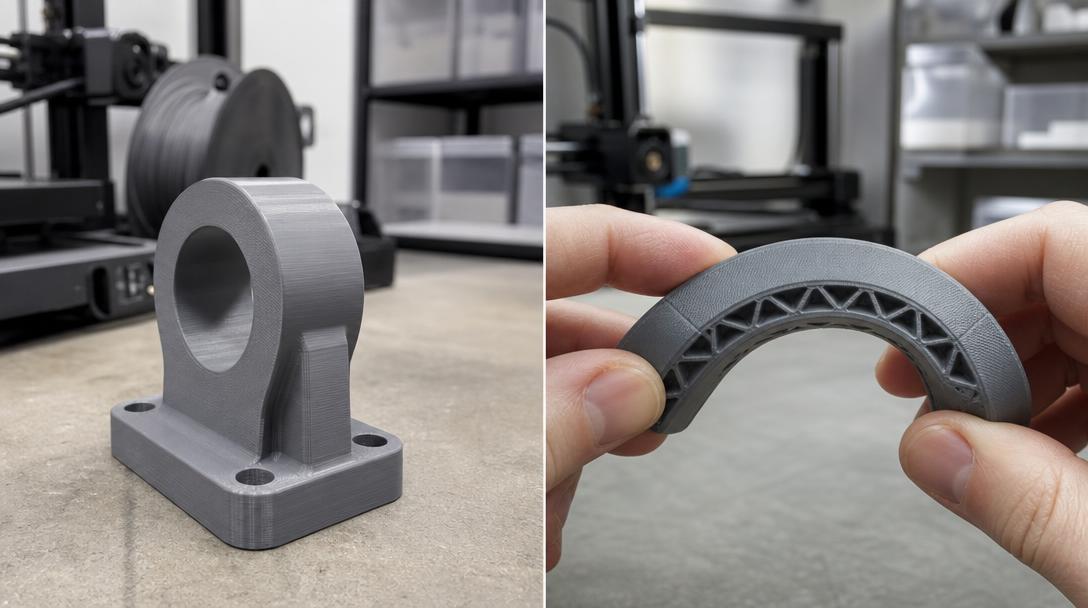

PLA or TPC? Lightweight Rigidity or Controlled Flexibility?
In FDM printing, material selection determines not only how a part will look, but also how it will behave during use. While PLA is an option that prints easily and stands out for its rigidity, TPC can offer a different solution for parts that require flexibility and repeated movement. For this reason, there is no single answer to the question of PLA or TPC; the right choice depends on the part’s load, movement, and working environment.
What are PLA and TPC used for?
PLA is often preferred for models, visual prototypes, enclosures, fixtures, dimensional inspection models, and desktop products. Its rigid structure, clear surface quality, and generally easier printability make it practical for a first prototype. However, PLA is not always suitable for parts exposed to constant flexing, high temperatures, or heavy impact.
TPC is a flexible filament family based on thermoplastic copolyester. Its flexibility can vary depending on the product and hardness level; it may be considered for cable pass-through protectors, vibration-damping parts, bumpers, flexible connections, and some wear parts. Since the printing behavior of TPC depends on the manufacturer and printer setup, it is smart to verify it with a small sample before placing an order or starting mass production. When reviewing our printing materials, look not only at the part’s hardness, but also at its movement and contact conditions.
Rigidity, flexibility, and impact behavior
PLA is advantageous for fixed parts that are expected to retain their shape under load. This rigidity can be useful for a box lid, measuring fixture, or decorative housing. On the other hand, thin PLA arms and clips exposed to impact may behave brittly depending on the design. Rounding corners, choosing the right layer orientation, and using sufficient wall thickness can improve the result; even so, the material’s basic character does not change.
TPC can dampen impact and vibration more effectively, and it also allows the part to deform in a controlled way. This feature is useful at certain contact points where a rigid part might crack. However, flexibility does not always mean durability: if TPC is designed too thin, it may tear, wear under constant friction, or deform more than expected under load. For a housing that must maintain precise dimensions, PLA may be the more predictable option.
Differences in outdoor use and heat
PLA requires caution in environments exposed to direct sunlight or rising temperatures because of the risk of deformation. In applications such as inside a vehicle, inside an enclosed box, or outdoors in the sun, the usage conditions should be evaluated separately. In some applications, TPC may behave more tolerantly against impact and weather conditions; however, it is not correct to treat all TPC products as the same. The technical data sheet, hardness, temperature range, and chemical resistance information should be checked.
Printability and design decisions
PLA offers an easier starting point on most FDM printers. Bed adhesion and flow adjustment are generally more manageable. Because of its flexible nature, TPC may require greater control along the filament path, a suitable extruder setup, lower and more stable speed, the correct retraction setting, and good spool feeding. Print time can also become longer for long, thin flexible walls.
At the design stage, for PLA it is better to consider thickness and rounded transitions that distribute the load, rather than snap-fit clips, thin arms, and sharp corners. For TPC, allowance for compression, minimum wall thickness, amount of flex, and how much the part will be stretched during assembly should be taken into account. In both materials, layer orientation, infill, and wall count have a major effect on the final result.
Which one for which part?
- Choose PLA: For rigid bodies, models, visual prototypes, measuring fixtures, and low-temperature desktop use.
- Choose TPC: For bumpers that need to flex, vibration-reducing parts, cable protectors, or special parts exposed to repeated movement.
- Question both: If the part will be exposed to high heat, intense UV, critical safety loads, or constant chemical contact, do not decide based only on the filament name.
If you cannot decide, first print a small test geometry and try it under real assembly conditions. If you would like support for production, you can review your part’s manufacturing options on the 3d printing service page. Seeing the logic of price per gram can help you evaluate material selection together with total part cost. If your file is ready, get an instant quote and compare the option that best suits your intended use between PLA and TPC.


 Türkçe
 العربية
 Русский
 فارسی
فارسی Deutsch