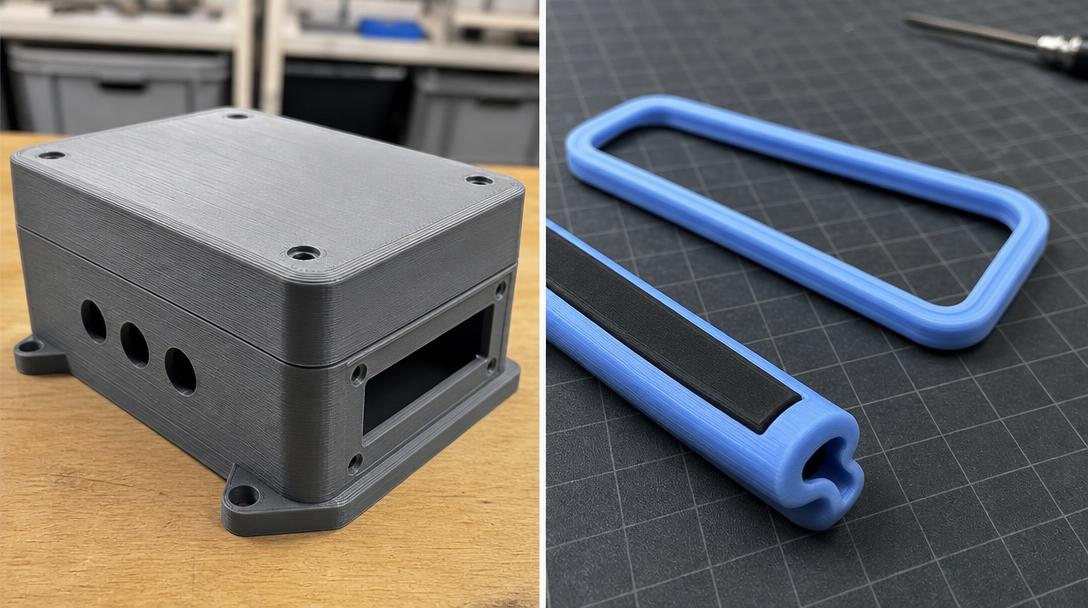

PLA or TPE? Rigid and Easy to Print, or a Flexible Part?
In an FDM part, the first decision is often about the material before the shape: Do you want a rigid body that holds its form, or a structure that flexes under pressure and dampens load? PLA and TPE are two different answers to that question. PLA offers a practical starting point for easy-to-print, rigid parts, while TPE is aimed at specialized applications that require elastic behavior. In this comparison, let’s clarify what these two materials are good for, where they struggle, and which type of part each one makes more sense for.
What do PLA and TPE basically offer?
PLA is a rigid thermoplastic that holds its dimensions and shape well. It is often preferred for decorative models, prototype housings, boxes, fixture handles, and general-purpose parts used at low temperatures. Its relatively easy printing process, manageable bed adhesion, and wide range of colors make PLA advantageous for everyday production.
TPE, on the other hand, is a family of flexible filaments with elastomeric, rubber-like behavior. After printing, the part can bend, compress, or recover to a certain degree. In return, print settings, filament feeding, and model geometry can be more sensitive than with PLA. Since TPE includes different hardness levels and manufacturer-specific formulations, results can vary depending on the product.
The difference in rigidity, impact, and flexibility
For a part that requires rigidity, PLA is by far the more sensible starting point. If an enclosure cover, measuring tool, or presentation model needs to keep its shape, the flexibility of TPE may become a design flaw rather than an advantage. Softening around screws, snap-fit points, and thin protrusions can also affect dimensional accuracy.
If the part needs to absorb impact energy or protect the surface it contacts, TPE stands out. Examples include feet, bumpers, vibration-damping pads, flexible strap-like parts, and protective elements that reduce the risk of scratching. However, being flexible does not mean TPE is resistant to every kind of impact; layer orientation, wall count, infill, sharp corners, and the material’s hardness level all determine the outcome.
Which one performs better outdoors and under heat?
PLA is more prone to losing its shape in environments exposed to sunlight, heat buildup, or hot car interiors. For that reason, it is not enough to look only at ease of printing for parts intended for outdoor use. TPE may feel more tolerant in some flexible applications, but UV resistance, temperature resistance, and chemical durability depend on the manufacturer and product class. If the use case involves constant sun, high heat, or safety-critical conditions, a final choice should not be made without the technical data sheet and a real-world use test.
Ease of printing and design approach
PLA is the more comfortable option for beginners and for those who want quick prototypes. With TPE, lower feed speed, controlled retraction, and as little gap as possible in the filament path may be necessary. Direct drive setups generally provide more controlled feeding with flexible filament, although the printer and the hardness of the TPE still affect the result. Keeping the spool dry is also important for TPE; moisture can negatively affect surface quality and flow stability.
There is also a difference in design. In PLA, structural ribs and snap-fits work more clearly, while in TPE, flex allowance, compression distance, and minimum wall thickness must be considered separately. Printing the same model in these two materials is often not just a filament swap; tolerances and connection methods may need to be reconsidered.
Cost logic and part selection
Do not evaluate material choice based only on spool price. PLA’s ease of printing can reduce total cost by lowering the need for trial prints and the risk of failed prints. TPE, in the right part, can reduce the need for a separate silicone or ready-made rubber component; however, setup time and testing requirements should be taken into account. If your part needs to hold its dimensions, stay flat, and remain rigid, PLA is the better option; if it needs to flex, dampen vibration, or protect the contact surface, TPE is the more suitable candidate.
- Choose PLA: for rigid prototypes, boxes, models, measuring tools, and low-temperature general-purpose parts.
- Choose TPE: for flexible feet, bumpers, grip surfaces, vibration-reducing parts, and protective components.
- Question both: if the application involves high heat, constant outdoor exposure, heavy chemical contact, or safety-critical loads, verify the technical requirements separately.
If you would like professional support by evaluating your part’s geometry and intended use together, you can take a look at the 3d printing service page. It is also useful to review the logic of price per gram and compare different production scenarios. If your file is ready, you can quickly make a preliminary assessment with the online 3d printing tool. For the general properties of PLA, TPE, and other options, visit the our printing materials page.



 Türkçe
 العربية
 Русский
 فارسی
فارسی Deutsch