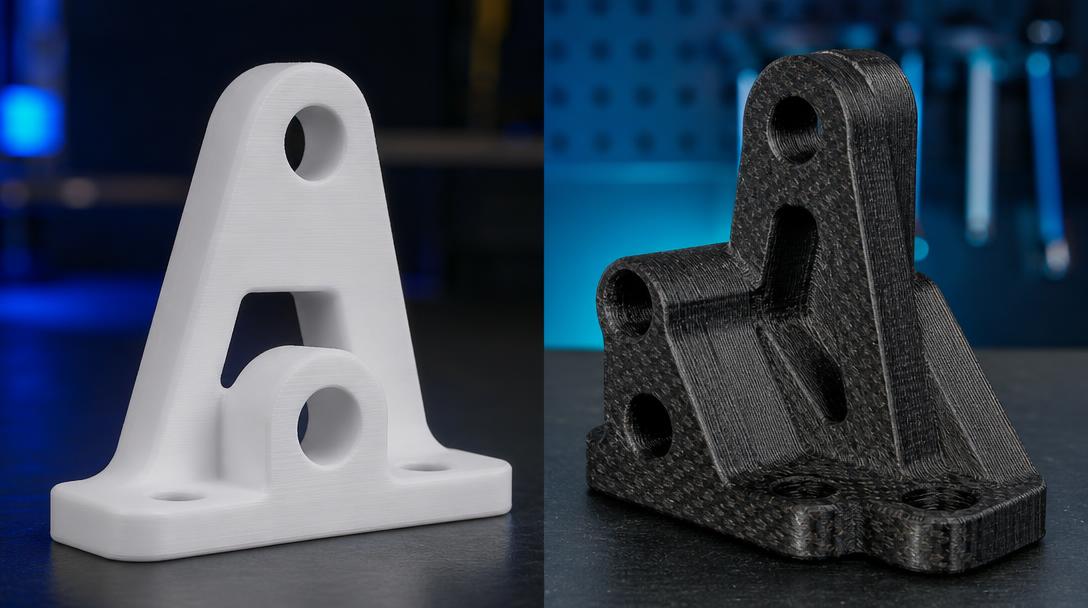
PLA+ or Carbon-Fiber-Reinforced Filament? Everyday Parts or Rigid Technical Prints?
Are you printing a part just to see its shape, or to make it flex less under load? The question of PLA+ or carbon-fiber-reinforced filament often comes up when moving from a prototype to a functional fixture. The two materials do not serve the same purpose: PLA+ stands out for easy prototyping and general use, while fiber-filled filament may be considered when specific stiffness and dimensional stability are required.
The key differences between the two materials
The name PLA+ is used for formulations that manufacturers differentiate from standard PLA; properties vary by brand and product. For this reason, it would be inaccurate to make a general claim such as “PLA+ is always this much stronger.” It can be a practical starting material for design trials, visual models, and uncomplicated fixtures. It is relatively easy to print on most desktop FDM setups and is often chosen for parts without special engineering requirements.
Carbon-fiber-reinforced filament is not made of pure carbon fiber; it is a family of filaments in which short fiber additives are blended into a base polymer. In some products, these additives can increase stiffness and help the printed part retain its dimensions more consistently. However, the result depends on the carrier polymer, fiber content, part geometry, and print orientation. Being “stiffer” does not mean having greater strength or impact toughness in every direction.
Which one makes more sense for your application?
If you are making a first prototype, cover, fit-check model, or simple non-load-bearing holder, PLA+ is often a sufficient starting point. If quick design changes and easy production matter, validating the part’s shape with this type of material before switching to a more expensive or technical material can save time and resources.
If you want to limit a fixture’s flex, maintain the position of connection points, or reduce shape changes during repeated use, a carbon-fiber-reinforced option may be worth considering. First, though, think about the direction of the load and how it will affect the print layers. FDM parts can behave differently between layers; wall count, infill, part orientation, and connection geometry all affect the result, regardless of material choice. If you expect very high impact, temperature, or fatigue resistance, do not decide based on the “carbon fiber” label alone.
- Easy prototyping and general use: Use PLA+ to check the design’s shape and fit.
- Need for a stiffer technical part: Evaluate the product specifications and printing conditions for the carbon-fiber-reinforced filament.
- Outdoor use or heat: Do not assume either material is automatically suitable; verify the operating temperature and environmental conditions.
- Wear or impact: Make a prototype or test part that represents the actual loads in use.
Printing and design trade-offs
Because they contain hard particles, carbon-fiber-filled filaments can accelerate wear in an unsuitable or soft nozzle; check the printing hardware and profile recommended by the manufacturer. Do not assume you can print these filaments reliably with the same settings as PLA+. Also, switching materials alone will not make thin arms or sharp internal corners safe in a rigid part; corner radii, wall thickness, and the areas that transfer the load are all part of the design.
For PLA+, the main advantage is often a simpler prototyping workflow. Still, since different product variants may behave differently, it is wise to print a small test piece for critical dimensions and fits. If parts need to fit together, reviewing how FDM tolerances are determined can reduce the need for reprints, regardless of the material.
Base your decision on the use case
The best way to choose is to first define what the part needs to do: how much load will it experience, would flexing cause a problem, what will the temperature and environmental conditions be, and how many parts will you produce? Then evaluate the material and geometry together. You can review the FDM printing materials available in both options; after preparing your part file, you can ask about its technical suitability as part of the 3D printing service. Since the total production cost can vary, check an estimate for your file using the 3D printing price calculator.
In short, PLA+ is a good starting point for easy prototyping and general use; carbon-fiber-reinforced filament may be considered when a stiffer technical part is needed. Make your final decision by evaluating the product’s actual properties alongside the part’s operating conditions.



 Türkçe
 العربية
 Русский
 فارسی
فارسی Deutsch