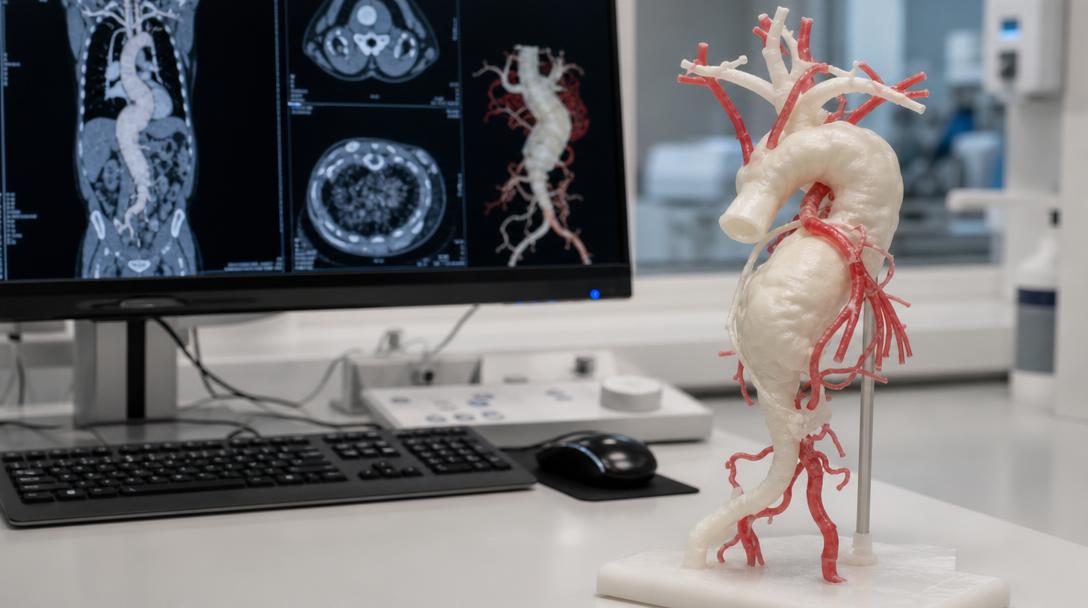
3D-Printed Models for Pulmonary Vascular Intervention: A Planning Case from UPMC and UCSF
3D-printed models can help clinicians examine complex vascular anatomy in physical form before a procedure. A clinical study by teams at UPMC and UCSF, shared on October 9, 2026, describes how models made from patient scans were used to plan and perform embolization of pulmonary arteriovenous malformations. The results are promising, but the study is small and retrospective, so they should not be taken as proof of general effectiveness on their own.
From CT scans to patient-specific models
The research team segmented the vascular structures from thin-slice, contrast-enhanced CT scans of six patients. After a radiologist reviewed the segmentations, anatomical models were produced. Eight lesions in total were treated at two centers; the team reported technical success for all eight. Here, technical success is defined as confirming on angiography that the vessel was completely occluded and blood flow had stopped.
The models allowed interventional radiologists to assess not only on-screen scan slices, but also the direction of the feeding vessels and how they related to one another in three dimensions. Clinical teams used them as references both during pre-procedure planning and while carrying out the interventions. In one case, an earlier embolization attempt without a model had failed; with the model’s help, the team shaped the catheter to guide it into the feeding artery, and the procedure was completed. This single case does not mean a model will change the outcome every time, but it illustrates the kind of challenge a physical reference may help address in difficult anatomy.
What does the model show—and what has it yet to prove?
Physicians in the study assessed the anatomical accuracy of the models, which received the highest scores at the first center. A physician at the second center also found them useful, but did not consider them essential for every case. The models were also used to explain the condition and planned procedure to five patients. This suggests that 3D printing may serve not only as a production tool but also as a visual aid for communication within the care team and with patients.
The main limitations are the small number of patients—six—and the retrospective design. The researchers did not measure procedure time, fluoroscopy time, radiation dose, or patient satisfaction. It is therefore not possible to conclude that physical models improve these measures or are needed for every patient. Their value should be assessed in light of anatomical complexity, image quality, segmentation accuracy, and the clinical team’s workflow.
Takeaways for clinical 3D printing and FDM workflows
This example shows how a physical part made from accurate digital data can make complex geometry easier to understand. In clinical models, material, validation, and regulatory requirements vary by application; this study concerns professional production systems and does not mean every FDM service is suitable for clinical use. Even so, the basic workflow is familiar from many prototyping projects: prepare the data, check the model, plan print orientation and supports, and then assess the physical part in its intended use scenario.
Examples that require high precision, such as patient anatomy, call for specialist teams and validated processes. For more general product development, enclosures, fixtures, or visual prototypes, you can explore suitable production options through our 3D printing service. The printing materials page can also help you compare materials and applications.
If you have a digital model, you can learn about affordable 3D printing prices and calculate the online 3D printing price for your file. For a broader look at patient-specific 3D modeling and surgical planning, read our guide to 3D printing in medicine.


 Türkçe
 العربية
 Русский
 فارسی
فارسی Deutsch