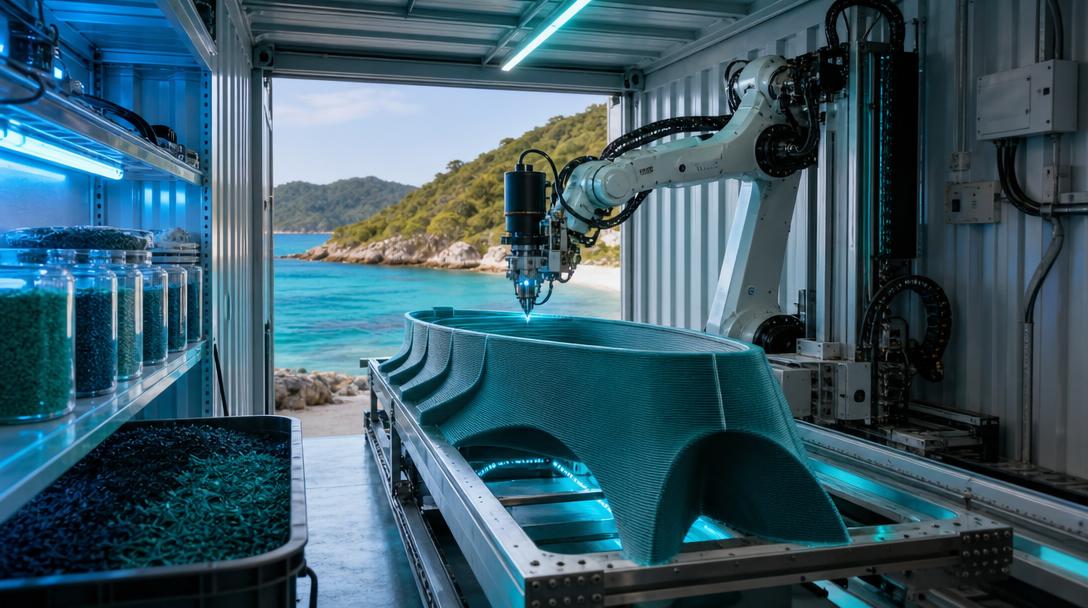
A 3D Printing Factory Using Recycled Plastic Is Being Set Up in Timor-Leste
Waiting for boat and infrastructure parts to arrive from elsewhere can make maintenance and production planning difficult in remote coastal communities. An agreement signed by Hyperion Systems and Inspire Robotics for Timor-Leste aims to establish an on-site, container-based 3D printing system capable of producing large parts from recycled plastic. Called TitanCell, the system is a striking example of how additive manufacturing can be used not only in fixed factories but also at locations reached by the supply chain.
A production facility that fits inside a container
According to a 9 October 2026 report by 3D Printing Industry, Hyperion Systems and Inspire Robotics plan to install the system in Timor-Leste later this year. TitanCell combines industrial robotics, large-scale 3D printing and the company’s recycled polymer technology in a mobile production setup. The aim is to turn hard-to-recycle plastics collected from coastlines and industrial waste streams into raw material for large structural parts.
The installation’s initial applications are reported to include crewed and autonomous boats, as well as marine equipment for coastal work. The project is also considering parts to support activities such as mangrove restoration, beach clean-ups and plastic waste collection. Potential products for the platform also include pontoons, culverts and modular building components. These are not completed, field-validated outputs; they are possible applications announced for the system.
Why it matters for local supply
In island countries such as Timor-Leste, reliance on imports for certain materials and parts can lead to maintenance delays and procurement difficulties. Bringing production closer to where it is needed could make it possible to produce suitable parts locally and use waste plastic as a local resource. However, the success of this approach depends on more than the printer: it also requires a usable supply of raw material, design and process expertise, quality control, and a local team to operate the system.
Inspire Robotics’ “Business-in-a-Box” model aims to pair the system with a structure operated by local entrepreneurs. This detail shows why the project should not be viewed as simply installing a machine: building lasting production capacity requires operator training, maintenance, a suitable business model, and validation of printed parts against their intended conditions of use. The companies have also expressed interest in considering similar systems in the future for remote communities and post-disaster production; these are goals for the future, not established applications.
Lessons for FDM services
TitanCell is a large-scale installation focused on recycled polymers; it should not be considered equivalent in production scale or process to desktop FDM printing. Still, there is a lesson both approaches share: where a part will be used, the loads it will carry and the environmental conditions all shape the choice of material and design. For small fixtures, prototypes and replacement parts that can be made with FDM, geometry, print orientation and intended use should also be considered together. For more on how print orientation affects part strength, see our guide to print orientation.
- Local production: For suitable projects, making a part close to where it is needed has the potential to reduce supply lead times.
- Recycled feedstock: When using recycled plastic, its properties and process consistency also need to be managed.
- People and processes: Operator training, maintenance and quality validation are as critical as the equipment.
What makes the project interesting is that it brings 3D printing together with recycling and local production capacity in a single system. Its long-term impact will become clearer after the facility is commissioned and its applications are assessed in real-world use. For a fixture or replacement part that can be made with FDM, explore our 3D printing service options, and see the available material alternatives on our printing materials page. Visit our affordable 3D printing prices page for an estimate, or check your model with our 3D printing price calculator.



 Türkçe
 العربية
 Русский
 فارسی
فارسی Deutsch