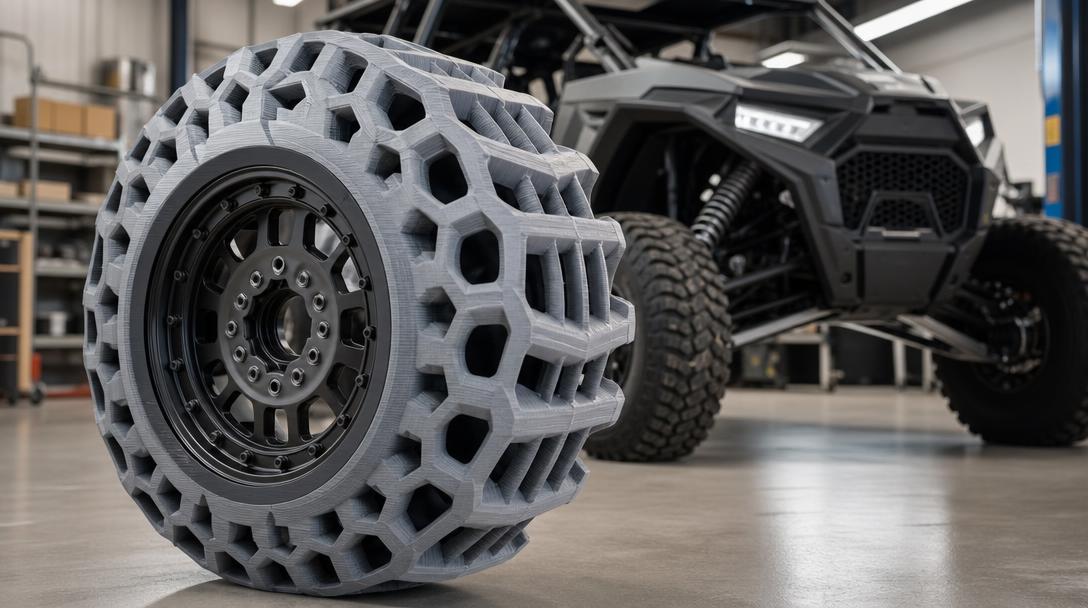
OTR3DLab Accelerates Off-Road Tire Prototyping with Large-Format 3D Printing
OTR Engineered Solutions, which develops off-road tires, wheels and tracks, has announced a new 3D-printing prototyping service called OTR3DLab to evaluate full-scale physical concepts earlier. According to a 17 September 2026 VoxelMatters report, the aim is to move more quickly beyond drawings and small-scale models to seeing and examining a new product on real equipment.
This development shows that 3D printing is not used only for desktop models or visual prototypes; it can also support design decisions for large parts before moving to production tooling. With OTR3DLab, physical concepts of full-scale tires, tracks, wheels, body panels and enclosure-like components can be prepared. This allows the design team to assess appearance, dimensions, assembly fit and surrounding clearances together.
Why is this new approach important?
For off-road equipment, it is not enough for a part to look correct on screen. The position of large components such as tires or tracks on the vehicle, and their relationship with the fenders, suspension, body and other parts, affect whether the design is practical. Full-scale printing can help check these relationships before production tooling is prepared.
In a traditional development workflow, long delays can occur between design, visualization, tooling preparation and physical testing. Large-format thermoplastic 3D printing, however, offers the opportunity to produce a physical sample more quickly during the initial decision-making stage. This does not mean that the final part will automatically meet all technical requirements; however, it can help identify issues such as incorrect proportions, insufficient clearance or assembly problems earlier.
Which parts is OTR3DLab targeting?
The service stands out because it produces not only small samples but also concepts that can be evaluated at full scale. The report mentions a build volume of up to approximately one cubic meter and flexible, rubber-like materials intended to imitate the appearance of a tire. These materials are not intended to replace the final tire compound; instead, they are being evaluated for creating prototypes that can be used to examine appearance, volume, contact and positioning decisions on the vehicle.
The ability to fit printed tire prototypes onto standard wheels means that design reviews do not have to remain limited to a model on a workbench. Where appropriate, teams can take the complete assembly onto the vehicle for visual evaluation, packaging reviews and final design validation. This stage should not be confused with testing a final product ready for road use; the role of the 3D-printed prototype is to accelerate decisions before production.
Lessons for FDM users
This news reminds us that material selection should be considered together with the function of the part. A rigid fixture, a flexible protective component, an impact-resistant enclosure or a sample intended only for dimensional inspection may not be designed with the same filament. When making these decisions for small and medium-sized parts, you can review the options on our printing materials page and clarify from the outset the part’s requirements for outdoor exposure, heat, flexibility and impact resistance.
If your model is ready, you can have the part you need produced through our 3D printing service. When making production decisions, it is healthier to evaluate the price per gram approach together with the effect of the part’s geometry on the total cost. You can also use the instant pricing page to upload your file and view the options.
Conclusion
The OTR3DLab example shows that large-format 3D printing is becoming positioned in automotive and heavy-equipment development as a “physical decision-making tool before tooling.” The most important benefit is being able to see the design at full scale before production and modify it quickly when necessary. The key message for Ucuz3D readers is clear: as the prototype gets larger, it is important to consider not only surface quality but also assembly fit, material behavior, print orientation and the real-world usage scenario together.


 Türkçe
 العربية
 Русский
 فارسی
فارسی Deutsch