How Is 3D Printing Production Becoming More Integrated into Factories at IMTS 2026?
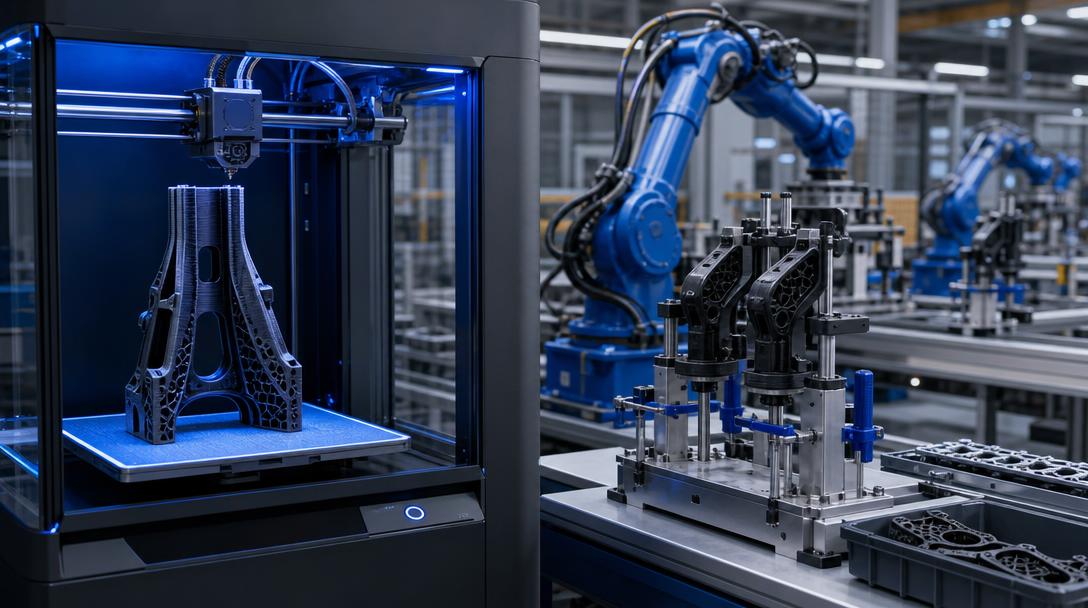
3D printing production stood out at IMTS 2026 not as a separate technology showcase, but as a practical tool working alongside automotive, robotics and traditional production lines. According to VoxelMatters’ field assessment dated 16 September 2026, the exhibition’s key message was that additive manufacturing should now be evaluated through integrated solutions covering not only the printer, but also software, automation, quality control and production decisions.
The change at the exhibition: From printer to production system
The closer physical positioning of the additive manufacturing area to machining at IMTS 2026 shows that the two methods do not necessarily have to be alternatives to each other. The right approach for a part or fixture may involve planning printing, machining, measurement and assembly steps together. This perspective is also important for workshops using FDM: value comes not only from printing the part, but from how reliably and consistently the part solves a specific problem on the production line.
One of the examples highlighted at the exhibition was Stratasys’ presentation on its General Motors applications. The VoxelMatters report states that GM has standardized Stratasys F900 systems for production aids and tooling at more than 20 facilities. The report also notes that a printed protection tool reduced paint touch-ups by 80 percent. This figure should be understood as a field result from a specific application; it does not guarantee the same outcome for every part. Nevertheless, it demonstrates concretely that FDM can be considered not only for prototypes, but also for producing production aids and fixtures.
Lessons for FDM in robotics and automotive applications
The lightweight robotic end-of-arm tool displayed by Stratasys for Toyota supports the same approach. The aim is to use a printed tool validated through an analysis of operating conditions instead of a heavier tool produced using conventional methods. The critical point here is that, just as much as material selection, the design, print orientation, layer structure and conditions of continuous use must be validated together. Not every FDM part automatically becomes an industrial tool; load, temperature, vibration and safety requirements must be examined separately.
- If a task is repeated: identify printable aids such as measuring gauges, assembly guides or protective tools.
- In part design: check how the load is distributed between layers and how print orientation affects strength.
- Before production: validate dimensional accuracy, assembly and expected service life using several trial parts.
- In the workflow: standardize file preparation, print monitoring and quality control steps as much as possible.
What this means in practice for Ucuz3D readers
The examples at IMTS do not mean that small and medium-sized businesses need to copy the same investment. The more accessible lesson is to identify the small but recurring parts that cause time loss on the production line. For a cable guide, assembly fixture, drilling template or machine guard, FDM printing can provide fast iteration and the flexibility to make changes to the part in low-volume production. However, if the appropriate material, wall count and print orientation are not selected, the same part may deform earlier than expected.
When planning this type of application, you can look at 3D printing in automotive examples and then review our printing materials for your project. To assess whether the part you need can be produced, you can find information on our 3D printing service page and see the price per gram structure and other production costs. If your file is ready, you can request an instant quote through the online 3D printing tool.
The main message from IMTS 2026 is clear: the value of FDM in production lies less in the technology label than in making a measurable task faster, lighter or more repeatable. The safest way to move from prototyping to production aids is to choose a small application and validate it under real operating conditions.


 Türkçe
 العربية
 Русский
 فارسی
فارسی Deutsch