How LLNL’s Camera-Based Inspection System Could Change Quality Control in FDM Printing
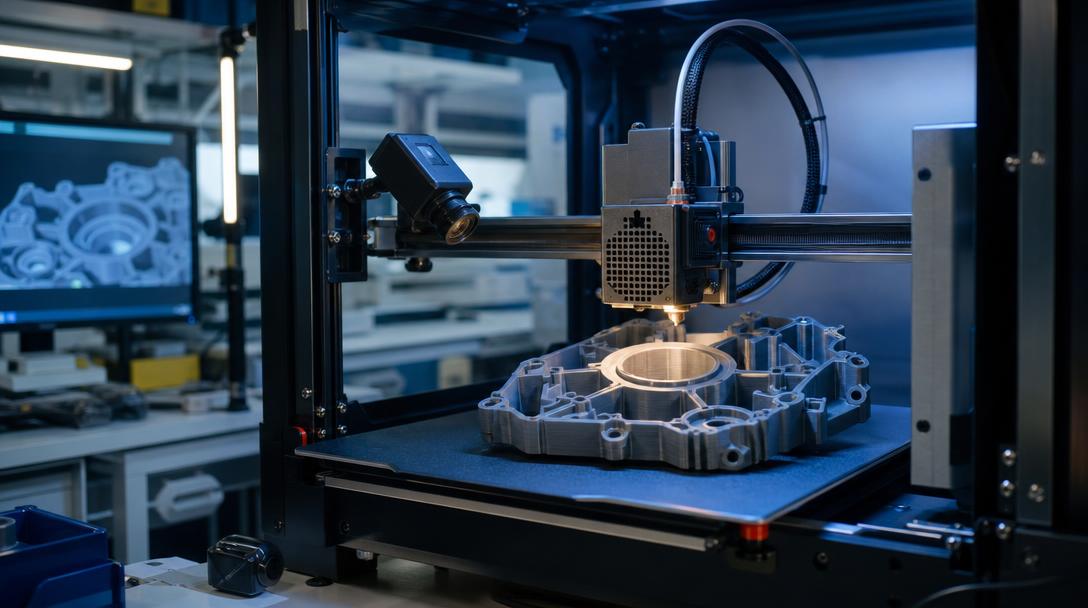
Reproducing the same model in FDM printing does not simply mean running the file again. Nozzle movement, layer formation, surface defects, and the machine’s operating conditions at that moment can all affect part quality. The camera-based 3D-printing inspection system developed by Lawrence Livermore National Laboratory (LLNL) is attracting attention for this reason: Its aim is to monitor the printing process during production rather than measuring it only after completion.
The report states that LLNL has developed a camera-based inspection system for 3D printing. The published headline indicates that the solution focuses particularly on observation and quality control during printing. It is too early to say that the system would deliver identical results on every desktop printer; however, the idea clearly demonstrates why repeatability is an important issue in FDM production.
Why is camera-based control important?
With conventional inspection, the part is often examined after printing has been completed. This approach may identify a defect, but it does not always show which layer it started in or at what point. Camera-assisted monitoring aims to collect visual data from the printing process. This can make it possible to detect layer formation, unexpected changes on the surface, or deviations from the normal printing sequence at an earlier stage.
The value of this approach is not limited to large production facilities. For a workshop producing many copies of the same part, a problem detected within the first few layers can prevent a lengthy failed print. In a prototype, it can help separate design-related issues from setting-related problems more quickly. Even so, camera footage alone cannot answer every question about dimensional accuracy, interlayer strength, or the material’s moisture condition. Visual inspection should be considered together with measurement and operator assessment.
What it means in practice for FDM users
The first step in quality control for FDM printing is to clearly define the criteria to be checked. Lines and gaps on the outer surface, insufficient first-layer adhesion, stringing, layer shifts, and a print breaking off halfway through are different problems. A camera-based system may be particularly useful for flagging visible and repeatable defects. However, not every material displays the same visual behaviour. Since gloss, colour, and surface texture may vary across PLA, PETG, ABS, ASA, and flexible filaments, applying a single image profile to all prints could be misleading.
For this reason, when establishing a quality-control workflow, reference prints should be produced first, acceptable surface and geometry limits should be defined, and different filaments should then be evaluated separately. When the camera system issues an alert, a decision logic that distinguishes between critical and non-critical deviations may be safer than stopping the print automatically. Unnecessary stops can also lead to wasted time and material, especially in small-scale production.
Impact on workshops and service production
For businesses producing on demand, process data affects not only quality but also delivery reliability. Knowing at which stage a print failed makes it possible to adjust the settings more consciously when reproducing the same part. If the part being produced for your customer has demanding dimensional, surface, or functional requirements, it is important to define the quality-control plan before printing. At this point, while reviewing our printing materials, you can assess the part’s operating conditions and verification requirements together.
When you would prefer professional support instead of testing on your own printer, you can explore 3d printing service options. To understand the impact of material quantity on the production decision, also take the price per gram approach into account. You can use the online 3d printing tool to send your file and perform a quick pre-production check.
Conclusion: From finding defects to learning from the process
LLNL’s camera-based inspection work reminds us that the future of quality control in FDM printing may involve more than examining the finished product. Images collected during printing can help clarify the relationship between settings, the machine, and the material. Nevertheless, this technology does not replace careful material selection, the use of dry filament, correct first-layer settings, or final measurement. The strongest results may be achieved in workshops that combine camera-based observation with a standard print-inspection checklist.


 Türkçe
 العربية
 Русский
 فارسی
فارسی Deutsch